The global magazine and marketplace for classic car enthusiasts, by enthusiasts.


Filter
Classic Spyker for sale - Spyker cars for sale
-

1936 Austin 7 Ruby | Brightwells | Auction Ends: Wed 24th Jun
Highly original with a wonderful history file; a proper time capsule; further photos and details to follow -
1925 Bean 14HP Tourer | Brightwells | Auction Ends: Wed 24th Jun
Bean 14 HP Tourer; Member of the Bean Car Club; 1,701cc engine; converted to 12 volts; showing just 5 owners in totalUp for auction is a 1925 Bean 14HP, a true vintage vehicle and a rare piece of British automotive history. This delightful beige example, currently owned since August 2024, has had five former keepers and boasts a 1,.. -
1928 Austin 7 Chummy | Brightwells | Auction Ends: Wed 24th Jun
In the current ownership for 17 years; expertly restored in c.2002 by Ray Edge and only 1,100 miles since; in light regular use; full set of weather gear; original number plate; very smart indeedUnveiled in October 1922, the Austin Seven did not go on sale until early-1923 and was initially only available as a two-door, four-seat t.. -
1921 AC Empire | Brightwells | Auction Ends: Wed 24th Jun
From a deceased estate; current owner 50+ years; last driven about seven years ago; Anzani engine; bespoke coachwork based on an AC prototype; interesting history file; further details to follow -
1927 Austin 20/4 Drophead Coupe | Brightwells | Auction Ends: Wed 24th Jun
In regular use and driven 20 miles to the sale; an impressive example of this powerful and dependable Austin Austin introduced its big 20hp model in 1919, a car heavily influenced by the Hudson Super Six that Herbert Austin drove during the war.Incorporating many of the Hudson features that had so impressed the Austin boss, .. -
1910 Buick Model 10
Beautiful 1910 Buick Model 10 RunaboutThis was the first mass-produced Buick. It was marketed as a "light 4-cylinder roadster for gentlemen" and quickly became one of Buick’s bestsellers.Its respectable performance of 22.5 hp from the 4-cylinder “valve-in-head” engine with a 2.7-liter displacement earned it the nickname "The White ..


Spyker
Netherlands, 1900 – 1925
(1) De Industrieele Maatschappij Trompenburg, Amsterdam, 1899 – 1916
(2) Nederlandsche Automobiel- en Vliegtuigenfabriek Trompenburg, Amsterdam, 1916 – 1925
The Spijkers (the simpler spelling Spyker cars was used for the cars) set up in business as coachmakers at Hilversum in 1880, taking a Benz agency in 1895, and modifying the German cars to their own ideas. The first true Spyker car appeared in 1900, a 5hp Spyker car with front-mounted air-cooled flat-twin engine, 2-speed and reverse gear, and shaft drive (Spyker cars never used chains). This Spyker car was not a commercial success; more promising were a 1.9-litre twin and a companion four Spyker car introduced in 1902, with separately cast cylinders, side valves in a T-head, coil ignition, and armoured frames. This bigger 20hp Spyker car had a 5-bearing crankshaft, full-elliptic front suspension was used; there was also a petrol brougham version. The close fit of the bonnet was the first step towards the dust sealing that became a strong Spyker selling point, accentuated by the full undershielding of later Spyker cars.
In 1904 Jacobus Spijker tried a ‘circular’ 4-cylinder engine, its curious shape the result of comprehensive but ineffectual water-jacketing. This Spyker car was available in 12/16hp, 20/24hp and 30/36hp sizes, along with a huge 8.7-litre 6-cylinder 4x4 race Spyker car, with brakes on all wheels. This Spyker car never reached production though three or four 32/40hp fours were made with the 4x4 configuration, and these 4x4 Spyker cars were sold at a price of £960. Conventional pair-cast engines and semi-elliptic front springs came on Spyker cars in 1905, and during the same year round radiators were adopted. The 1906 Spyker cars had ball-bearing crankshafts; the biggest of a range of four 4-cylinder Spyker cars was the 7.9-litre 25/38. Pressed-steel frames arrived on the 1907 Spyker cars, smallest of which was a short-stroke (80x90mm) four Spyker car with high-tension magneto ignition intended for taxicab service. The next major departure came in 1909, when the Spyker car company adopted Valentin Laviolette’s ingenious T-head, transverse-camshaft layout, a feature of all Spyker cars up to 1917, and offered in a wide diversity of Spyker cars. A 2-cylinder light Spyker car did not progress beyond the prototype stage, but the fours extended from a 1.7-litre 12hp up to a 7.2-litre 40, all with thermos-syphon cooling; at first only the larger Spyker cars had four forward speeds, and all but the smallest now wore three-quarter elliptic springs at the rear. The 12hp Spyker car had a 3-speed transaxle, and some Spyker cars were available with Allen-Liversidge 4-wheel brakes as an optional extra in 1911, though these (like a 4.2-litre Monobloc 6-cylinder) were apparently not a success. Electric lighting was available on Spyker cars in 1913 and standard by 1915. V-radiators appeared during 1914, when the Spyker car company introduced a sports version of the 3.4-litre 20 with light steel pistons, this Spyker car was capable of 68mph.
A shortage of raw materials reduced production of Spyker cars to a trickle by 1916, and the first new post-World War 1 Spyker car, the 3.3-litre 13/30, reverted to an L-head layout, as well as making liberal use of American components (Delco coil ignition, Stewart vacuum feed, Stromberg carburetto). The Spyker car had a 3-speed unit box with central change, and was noteworthy only for the peculiar aerocoque sports coachwork with aerofoil wings and tail fin fitted to some examples. In 1920 the Spyker car company tried importing Mathis light car from France and selling them with Spyker badges, but the last real Spyker car was the Frits Koolhoven-designed 6-cylinder 30/40. The Spyker car featured a 5.6-litre sv Maybach engine, dual ignition and a 2-speed fan, and there were four forward speeds. Front-wheel brakes came on the Spyker car in 1923, but though Queen Wilhelmina of the Netherlands purchased two Spyker landaulettes in 1921, and S.F. Edge used a two-seater Spyker car for a successful attack on his Double-12-Hour record at Brooklands in 1922, there was little future for such a car at £1.950. The last of 150 examples Spyker cars left the Spyker works in 1925.
Source: Georgano, encyclopedia of motorcar; MCS
The information is written with the greatest of care. However, if you have any suggested amendments please contact us at office@prewarcar.com


Featured
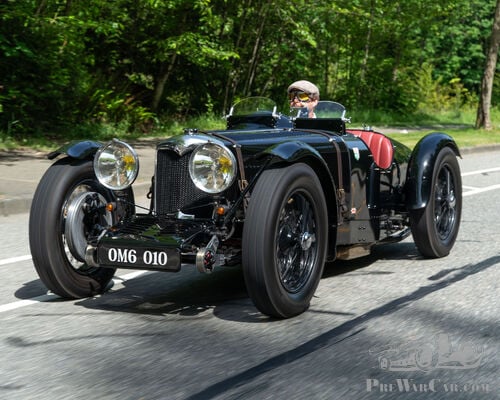
Riley 14/6 Special 1933
The ExperienceStep into the golden age of British motoring. This 1933 Riley 14/6 Special is a masterclass in pre-w..

K3 Replica on KN Chassis
"The K3 Magnette must rank in the history books as the most famous and successful of all the record breaking MGs. With only 33 examples produced durin..
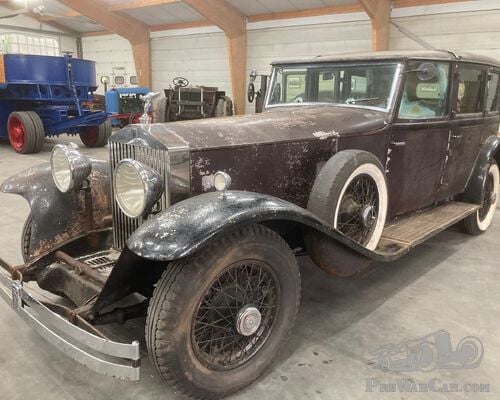
Rolls-Royce
Rolls-Royce Phantom ll chassisnummer 287 AJS. bouwjaar 1932, Links gestuurd, Brewster Keswick Sedance Towncar