The global magazine and marketplace for classic car enthusiasts, by enthusiasts.


Filter
Classic Du Pont, Stanley for sale - Du Pont, Stanley cars for sale
-

Stanley Steamer 1919 touring
Very original . Runs good and has new boiler , with pressure test.Use it from day one. Has Danish registration document .Price : please ask ! -
1929 Du Pont Model G Two-Passenger Speedster by Merrimac | RM Sotheby's | The Monterey Auction
To Be OFFERED AT AUCTION at RM Sothebys' The Monterey Auction event, 13 - 15 August 2026. $800,000 - $1,200,000 USD One of the most beautiful American automobiles of its generationThe 1929 New York International Automobile Show display carOne of three two-passenger “taper tail” models with an external spareOne ..


Du Pont
US, 1920 – 1932
(1) Du Pont Motors Inc, Wilmington, Del., 1920 – 1923
(2) Du Pont Motors Inc, Moore, Pa., 1923 – 1932
E. Paul du Pont’s company built quality cars in limited numbers, total production being 537 vehicles of all Du Pont types. First of the line was a Du Pont 4.1-litre sv four with their own engine, selling for $2.600, but this gave way to proprietary-engined sixes, initially powered by Herschell-Spillman. The 1925 Du Pont Model D had a 6-cylinder 5-litre Wisconsin engine with overhead valves that developed 75bhp, a constant-mesh gearbox, and Lockheed hydraulic brakes to all four wheels. Its successor, the Du Pont Model E, could be had with a supercharger, but the best-known, and best, Du Pont was the Du Pont Model G speedster introduced in 1928. With its narrow straight wings copied from the Amilcar, Woodlite headlamps and grille concealing the radiator, the last a pioneering feature, the Du Pont Model G was not a good-looking car, but it was a very effective one. Like all the DuPont speedsters it had four forward speeds. The 5.3-litre, sv straight-8 engine, by Continental, gave 114bhp at 3600rpm with catalogued modifications. With the latter, 100mph was guaranteed. In the 1929 Le Mans 24 Hours race the Du Pont Model G proved itself faster than the other American entries, Stutz and Chrysler. Touring bodywork was, of course, available on the Du Pont car, and in 1931 came the long wheelbase (12ft 2 in) Du Pont Model H, built in a Stearns Knight frame. The later Du Pont cars were assembled in the Indian motorcycle factory at Springfield, after E. Paul du Pont had acquired this concern.
Source: Georgano, encyclopedia of motorcar; TRN
The information is written with the greatest of care. However, if you have any suggested amendments please contact us at office@prewarcar.com
Stanley
US, 1897 – 1927
(1) Stanley Dry Plate Co, Newton, Mass., 1897 – 1899
(2) Stanley Manufacturing Co, Lawrence, Mass., 1899 – 1901
(3) Stanley Motor Carriage Co, Newton, Mass., 1901 – 1924
(4) Steam Vehicle Corporation of America, Newton, Mass., 1924 – 1927
The Stanley twins, F.E. and F.O., were partners in a photographic dry plate business in Newton, where they produced their first light steam Stanley car in 1897. This Stanley car proved a great success, over 200 Stanley cars being sold in the first year of production. In 1898 a Stanley car was timed over a mile at Charles River Park at 27.40mph. Among the customers of the Stanley cars were A.L. Barber and J.B. Walker, who purchased the manufacturing rights of the Stanley car, and produced it as the Locomobile and Mobile respectively. In 1899 some Stanley cars were advertised by the Locomobile Co of America under the name Stanley-Locomobile. The Stanley cars proceeded to evolve an entirely new design, which appeared in 1902 with a simple non-condensing engine, driving directly on the rear axle. The boiler was mounted at the front of these Stanley cars, frames were of wood, and steering was by tiller. Locomobile went over to Petrol cars at the end of 1903, but the Stanley cars prospered, listing an 8hp Stanley car at $750, and selling their Stanley cars to police and fire departments. More powerful versions Stanley cars rated at 10 and 20hp were available by 1904, and by 1906 the Stanley car had assumed its characteristic appearance, with coffin-like bonnet concealing the boiler, and wheel steering. The Stanley car could out-accelerate petrol cars, and that year Frank Marriott was timed at 127.66mph on Daytona Beach with the streamlined Woggle-Bug. Marriott tried again the following year, but a spectacular crash at about 150mph destroyed the car. Stanley cars 1908 Gentleman’s Speedy Roadster was capable of 60mph, and would run over 50 miles on a filling of water. 1913 Stanley cars were electrically-lighted, and 1915 brought the introduction of steel framed and V-shaped frontal condensers on the Stanley cars on a 10ft 10in wheelbase chassis which lent itself to seven-seater coachwork. However, the advent of Cadillac’s electric self-starter in 1912 had signaled the end of the steamer , with its need for a long warm-up from dead cold. The 1920 Model 735 Stanley car resembled a conventional petrol car in outward appearance with a flat radiator of typically American aspect, but the boiler of the Stanley car was still under the bonnet, and the double-acting 2-cylinder engine still drove direct on the back axle. Acceleration was well above par for the standards of the day, and the Stanley car would cruise at 45mph, with more available. But at around the $2.600 mark sales were low (about 600 Stanley cars per annum), and the Stanley cars had retired from the company during World War 1. The Stanley car firm was reorganized in 1925, and the last Stanley cars had hydraulic front-wheel brakes and balloon tyres.
US, 1907 – 1910
(1) Stanley Automobile Manufacturing Co, Mooreland, Ind., 1907
(2) Troy Automobile & Buggy Co, Troy, Ohio, 1908 – 1910
This Stanley car was a five-seater touring car weighing 1.550lb. The Stanley car was powered by a 2-cylinder, water-cooled engine of 3.6-litres. A friction transmission was used, with a single-chain to drive the rear axle.
Source: Georgano, encyclopedia of motorcar; MCS, GMN
The information is written with the greatest of care. However, if you have any suggested amendments please contact us at office@prewarcar.com


Featured
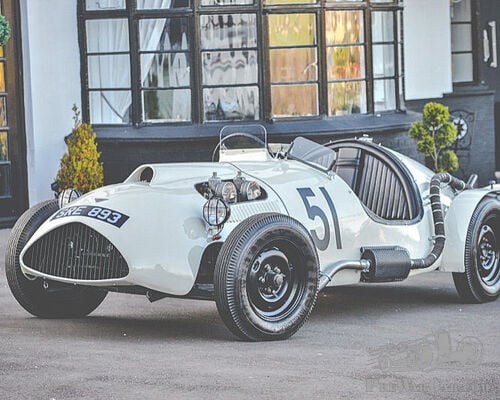
1933 Alvis 3.0 Special - One-Off Alloy Body | Period Competition Car | Featured in “Alvis – A Century of Drivers”
1933 Alvis 3. 0 Special - One-Off Alloy-Body | Period Competition Car | Featured in “Alvis – A Century of Drivers”
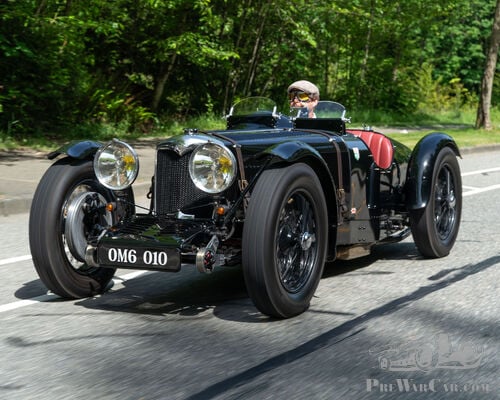
Riley 14/6 Special 1933
The ExperienceStep into the golden age of British motoring. This 1933 Riley 14/6 Special is a masterclass in pre-w..

K3 Replica on KN Chassis
"The K3 Magnette must rank in the history books as the most famous and successful of all the record breaking MGs. With only 33 examples produced durin..