The global magazine and marketplace for classic car enthusiasts, by enthusiasts.


Filter
Classic Stephens for sale - Stephens cars for sale
-

1922 Rolls-Royce 40/50hp Silver Ghost Alpine Eagle
1922 Rolls-Royce 40/50hp Silver Ghost Alpine Eagle Chassis Number: 72MG Registration Number: KK1331 This Silver Ghost is very simply the fastest one ever produced. It has a top speed of somewhere between 80 & 90 MPH with 70MPH cruising easily achieved. Its history is fascina.. -
1931 Alfa Romeo 8C 2300 Zagato Spider
1931 Alfa Romeo 8C 2300 Spider, Chassis 2111006 Ex-Works Alfa Corse and Scuderia FerrariTazio Nuvolari’s Coppa Ciano race-winning car1932 & 1934 Mille Miglia, and 1932 Targa Florio entrant6,500-hour, £805k Jim Stokes restoration to 1932 Mille Miglia specificationRetains original engine and peri.. -
MG K1/K3 ‘TT’ Replica
1934 MG K1 TO “K3” SPECIFICATIONToolroom copy of the factory ‘TT’ bodied K3:Chassis No. K 0433Registration No. BPD 728Introduced at the 1932 London Motor Show, the MG Magnette K-type series represented the ultimate evolution of MG's pre-war overhead-camshaft sports cars. Built around a deep-section chassi.. -
1927 Frazer Nash Vitesse (Period Brooklands Race History)
1927 Frazer Nash VitesseRegistration: PH 2042Chassis No. 1120Engine No. 126 (Lea-Francis Twin Cam)Few Frazer Nash’s tell a story quite as completely as PH 2042.Supplied new by the Frazer Nash works in 1927 as a Vitesse fitted with a supercharged Anzani engine, this is a car that has spent much of its life doing.. -
Model A Ford restored complete rolling chassis.
These rolling chassis are completely restored in every respect. All metalwork powder coated. The front and rear axels are completely rebuild using the original crown wheel and pinion where possible or a high ratio 3.25:1 if required at extra cost. Every bush and bearing is renewed. The braking system is completely u.. -
Mid 1920s Hupmobile R series open tourer project car
Mid 1920s Hupmobile R series open tourer project car. Chassis N° R 179775, castingnumber on engine 52900. Very good condition older restored chassis. Also work done on both engine and rearaxle. Radiator shell is straight but needs to be renickeled. A number of smaller parts are in boxes and not shown. Suitable inexpensive project car fo.. -
Ford Model A Beach Racer 1930
An ideal car for events such as the Beach Races at Romo (Denmark), Pendine (England), and Normandy (France).Completely overhauled chassis.Converted to 12 Volt, starts very easily.A car for lots of fun and certainly an eye-catcher at any moment.Thanks to the large 21-inch wheels with 6.00 x 21 Blockley tires, the car n.. -
Bugatti Type 35B
UK Registered with DVLA Chassis Number.Assembled from all original major components and crucially approved for historic status by DVLA. £POA -
BMW 327/328 convertible 1939
This BMW left the BMW factory in januari 1939 to BMW Versuchsabteilung. Car was delivered to her first owner in December 1939 through dealer Bovenkamp in Wuppertal. Original color of the car is black. Engine and gearbox ar completely overhauled. Invoices available. Chassis and brake system is overhauled as well. Dashboard and instruments are res.. -
Fiat Biposto Spider 1924
Very original car. Old pictures available. ASI Gold Plate. Dutch license. Regurlary use for rallies in the past years. Very spectactular to drive.


Stephens
GB, 1898 – 1900
R. Stephens, Clevedon, Somerset
Stephens was a cycle and general engineer who made a small number of Stephens cars, including two nine-seater buses which plied between Clevedon and Portishead in 1900. The 1898 prototype Stephens cars still exists; this Stephens car has an 8hp 2-cylinder horizontal engine built into the frame, and drive is taken by belts to a countershaft and thence by chains to the rear wheels. Front suspension is independent, and the Stephens car has wire wheels, although production Stephens cars had wooden wheels. About 12 Stephens cars were made altogether.
US, 1916 – 1924
(1) Moline Plow Co, Moline, Ill., 1916 – 1921
(2) Stephens Motor Car Co, Freeport, Ill., 1922 – 1924
The Stephens car was a highly regarded car that used a 3.7-litre sv Continental engine up to 1918, and thereafter a similar-sized ohv unit of the Stephens car company’s own manufacture. Nearly 25.000 Stephens cars were sold during the years of production and a variety of open and closed models Stephens cars constituted its catalogue. Until 1922, Stephens cars were prosaic in appearance, if good dependable cars. That year, the Stephens Salient Six Model 10 appeared as the 1923 line and the moderately-rounded radiator on the earlier Stephens cars was replaced by a high rounded type similar to that used by Kissel or ReVere. Among its more aesthetically appealing types, the new line Stephens cars featured a four-seater, close-coupled sports phaeton with cycle mudguards and side-mounted spare wheels. Wire wheels were used for this Stephens car model which was sold in French grey with apple-green wheels and trim.
Source: Georgano, encyclopedia of motorcar; GNG, KM
The information is written with the greatest of care. However, if you have any suggested amendments please contact us at office@prewarcar.com


Featured
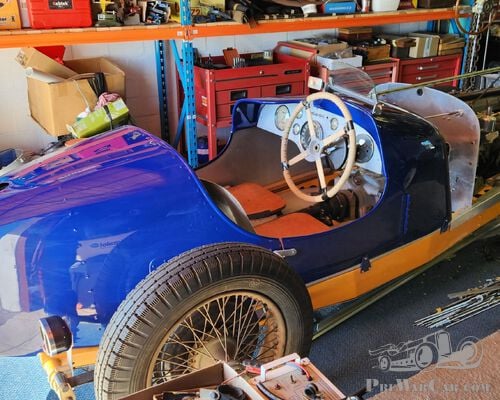
Riley TT Sprite
1935 6-cylinder TT Sprite replica. Chassis # 46A2722. Engine # 6A2722. Original Ulster Imp body. Restoration nearing completion. Engine, Ge..
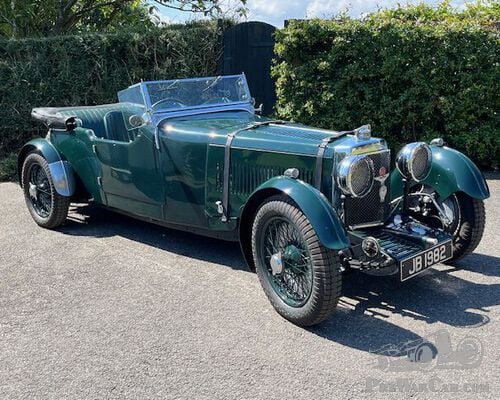
1933 Aston Martin Le Mans
Exceptional 1933 Astron Martin Le MansOriginally bodied as a Standard (Chassis No. L2/222), this unique vehicle was thoughtfully re-bodied i..
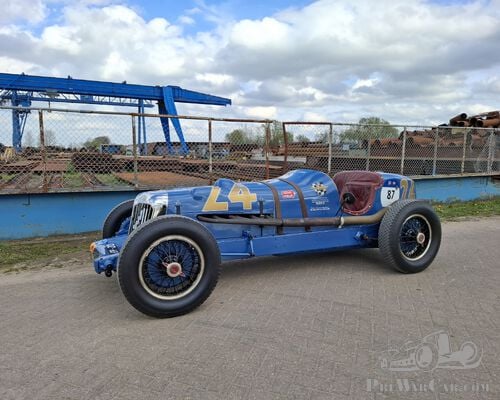
1932 - Graham " Lucenti " Indianapolis
Original participant of the 1932, 1934 and 1935 Indy 500. Best result: finishing 10th overall in the 1934 Indy 500 with driver “Herb” Ardinger...