The global magazine and marketplace for classic car enthusiasts, by enthusiasts.


Filter
Classic E.R.A., Straker-Squire for sale - E.R.A., Straker-Squire cars for sale
-

1913 Straker-Squire 15 HP 2 seat Tourer | The Ernie Warren Collection Auction | 13th June 2026
A 1913 Straker-Squire 15 HP 2 seat Tourer, Reg No. SD1726, in blue/black

E.R.A.
GB, 1934 – 1952
(1) English Racing Automobiles Ltd, Bourne, Lincs., 1934 – 1945
(2) English Racing Automobiles Ltd, Dunstable, Bedfordshire, 1946 – 1952
The ERA was produced by Raymond Mays, Humphrey Cook and Peter Berthon as a challenger in the 1500cc racing class. The ERA used a conventional chassis, a 4-speed pre-selector gearbox and a highly-developed version of the blown 6-cylinder ohv Riley engine giving 165bhp. There were 1100cc and 2-litre power units as alternatives, and with the D-series Porsche trailing-arm independent front suspension was introduced. Only 16 ERA cars were made, but the ERA car dominated the voiturette class in the hands of such drivers as Mays, B. Bira, Seaman, Fairfield, Arthur Dobson and Earl Howe. Victories outside Britain included the Eifelrenne, the Coppa Acerbo, Berne and Masaryk in 1935; the Prince Rainier Cup and Albi in 1936; the Avus, Picardie, Albi and Berne in 1937; and Picardie again in 1938. The ERA cars also dominated British road racing in their day and Raymond Mays achieved numerous fastest times at Shelsley Walsh with his ERA 2-litre car. Fifteen ERA cars still survive and are prominent in ‘historic’ racing. A sports-car project in 1937 came to nothing, but a new ERA 240bhp short-stroke six, the E-type with torsion-bar independent front suspension, a De Dion rear axle, synchromesh gearbox and streamlined body, appeared in 1939.
After World War 2 Mays and Berthon worked on the BRM V16, while ERA, now under the control of Leslie Johnson, struggled on with the unsuccessful ERA E-types until 1949. The company assisted in the design of Jowett’s 1950 ‘Jupiter’ sports car, but their last racing machine, the ERA G-type, was designed for Formula 2, and had a 150bhp 6-cylinder Bristol engine and tubular frame to the designs of David Hodkin. This final ERA product was sold to Bristol’s for testing.
Source: Georgano, encyclopedia of motorcar; MCS
The information is written with the greatest of care. However, if you have any suggested amendments please contact us at office@prewarcar.com
Straker-Squire
GB, 1906 – 1926
(1) S. Straker & Squire Ltd, Fishponds, Bristol, 1906 – 1918
(2) Straker-Squire Ltd, Edmonton, London N., 1918 – 1926
The first road vehicles of Sidney straker and L.R.L. Squire were steam wagons, made from 1901, followed by petrol buses. During 1906 Straker acquired the licence to make the Cornilleau-Ste Beuve car from France as the 25hp Straker-Squire- CSB. By mid-1907 a straightforward four Straker Squire car of 16/20hp was being offered under the name of Straker Squire cars. Late that year, a smaller 12/14hp Straker Squire car was added. It was the Straker Squire car company’s first wholly home-grown model, and was at first called a Shamrock, not a Straker-Squire car. The best-known of the pre-World War 1 Straker-Squire cars was certainly the 15hp Straker Squire car of 1910 – 1914, a sporting 3-litre with a 4-cylinder, sv engine and an excellent performance, this Straker Squire car was designed by AHR Fedden. In 1919 a completely new and in some respects very modern Straker Squire car was announced. This Straker Squire car was also a 6-cylinder machine with a capacity of 4-litres, still designated the 20/25hp, but this Straker Squire car had a single overhead camshaft and aluminium pistons, and to ease manufacturing problems, its cylinders were separately cast. The valve gear of the Straker Squire car was exposed. The whole unit of the Straker Squire car resembled the Rolls-Royce Eagle aero engine the Straker Squire car company had made during World War 1. In spite of an old-fashioned appearance, this was a powerful, if noisy engine that gave the Straker Squire car an 80mph performance. Brakes and steering of this Straker Squire car were suitably good. Unfortunately, even when the Straker Squire car went into production in 1921, as the 24/90hp, very few of these Straker Squire cars were made. The pre-war 15hp Straker Squire car was resurrected, and for 1923, a dull little light Straker Squire car with a 1½-litre ohv Dorman engine was added. By 1926 only the 24/90 and the light car remained, both Straker Squire cars came with hydraulic 4-wheel brakes.
Source: Georgano, encyclopedia of motorcar; TRN
The information is written with the greatest of care. However, if you have any suggested amendments please contact us at office@prewarcar.com


Featured
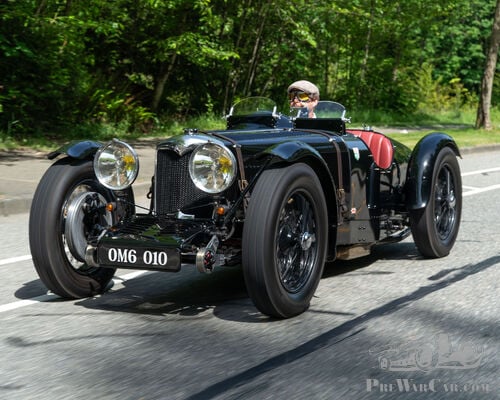
Riley 14/6 Special 1933
The ExperienceStep into the golden age of British motoring. This 1933 Riley 14/6 Special is a masterclass in pre-w..

Lagonda LC Tourer 1934
The Lagonda story began in 1901 in Staines, a small town in the UK. The company enjoyed its greatest successes around 1935. During this period, the..

Alfa 6C1750 Spider
Alfa 6C1750 Spider with complete history from delivery in 1930 to first owner in Firenze till today with copy Libretto/license plate all the years