The global magazine and marketplace for classic car enthusiasts, by enthusiasts.


Filter
Classic Auburn, Studebaker for sale - Auburn, Studebaker cars for sale
-

Studebaker Commander Big Six 1928
A special and very beautiful Studebaker Commander from 1928, also known as the Big Six due to its powerful 5.8-liter 6-cylinder engine.The car was very well restored in the 1970s and subsequently won a senior award at the Hershey car show in 1973. After that, the car was purchased by a collector, well maintained, and used for several rall.. -
Auburn 8-125 , 1930
Auburn Model 8-125, 8-cylinder, 4-door saloon, first registered in 1930, a lovely car in running order, with a German vehicle registration document and historical certification. Viewing and test drive by arrangement, price negotiable -
1935 Auburn 851 Supercharged Speedster | RM Sotheby's | The Hershey Auction
To Be OFFERED AT AUCTION at RM Sothebys' The Hershey Auction event, 7 - 8 October 2026. $850,000 - $950,000 USD The very first Auburn 851 Speedster produced, with numerous early production featuresKnown history back to the early 1950s, with several noted collectorsWell-preserved restoration by RM Auto Restoration; benef.. -
1936 Auburn 852 Super-Charged "Boattail" Speedster
Reimel Motor Cars is proud to offer this: stunning 1936 Auburn 852 Super-Charged "Boattail" Speedster. Penned by the legendary Gordon Buehrig, this Art Deco masterpiece is widely celebrated as one of the most breathtaking American cars ever produced. It balances show-ready elegance with tour-ready usability, perfectly prepared to anchor any .. -
1936 Auburn 852 SC Cabriolet
Presented in striking Auburn Onyx Black with a rich slate gray leather interior, this 1936 Auburn 852 Convertible Cabriolet is a true jewel of prewar American motoring. The car underwent a comprehensive, nut-and-bolt, frame-off restoration by renowned Auburn authority James Milligan and owner of Auburn West, a respected purveyor of Auburn new-ol.. -
1935 Auburn 851SC Speedster
Vehicle Highlights Chassis No. 32741EEngine No. GH537 Vehicle DescriptionThis vehicle was first sold to Mr. Schilling (A. Schilling & Company founded in 1881). After some degree of use by Mr. Schilling, he directed his mechanic to mount the Auburn Speedster body on a Lincoln V12 chassis... -
Auburn 851 Phaeton Sedan 1935
A very well-driving Auburn with a powerful engine, excellent brakes, and light steering. This five-seat open convertible features a rebuilt engine and a well-functioning dual-ratio rear axle, ideal for relaxed cruising at around 90 km/h (56 mph). An older restoration, it's in remarkably good condition, with a new convertible top. -
1919 Studebaker Chummy Roadster
Model: chummy roadsterColour: soft yellow body with black mudguardsInterior: dark brown leatherEngine: in-line 6 cylinderTransmission: 3-speed manual transmissionCondition: body off restoredPrice € : 49,500,- Description:Beautifully restored car. Very special model because of its tou..


Auburn
US, 1900 – 1937
Auburn Automobile Co, Auburn, Ind.
One of the most famous of all American cars, the Auburn first appeared in 1900 when Frank and Morris Eckhart of the Eckhart Carriage Co, in Auburn, Ind., began experimenting with hand-built cars, selling them in and around Auburn. The first production Auburn car for sale appeared in 1903 as a single-cylinder chain-driven runabout with the engine under the body and the fuel tank under the bonnet. A touring Auburn model was added in 1904 and in 1905, 2-cylinder Auburn cars were introduced and continued until 1910, in which year a 4-cylinder type with a Mercedes-shaped radiator and a Rutenber engine was introduced. Both open and closed bodies were available on this larger chassis. In 1911 Auburn bought the Zimmerman Manufacturing Co, which had been producing high wheelers under that name, and continued to manufacture them. Auburn introduced a 6-cylinder car with electric lights as standard equipment in 1912. Right- or left-hand steering was optional in 1914 on Auburn cars for sale, and from 1914 to 1919, 4- and 6-cylinder Auburn cars were available with Teetor, Rutenber and Continental engines. In 1919, the company introduced its Auburn Beauty Six model featuring streamlined bodies with beveled edges on the sides. In 1921 this became the Auburn 6-51 sports model with cycle-type mudguards, step-plates instead of running-boards, disc wheels and a small luggage compartment behind the front bumper. Nickel trim was also featured, as well as leather upholstery and an abundance of bright colour schemes. The Auburn for sale in 1923 were powered by a Continental engine for the 6-43 or a Weidely ohv six for the larger model Auburn 6-63, or Auburn Supreme. In 1924, balloon low-pressure tyres were available on Auburn at extra cost. Up to now production figures had seldom exceeded 4000 units per year.
In 1924 E.L. Cord bought the Auburn company and from that point on, the Auburn took a leading position in the American automobile business. Cord had the entire range redesigned by J.M. Crawford, and the 1925 Auburn line consisted of 4-, 6- and 8-cylinder models. The new car had two-tone colour schemes and a novel belt moulding which extended at the cowl over the top of the bonnet with its apex at the radiator cap. The Auburn cars for sale were handsome and well built, although some of the larger models had ugly 6-spokes iron wheels more suited to truck design. These were soon discontinued and normal spoke or wire wheels became standard. The basic lines of the 1925 Auburn model were so advanced that the design remained practically the same until 1930. The 4-cylinder Auburn for sale was dropped in 1927 and sales climbed steadily. The 1931 Auburn was perhaps the sleekest car in the company’s history and sales reached a peak of 28.103 Auburn cars that year. The 1931 Auburn Straight-Eight was augmented in 1932 with a new 6.4-litre V12, both cars being equipped with a Columbia dual-ratio rear axle. This Auburn V12 was the first 12-cylinder car to sell under $1.000, and probably the only one, too. These lines were continued in 1933. In 1934 a new design replaced the basic 1931 type and a six was added to the range. In 1935 a new and handsome sports design was announced and a supercharged line of Auburns augmented the Auburn 653 six for sale and Auburn 851 eight for sale. The pointed-tail 150bhp Auburn speedster models were guaranteed to have been test driven at more than 100mph. The cars remained unchanged for 1936 and although a new range of Auburns had been planned for 1937, no cars were produced.
Source: Georgano, encyclopedia of motorcar; KM, GNG
The information is written with the greatest of care. However, if you have any suggested amendments please contact us at office@prewarcar.com
Studebaker
US/ CDN, 1902 – 1966
(1) Studebaker Corp, South Bend, Indiana, 1902 – 1954
(2) Studebaker-Packard Corp, South Bend, Indiana, 1954 – 1964
(3) Studebaker Corp of Canada Ltd, Hamilton, Ontario, 1964 – 1966
The brothers Henry and Clem Studebaker opened a blacksmith’s and wagon-building shop in South Bend in 1852, horse-drawn vehicles of their construction serving in both the American Civil War and World War 1, and production continuing until 1919. Their first Studebaker cars were electrics, made in modest numbers from 1902 to 1912: these Studebaker carwere joined in 1904 by the Model-C petrol Studebaker car, a typically American 16hp flat-twin with amidships engine, 2-speed gearbox, and chain drive. This Studebaker carwas followed a year later by a vertical 4 on more European lines, this Studebaker car was selling for $3.000. For the next few seasons, however, Studebaker electred to act as selling gents for Studebaker cars built to their order, and their more expensive offerings of Studebaker cars were built by Garford of Elyria. The cheaper machines were the EMF and Flanders built by the Everitt-Metzger-Flanders Co, and these two makes accounted for 9.700 Studebaker cars in 1910. 1913 saw a brace of Studebaker cars made at South Bend, both with sv monobloc engines, dual ignition, and electric lighting and starting: the 3-speed gearboxes on the Studebaker cars were mounted in unit with the back axles, and the 6-cylinder Studebaker car was claimed to be the first such car to retail in the USA for less than $2.000. In 1914 there was a smaller, 15/20hp Studebaker car with 3.2-litre 4 with coil ignition only. Studebaker sold over 45.000 Studebaker cars in 1915, and their sixth position in 1916 US sales was matched by a seventh place in 1920. 1919 was the last year for 4-cylinder Studebaker cars, and the 1920 Studebaker cars, while retaining separate gearboxes, abandoned the transaxle layout. Studebaker carmodels available were 6s of 4.7-litres and 5.8-litres, the latter establishing a line of really large 6-cylinder Studebaker cars which survived until 1928. An inexpensive 3.3-litre Studebaker Light 6 joined the range in 1921, and 1923 Studebaker cars had all-metal bodies with welded steel pressings. Balloon tyres were standardized on Studebaker cars in 1925, in which year contracting-type hydraulic front wheel brakes were an option: open Studebaker cars were made with permanent tops of the ‘California’ type and detachable side-curtains. Front wheel brakes were standard on the Studebaker carin 1926, but the Studebaker carcompany reverted to mechanical actuation in 1927, in which year a ‘compact’, the Studebaker Erskine, was marketed. Studebaker cars went after stock-car records in a big way in the later 1920s, an outstanding performance of a Studebaker car being 25.000 miles in 25.000 minutes. The 1929 range Studebaker cars consisted of two 6s, the ‘Studebaker Dictator’ and ‘Studebaker Commander’ (at $1.265 and $1.495 respectively), and a brace of straight-eights of 4-litres’ and 5.5-litres’ capacity. Pierce-Arrow was acquired by the Studebaker car company in 1928, but regained its independence five years later. In 1930 Studebaker cars, with Plymouth, pioneered the free wheel, offered initially on 8-cylinder Studebaker cars alone, but available throughout the range by the latter part of the year, when the cheapest Studebaker car, the Light 6, could be bought in England for £295.
Another compact Studebaker carappeared under the Rockne nameplate in 1932. Special versions of the ‘Studebaker President 8’ distinguished themselves in the Indianapolis 500-Mile Race. Cliff Bergere’s Studebaker Special finishing 3rd, while in 1933 6th to 12th places were filled by similar Studebaker cars. Studebaker cars went into receivership in 1933, but came back strongly in 1934 with an unattractively-styled three-model range of Studebaker cars – the 3.4-litre ‘Studebaker Dictator 6’, the 3.6-litre ‘Studebaker Commander 8’, and the 4.1-litre ‘Studebaker President 8 ‘, all with synchromesh, free wheel, and X-braced frames. Subsequent evolution of Studebaker cars followed accepted American lines: transverse independent front suspension, automatic overdrive, and hydraulic brakes once more in 1935: a hill-holder (modernized version of the sprag) in 1936: headlamps half-faired into the wings of the Studebaker car in 1938: and column change in 1939, when Raymond Loewy became responsible for the Studebaker car Corporation’s styling. 1939 was also the first year for one of America’s longest-lived modern economy cars, the 2.7-litre 6-cylinder sv ‘Studebaker Champion’ selling at $765. Fluid couplings was available on the 1942 Studebaker car range, which included Studebaker cars last straight-8s. The revolutionary post-war ‘coming or going’ style with wrap-around rear window on Studebaker cars was launched by Loewy on the 1946/ 1947 Studebaker cars with 2.8-litre and 3.7-litre 6-cylinder engines. Sales climbed to 239.000 Studebaker cars in 1949, and the inevitable ohv V8 – a relatively small one of 3.8-litres – replaced the bigger 6 in 1951 Studebaker cars. Studebaker car companys answer to the big battalions was the low and elegant line of the 1953 Studebaker cars, which unfortunately became more cluttered down the years, and finances were not impoved by the merger of the Studebaker car company with Packard in 1954. An interesting departure was the sporting ‘Studebaker Hawk’ coupé powered by Packard’s V8 engine and Ultramatic transmission in 1956: 1957 versions had blown Studebaker car engines, the only example of a factory-equipped super-charger (save the 1954 Kaiser) since the Graham. The Studebaker car company managed to get their ‘Studebaker Lark’ compact sedan tooled and into production in ten months in 1959, and this descendant of the old sv ‘Champion’ was the only Studebaker car now offered with the exception of the ‘Studebaker Hawk’. The small 6 Studebaker car achieved ohv at long last in 1961, and 1962 saw the exciting fiberglass-bodied ‘Studebaker Avanti’ coupé with disc brakes on the front wheels, a 4-speed gearbox, and optional supercharger. The Studebaker car annexed 29 stock-car records, including a flying mile at 168.15mph, but neither this nor the continuing ‘Lark’ range could save Studebaker cars. A wide choice of Studebaker car models – two 6s and three 8s – was listed for 1964, but early in the season South Bend stopped making Studebaker cars, and production was transferred to the Canadian plant which had been assembling Studebaker cars since 1912. Even as an ‘import’, the Studebaker car did not sell well: the last examples of the Studebaker car marque had 3.2-litre 6-cylinder and 4.7-litre 8-cylinder Chevrolet engines, but even these were abandoned in the spring of 1966. Production of the ‘Studebaker Avanti’ was continued on a small scale by an independent factory in South Bend.
Source: Georgano, encyclopedia of motorcar; MCS
The information is written with the greatest of care. However, if you have any suggested amendments please contact us at office@prewarcar.com


Featured
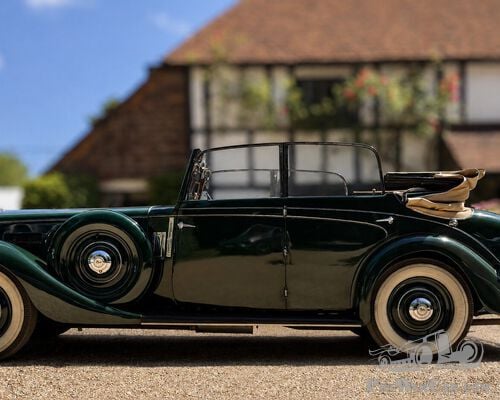
1936 Armstrong Siddeley 20/25 Cabriolet with Tickford coachwork by Salmons & Sons, Newport Pagnell
This exceptionally rare Armstrong Siddeley 20/25 Cabriolet with original Tickford coachwork by Salmons & Sons of Newport Pagnell was first reg..
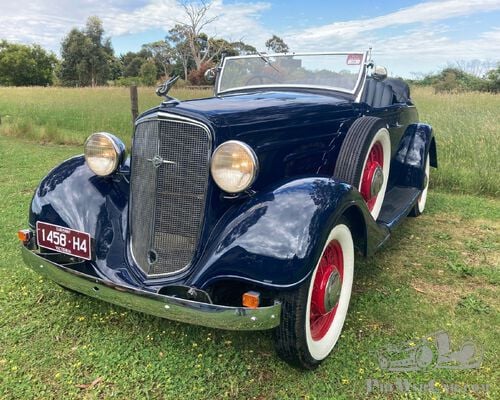
1934 Chevrolet Standard Roadster
1934 Chevrolet Standard Roadster This vehicle was delivered to Australia from Chevrolet and the body was manufactured by Holden Body Works w..
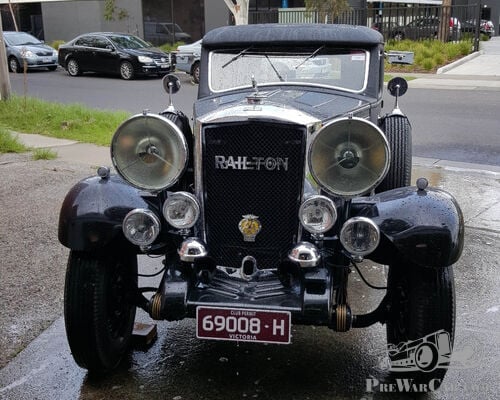
Railton straight 8 sports coupe for rallying REDUCED PRICE run with the bentleys at a fraction of the price
1934 Railton Sports CoupeBuilt for long distance rallyingRebuilt 2017built up at a cost of $160,000AUD, OFFERED FOR SALE AT A ..