The global magazine and marketplace for classic car enthusiasts, by enthusiasts.


Filter
Classic Studebaker, Darracq for sale - Studebaker, Darracq cars for sale
-

Studebaker Commander Big Six 1928
A special and very beautiful Studebaker Commander from 1928, also known as the Big Six due to its powerful 5.8-liter 6-cylinder engine.The car was very well restored in the 1970s and subsequently won a senior award at the Hershey car show in 1973. After that, the car was purchased by a collector, well maintained, and used for several rall.. -
Exceptional 8Hp Darracq Type C
This breath-takingly original 1901 Veteran Darracq Motorcar is the later version of the Type C Rear-entrance Tonneau Model. One of about 1200 thought to have been built, it is the most original example of a veteran or vintage car that we have ever encounteredIt stands as a true witness to over 125 years of motoring, and is, in our opinio.. -
1919 Studebaker Chummy Roadster
Model: chummy roadsterColour: soft yellow body with black mudguardsInterior: dark brown leatherEngine: in-line 6 cylinderTransmission: 3-speed manual transmissionCondition: body off restoredPrice € : 49,500,- Description:Beautifully restored car. Very special model because of its tou..


Studebaker
US/ CDN, 1902 – 1966
(1) Studebaker Corp, South Bend, Indiana, 1902 – 1954
(2) Studebaker-Packard Corp, South Bend, Indiana, 1954 – 1964
(3) Studebaker Corp of Canada Ltd, Hamilton, Ontario, 1964 – 1966
The brothers Henry and Clem Studebaker opened a blacksmith’s and wagon-building shop in South Bend in 1852, horse-drawn vehicles of their construction serving in both the American Civil War and World War 1, and production continuing until 1919. Their first Studebaker cars were electrics, made in modest numbers from 1902 to 1912: these Studebaker carwere joined in 1904 by the Model-C petrol Studebaker car, a typically American 16hp flat-twin with amidships engine, 2-speed gearbox, and chain drive. This Studebaker carwas followed a year later by a vertical 4 on more European lines, this Studebaker car was selling for $3.000. For the next few seasons, however, Studebaker electred to act as selling gents for Studebaker cars built to their order, and their more expensive offerings of Studebaker cars were built by Garford of Elyria. The cheaper machines were the EMF and Flanders built by the Everitt-Metzger-Flanders Co, and these two makes accounted for 9.700 Studebaker cars in 1910. 1913 saw a brace of Studebaker cars made at South Bend, both with sv monobloc engines, dual ignition, and electric lighting and starting: the 3-speed gearboxes on the Studebaker cars were mounted in unit with the back axles, and the 6-cylinder Studebaker car was claimed to be the first such car to retail in the USA for less than $2.000. In 1914 there was a smaller, 15/20hp Studebaker car with 3.2-litre 4 with coil ignition only. Studebaker sold over 45.000 Studebaker cars in 1915, and their sixth position in 1916 US sales was matched by a seventh place in 1920. 1919 was the last year for 4-cylinder Studebaker cars, and the 1920 Studebaker cars, while retaining separate gearboxes, abandoned the transaxle layout. Studebaker carmodels available were 6s of 4.7-litres and 5.8-litres, the latter establishing a line of really large 6-cylinder Studebaker cars which survived until 1928. An inexpensive 3.3-litre Studebaker Light 6 joined the range in 1921, and 1923 Studebaker cars had all-metal bodies with welded steel pressings. Balloon tyres were standardized on Studebaker cars in 1925, in which year contracting-type hydraulic front wheel brakes were an option: open Studebaker cars were made with permanent tops of the ‘California’ type and detachable side-curtains. Front wheel brakes were standard on the Studebaker carin 1926, but the Studebaker carcompany reverted to mechanical actuation in 1927, in which year a ‘compact’, the Studebaker Erskine, was marketed. Studebaker cars went after stock-car records in a big way in the later 1920s, an outstanding performance of a Studebaker car being 25.000 miles in 25.000 minutes. The 1929 range Studebaker cars consisted of two 6s, the ‘Studebaker Dictator’ and ‘Studebaker Commander’ (at $1.265 and $1.495 respectively), and a brace of straight-eights of 4-litres’ and 5.5-litres’ capacity. Pierce-Arrow was acquired by the Studebaker car company in 1928, but regained its independence five years later. In 1930 Studebaker cars, with Plymouth, pioneered the free wheel, offered initially on 8-cylinder Studebaker cars alone, but available throughout the range by the latter part of the year, when the cheapest Studebaker car, the Light 6, could be bought in England for £295.
Another compact Studebaker carappeared under the Rockne nameplate in 1932. Special versions of the ‘Studebaker President 8’ distinguished themselves in the Indianapolis 500-Mile Race. Cliff Bergere’s Studebaker Special finishing 3rd, while in 1933 6th to 12th places were filled by similar Studebaker cars. Studebaker cars went into receivership in 1933, but came back strongly in 1934 with an unattractively-styled three-model range of Studebaker cars – the 3.4-litre ‘Studebaker Dictator 6’, the 3.6-litre ‘Studebaker Commander 8’, and the 4.1-litre ‘Studebaker President 8 ‘, all with synchromesh, free wheel, and X-braced frames. Subsequent evolution of Studebaker cars followed accepted American lines: transverse independent front suspension, automatic overdrive, and hydraulic brakes once more in 1935: a hill-holder (modernized version of the sprag) in 1936: headlamps half-faired into the wings of the Studebaker car in 1938: and column change in 1939, when Raymond Loewy became responsible for the Studebaker car Corporation’s styling. 1939 was also the first year for one of America’s longest-lived modern economy cars, the 2.7-litre 6-cylinder sv ‘Studebaker Champion’ selling at $765. Fluid couplings was available on the 1942 Studebaker car range, which included Studebaker cars last straight-8s. The revolutionary post-war ‘coming or going’ style with wrap-around rear window on Studebaker cars was launched by Loewy on the 1946/ 1947 Studebaker cars with 2.8-litre and 3.7-litre 6-cylinder engines. Sales climbed to 239.000 Studebaker cars in 1949, and the inevitable ohv V8 – a relatively small one of 3.8-litres – replaced the bigger 6 in 1951 Studebaker cars. Studebaker car companys answer to the big battalions was the low and elegant line of the 1953 Studebaker cars, which unfortunately became more cluttered down the years, and finances were not impoved by the merger of the Studebaker car company with Packard in 1954. An interesting departure was the sporting ‘Studebaker Hawk’ coupé powered by Packard’s V8 engine and Ultramatic transmission in 1956: 1957 versions had blown Studebaker car engines, the only example of a factory-equipped super-charger (save the 1954 Kaiser) since the Graham. The Studebaker car company managed to get their ‘Studebaker Lark’ compact sedan tooled and into production in ten months in 1959, and this descendant of the old sv ‘Champion’ was the only Studebaker car now offered with the exception of the ‘Studebaker Hawk’. The small 6 Studebaker car achieved ohv at long last in 1961, and 1962 saw the exciting fiberglass-bodied ‘Studebaker Avanti’ coupé with disc brakes on the front wheels, a 4-speed gearbox, and optional supercharger. The Studebaker car annexed 29 stock-car records, including a flying mile at 168.15mph, but neither this nor the continuing ‘Lark’ range could save Studebaker cars. A wide choice of Studebaker car models – two 6s and three 8s – was listed for 1964, but early in the season South Bend stopped making Studebaker cars, and production was transferred to the Canadian plant which had been assembling Studebaker cars since 1912. Even as an ‘import’, the Studebaker car did not sell well: the last examples of the Studebaker car marque had 3.2-litre 6-cylinder and 4.7-litre 8-cylinder Chevrolet engines, but even these were abandoned in the spring of 1966. Production of the ‘Studebaker Avanti’ was continued on a small scale by an independent factory in South Bend.
Source: Georgano, encyclopedia of motorcar; MCS
The information is written with the greatest of care. However, if you have any suggested amendments please contact us at office@prewarcar.com
Darracq , Talbot Suresnes
France, 1896 – 1959
(1) Société A. Darracq, Suresnes, 1896 – 1905
(2) A. Darracq & Co (1905) Ltd, Suresnes, 1905 – 1920
(3) Automobiles Talbot, Suresnes, 1920 – 1959
An immense complexity of nomenclature surrounds the two makes, Darracq and Talbot Suresnes. While the cars themselves were always designed and built in France, the Darracq company was financed in England during its golden period and after (1905-1935), then merged with a French concern which had been formed to make Italian cars, and subsequently acquired American affiliations. Alexandre Darracq founded the Gladiator cycle company in 1891, selling out to British interests five years later. Darracq then turned briefly to the manufacture of electric carriages, exhibiting a Darracq coupé at the 1896 Paris Salon. In 1898, however, he acquired (for £10.000) the manufacturing rights of Léon Bollée’s 4-wheeler voiturette, a belt-driven 5hp machine with a single-cylinder air-cooled horizontal engine, tube ignition and steering-column gear-change. It was not a success, though column change was to persist on some of Darracq’s own designs until 1910.
The idea of a small and inexpensive Darracq runabout persisted, and in 1900 came the first real Darracq: its 785cc front-mounted vertical single-cylinder engine had automatic inlet valves, coil ignition, a cone clutch and shaft drive – Alexandre Darracq, like Louis Renault, never marketed a chain-driven car. The Darracq could be bought in England for £250 in 1901, in which year the Société Darracq took up racing with a 1.9-litre 2-cylinder machine driven by Henry Farman. Though only ‘Darracq singles’ were offered to the public in 1902, racing Darracq cars were formidable voiturettes with 5.9-litre 4-cylinder engines and won the light-car category of the Concours du Ministre alcohol race, besides doing well in the Paris-Vienna. A manufacturing licence for Germany was taken out by Opel that year. Darracq cars were raced until 1906, winning the light-car and voiturette categories of the Circuit des Ardennes. The Darracq company’s grandes voitures were less successful: Darracq was determined to win the 1904 Gordon Bennett Cup and entered not only his Darracq own team of 11.3-litre machines for the French éliminatoire, but also sponsored three Opel-built cars in Germany, with another three Darracq cars specially built from scratch by Weir of Glasgow, to carry the British colours. Only von Opel’s Opel-Darracq actually raced at Homburg and this failed to survive a single lap. Some very light 9.9-litre ohv Darracq cars were prepared for 1905, but it was not until the following season that a twofold success was achieved: Wagner’s victory in the Vanderbilt Cup, and Algernon Lee Guinness’s 117.66mph over the kilometer at Ostend on a special 22.5-litre ohv V8 Darracq sprint car. Darracq cars took 2nd and 3rd places in the 1908 TT but no more were raced until 1921.
Meanwhile the utility cars prospered. Single-, twin- and 4-cylinder Darracq models were marketed in 1903, all but the smallest having mechanically-operated side valves in a T-head, while the simplified 8hp Darracq Populaire sold for only 4.800fr in France. 1904 saw the introduction of steel frames pressed out of a single sheet of metal and also the advent of the rapid 3.1-litre 4-cylinder Darracq Flying 15 for sale at £460. The new type of chassis was universal by 1905, when the Darracq company was reorganized under British registry, and some quite big Darracq car were offered, though these were modestly priced, at the top of the regular range being a 5.9-litre 28hp with dual ignition and a 12ft 4in wheelbase at only £687. It was also possible to buy a 70hp Darracq sporting model based on the 1904 Gordon Bennett cars.
The 1907 1100cc single Darracq sold for £159 and had mechanically-operated valves, but at the other end of the range there were the 4.7-litre ‘20/28’, the 11½-litre ohv ‘Vanderbilt Cup’ type, and a 5.7-litre 4-speed six Darracq selling for £850. This had grown up to 8.1-litres with square cylinder dimensions a year later, though Darracqs still had a progressive gear change, and there was a short vogue for rear-axle-mounted gearboxes on a brace of new L-head monobloc fours with 2.3-litre and 3.1-litre engines. This transmission was dropped in 1909, the last year of ‘Darracq singles’, and the twins disappeared twelve months later. Gate change arrived in 1910 on Darracq cars for sale. In 1911 there were seven Darracq models, the 15hp at £275 having overhead inlet valves. The 1912 p Darracq rogramme, however, saw a catastrophic flirtation with the Henriod rotary-valve engine, installed in the 4.4-litre P12 4-cylinder with a 10ft 5in wheelbase, worm drive and dashboard radiator. A 2.6-litre rotary-valve Darracq model had conventional cooling arrangements, but profits faded away to almost nothing, and in the ensuing upheaval M. Darracq retired. Owen Clegg from Rover took over the management and the 1913 Darracq cars were obviously inspired by his successful Rover Twelve. They came in 2.1-litre and 2.9-litre sizes with L-head Monobloc-cylinder engines and worm drive and very soon the Darracq firm was back on a sound footing. Additional to the 1914 range was a 4-litre ’ Darracq 20/30’ and the 16hp Darracq was sold with electric lighting and starting. This latter Darracq model went back into production in 1919 and was joined shortly afterward by an advanced 4.6-litre sv V8 with coil ignition and spiral bevel final drive, which had acquired 4-wheel brakes by the time it reached the production stage.
In June 1920 the British firms of Sunbeam and Talbot, who had joined forces in 1919, merged with Darracq and thenceforward nomenclature becomes complex. For the first few years after the amalgamation, the term ‘Talbot-Darracq’ was freely used on both sides of the Channel, but strictly the cars were ‘Talbot’ (pronounced à la Francaise) in Europe, and ‘Darracq’ in the British Commonwealth up to 1939. The new combine Talbot and Darracq supported racing, though the very successful Henry-designed twin ohc 4-cylinder differential-less voiturettes evolved in 1922 ran indiscriminately as Talbots and Darracqs. They and their descendants were, however, conceived and designed at Suresnes and victories included the 200-Mile Race at Brooklands (1922 running unblown, 1924 and 1925 in supercharged form), the Coupe des Voiturettes (1922 and 1923), and the Penya Rhin race (1923). 1926 saw a team of advanced blown twin ohc 1½-litre straight-8s which never really proved themselves before Sunbeam-Talbot-Darracq’s precarious finances forced a withdrawal from racing in 1927.
In the touring-car field, Sunbeam-Talbot-Darracq settled down to fifteen years of competing against themselves. A 3.2-litre sv 15hp Darracq with detachable head appeared in 1921, still with worm drive, and this was followed a year later by a small ohv 970cc Darracq machine with no differential and coil ignition, made also in England as the 8/18 Talbot, and the first of a line of 1½-litre ohv fours, the 10CV, selling at £595. Worm drive was dropped, and fwb had spread to the smaller Darracq cars in 1924 with the 2.1-litre Darracq DS – in sports form this was said to give 57bhp – but though the firm reverted to magneto ignition they retained wood wheels (still found on some Darracq cars as late as 1931) and 3-speed gearboxes. A year later the 1½-litre Darracq had grown up into the handsome ‘Darracq 12/32’ with 4-wheel brakes and Weymann saloon bodywork; this theme was continued until 1928, by which time the car had a 1.7-litre engine and four forward speeds. Late in 1925 came the first of a long line of ohv push-rod sixes on conventional lines, with 3-speed gearboxes, single-plate clutches, magneto ignition and Perrot-type fwb: the 2.5-litre Darracq TLA gave 72bhp and sold for £800. Both an extra forward ratio and the option of a 2.9-litre unti came the following year. 1928 saw a real light six of 2 litres’ capacity with coil ignition, Talbot’s bi-metal pistons and Bendiz brakes. Only 6-cylinder cars were marketed for sale by Darracq in 1929, when 7-bearing crankshafts and centralized chassis lubrication made their appearance, while the inevitable straight-8 was listed for 1930: it featured a 3.8-litre 100mhp engine with a 9-bearing crank and nitralloy liners, and could be had on an 11ft 10in wheelbase. The next major facelift came in 1933, with box-section frames and transverse ifs on the sixes and eights. Only one 6-cylinder Darracq model was catalogued in 1934, the year in which Darracq followed the lead of Roesch at Talbot by adopting the Wilson preselective gearbox which was retained until 1954.
After the collapse of Sunbeam-Talbot-Darracq Motors in 1935 the Suresness factory came under the control of Major A.F. Lago, who had been well known in London for his L.A.P. ohv conversions in the 1920s. Lago introduced a new line of 6-cylinder ohv cars retaining the X-braced frames and ifs, while synchromesh gearboxes were available on the cheaper variants. The 2.7-litre Darracq 15CV and 3-litre Darracq 17CV were pleasant but not particularly lively tourers, but the 4-litre Darracq 23CV with 7-bearing crank disposed of 165bhp in its Lago Special guise with cross-push-rod valve gear and hemispherical head, and would comfortably exceed 100mph. A 1-2-3- victory in the 1937 French sports-car Grand Prix at Montlhéry in 1937 was followed up by Comotti’s win in the TT. Under the 1938 GP formula the cars were less successful – stripped sports machines could do nothing against Mercedes-Benz and Auto-Union, while the low offset 1939 4½-litre single-seaters were not much faster. A 3-litre blown V16 engine never came to anything, any more than did a plan laid in 1937 to revive the Invicta name by building 3-litre and 4-litre Darracqs with Delage-style bodywork in London.
After World War 2, however, the 4½-litre racers (now ‘Talbot’ or ‘Lago-Talbot’, never ‘Darracq’) came into their own. What they lacked in power they made up in modest fuel consumption, and could often go through a race without refueling, an attribute not shared by blown 1½-litre machines. Chiron’s win at Comminges in 1947 was a prelude to a career that spanned four seasons, and was backed by Rosier’s 1950 Le Mans victory on a similar machine with sketchy road equipment. Pierre Levegh would have repeated this in 1952, against Mercedes-Benz, had he not attempted a single-handed drive for the 24 hours. Touring-car production was hampered by crippling taxation and uncertain finances: 433 cars were sold in 1950, but only 80 in 1951. In spite of this M. Lago had a revised 4½-litre 170bhp Lago Record sports car with hydraulic brakes in production in 1946, following it up with a simpler and cheaper corss-pushrod four, the 2.7-litre Baby in 1950. This was said to have 118bhp, had hydraulic brakes and the choice of synchromesh or preselector, and was offered only with rhd; but it was not a particularly good car, and its styling did not enhance it. By 1952 the range had been restyled, but though Lago was extracting 247bhp from his Le Mans engines, he met with no success, and henceforward the road lay downhill. Various engines were tried: in 1955 there was a 5-bearing 2½-litre four on established Talbot lines, with a 4-speed ZF gearbox and handsome GT-style bodywork. In 1956 Maserati 250 engines were fitted in the Le Mans cars and in 1957, when two cars were still being turned out every week, a final attempt was made to earn dollars with the Lago America, the 1955 chassis with a 2.6-litre BMW V8 power unit. By 1959 Simca were in control at Suresnes, and the Talbot coupé had yet another engine – the old sv V8 motor inherited from Ford of France. Though an odd-looking coupé with Simca Aronde engine was shown on the Talbot stand at the 1960 Paris Salon, no more cars have been made. It is ironic to note that the three partners in the Sunbeam-Talbot- Darracq venture were re-united once more as a result of the Rootes-Chrysler deal in 1965, Chrysler already having a substantial stake in Simca.
Source: Georgano, encyclopedia of motorcar; MCS
The information is written with the greatest of care. However, if you have any suggested amendments please contact us at office@prewarcar.com


Featured
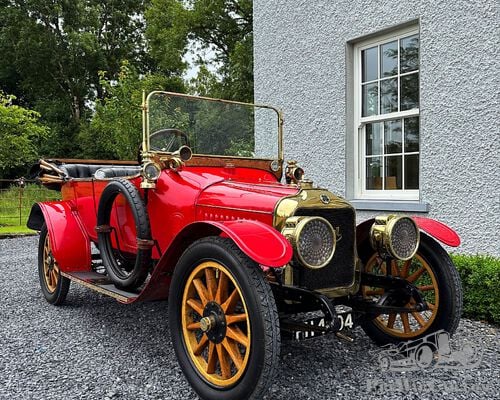
1914 Brasier
1914 Brasier Tourer 9ABrasier were a French manufacturer who were in business from 1901 until 1930, when the company became victim of the gr..
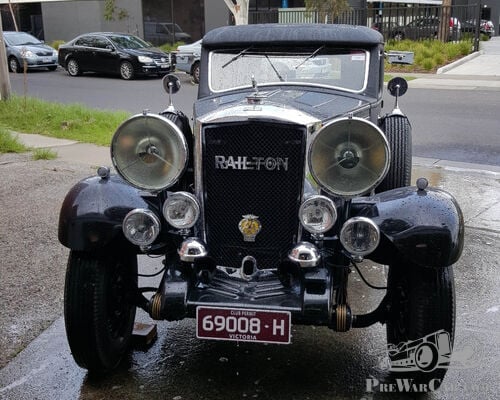
Railton straight 8 sports coupe for rallying REDUCED PRICE run with the bentleys at a fraction of the price
1934 Railton Sports CoupeBuilt for long distance rallyingRebuilt 2017built up at a cost of $160,000AUD, OFFERED FOR SALE AT A ..
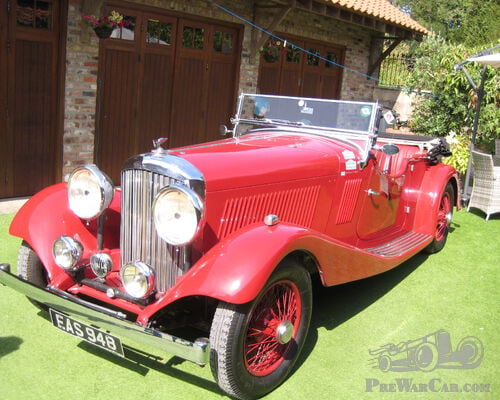
1935 Bentley 3.5 ltr. VDP 4str. Tourer
Chassis B 123 CW was first registered 14th March 1935, and in the late eighties underwent a " body-off" restoration and fitted with VANDEN PLAS