The global magazine and marketplace for classic car enthusiasts, by enthusiasts.


Filter
Classic Studebaker, Lea Francis for sale - Studebaker, Lea Francis cars for sale
-

Studebaker Commander Big Six 1928
A special and very beautiful Studebaker Commander from 1928, also known as the Big Six due to its powerful 5.8-liter 6-cylinder engine.The car was very well restored in the 1970s and subsequently won a senior award at the Hershey car show in 1973. After that, the car was purchased by a collector, well maintained, and used for several rall.. -
Lea Francis Hyper 4 Seater Tourer
The first time on the market since the 1970's, an elegant 4 seater tourer with a 4ED meadows supercharged engine.We have quite a bit of history with this car, at some point in its life it was converted to a two seater with a streamlined racing body and then rebulit to its original specification in 1995 by A.B Price Ltd, its original body.. -
1919 Studebaker Chummy Roadster
Model: chummy roadsterColour: soft yellow body with black mudguardsInterior: dark brown leatherEngine: in-line 6 cylinderTransmission: 3-speed manual transmissionCondition: body off restoredPrice € : 49,500,- Description:Beautifully restored car. Very special model because of its tou..


Studebaker
US/ CDN, 1902 – 1966
(1) Studebaker Corp, South Bend, Indiana, 1902 – 1954
(2) Studebaker-Packard Corp, South Bend, Indiana, 1954 – 1964
(3) Studebaker Corp of Canada Ltd, Hamilton, Ontario, 1964 – 1966
The brothers Henry and Clem Studebaker opened a blacksmith’s and wagon-building shop in South Bend in 1852, horse-drawn vehicles of their construction serving in both the American Civil War and World War 1, and production continuing until 1919. Their first Studebaker cars were electrics, made in modest numbers from 1902 to 1912: these Studebaker carwere joined in 1904 by the Model-C petrol Studebaker car, a typically American 16hp flat-twin with amidships engine, 2-speed gearbox, and chain drive. This Studebaker carwas followed a year later by a vertical 4 on more European lines, this Studebaker car was selling for $3.000. For the next few seasons, however, Studebaker electred to act as selling gents for Studebaker cars built to their order, and their more expensive offerings of Studebaker cars were built by Garford of Elyria. The cheaper machines were the EMF and Flanders built by the Everitt-Metzger-Flanders Co, and these two makes accounted for 9.700 Studebaker cars in 1910. 1913 saw a brace of Studebaker cars made at South Bend, both with sv monobloc engines, dual ignition, and electric lighting and starting: the 3-speed gearboxes on the Studebaker cars were mounted in unit with the back axles, and the 6-cylinder Studebaker car was claimed to be the first such car to retail in the USA for less than $2.000. In 1914 there was a smaller, 15/20hp Studebaker car with 3.2-litre 4 with coil ignition only. Studebaker sold over 45.000 Studebaker cars in 1915, and their sixth position in 1916 US sales was matched by a seventh place in 1920. 1919 was the last year for 4-cylinder Studebaker cars, and the 1920 Studebaker cars, while retaining separate gearboxes, abandoned the transaxle layout. Studebaker carmodels available were 6s of 4.7-litres and 5.8-litres, the latter establishing a line of really large 6-cylinder Studebaker cars which survived until 1928. An inexpensive 3.3-litre Studebaker Light 6 joined the range in 1921, and 1923 Studebaker cars had all-metal bodies with welded steel pressings. Balloon tyres were standardized on Studebaker cars in 1925, in which year contracting-type hydraulic front wheel brakes were an option: open Studebaker cars were made with permanent tops of the ‘California’ type and detachable side-curtains. Front wheel brakes were standard on the Studebaker carin 1926, but the Studebaker carcompany reverted to mechanical actuation in 1927, in which year a ‘compact’, the Studebaker Erskine, was marketed. Studebaker cars went after stock-car records in a big way in the later 1920s, an outstanding performance of a Studebaker car being 25.000 miles in 25.000 minutes. The 1929 range Studebaker cars consisted of two 6s, the ‘Studebaker Dictator’ and ‘Studebaker Commander’ (at $1.265 and $1.495 respectively), and a brace of straight-eights of 4-litres’ and 5.5-litres’ capacity. Pierce-Arrow was acquired by the Studebaker car company in 1928, but regained its independence five years later. In 1930 Studebaker cars, with Plymouth, pioneered the free wheel, offered initially on 8-cylinder Studebaker cars alone, but available throughout the range by the latter part of the year, when the cheapest Studebaker car, the Light 6, could be bought in England for £295.
Another compact Studebaker carappeared under the Rockne nameplate in 1932. Special versions of the ‘Studebaker President 8’ distinguished themselves in the Indianapolis 500-Mile Race. Cliff Bergere’s Studebaker Special finishing 3rd, while in 1933 6th to 12th places were filled by similar Studebaker cars. Studebaker cars went into receivership in 1933, but came back strongly in 1934 with an unattractively-styled three-model range of Studebaker cars – the 3.4-litre ‘Studebaker Dictator 6’, the 3.6-litre ‘Studebaker Commander 8’, and the 4.1-litre ‘Studebaker President 8 ‘, all with synchromesh, free wheel, and X-braced frames. Subsequent evolution of Studebaker cars followed accepted American lines: transverse independent front suspension, automatic overdrive, and hydraulic brakes once more in 1935: a hill-holder (modernized version of the sprag) in 1936: headlamps half-faired into the wings of the Studebaker car in 1938: and column change in 1939, when Raymond Loewy became responsible for the Studebaker car Corporation’s styling. 1939 was also the first year for one of America’s longest-lived modern economy cars, the 2.7-litre 6-cylinder sv ‘Studebaker Champion’ selling at $765. Fluid couplings was available on the 1942 Studebaker car range, which included Studebaker cars last straight-8s. The revolutionary post-war ‘coming or going’ style with wrap-around rear window on Studebaker cars was launched by Loewy on the 1946/ 1947 Studebaker cars with 2.8-litre and 3.7-litre 6-cylinder engines. Sales climbed to 239.000 Studebaker cars in 1949, and the inevitable ohv V8 – a relatively small one of 3.8-litres – replaced the bigger 6 in 1951 Studebaker cars. Studebaker car companys answer to the big battalions was the low and elegant line of the 1953 Studebaker cars, which unfortunately became more cluttered down the years, and finances were not impoved by the merger of the Studebaker car company with Packard in 1954. An interesting departure was the sporting ‘Studebaker Hawk’ coupé powered by Packard’s V8 engine and Ultramatic transmission in 1956: 1957 versions had blown Studebaker car engines, the only example of a factory-equipped super-charger (save the 1954 Kaiser) since the Graham. The Studebaker car company managed to get their ‘Studebaker Lark’ compact sedan tooled and into production in ten months in 1959, and this descendant of the old sv ‘Champion’ was the only Studebaker car now offered with the exception of the ‘Studebaker Hawk’. The small 6 Studebaker car achieved ohv at long last in 1961, and 1962 saw the exciting fiberglass-bodied ‘Studebaker Avanti’ coupé with disc brakes on the front wheels, a 4-speed gearbox, and optional supercharger. The Studebaker car annexed 29 stock-car records, including a flying mile at 168.15mph, but neither this nor the continuing ‘Lark’ range could save Studebaker cars. A wide choice of Studebaker car models – two 6s and three 8s – was listed for 1964, but early in the season South Bend stopped making Studebaker cars, and production was transferred to the Canadian plant which had been assembling Studebaker cars since 1912. Even as an ‘import’, the Studebaker car did not sell well: the last examples of the Studebaker car marque had 3.2-litre 6-cylinder and 4.7-litre 8-cylinder Chevrolet engines, but even these were abandoned in the spring of 1966. Production of the ‘Studebaker Avanti’ was continued on a small scale by an independent factory in South Bend.
Source: Georgano, encyclopedia of motorcar; MCS
The information is written with the greatest of care. However, if you have any suggested amendments please contact us at office@prewarcar.com
Lea-Francis
GB, 1904 – 1906; 1920 – 1935; 1937 – 1953; 1960
(1) Lea & Francis Ltd, Coventry, Warwickshire, 1904 – 1935
(2) Lea-Francis Cars Ltd, Coventry, Warwickshire, 1937 – 1960
Lea Francis started as bicycle manufacturers, like so many car makers, but unlike most of the rest, never went over permanently and consistently to Lea Francis cars. These Lea Francis cars appeared in fits and starts. The first appeared in 1904, in the shape of a 15hp Lea Francis car with a 3-cylinder horizontal engine, the oddest feature of which was its connecting rods over 3ft long. In the same year, however, Lea Francis stopped making their cars, and Singer the Cycle Company began building Lea Francis cars under licence and under the Singer name. R.H. Lea had in fact worked for Singer before branching out on his own. Thus began another famous car name. Lea Francis made motor cycles from 1911, and they concentrated on these until 1920. In that year two Lea Francis cars reappeared beside the motorcycles; assembled 4-cylinder touring Lea Francis cars of 11.9 and 13.9hp. Few of either were made. Then, late in 1922, the Lea Francis car company found its feet at last, with an equally conventional assembled light Lea Francis car. This Lea Francis car had a 1.074cc 4-cylinder sv engine of 8.9hp by Coventry-Simplex, replaced in the following year by a 10hp Meadows unit of 1¼ litres with overhead valves. A Lea Francis car with 7hp Bradshaw flat-twin engine came to nothing. There were 3 forward speeds and quarter-elliptic springs at both ends. The 10hp Lea Francis car was very popular, and was made until 1928. Like other Lea Francise cars to come, it was well made, dependable, and lively. The great moment came for the Lea Francis cars in the very important RAC Small Car Trials of 1924, in which the Lea Francis car made the best all-round performance. During 1925 a wider family market was sought with the 12/22hp J-type Lea Francis car. This Lea Francis car had a longer wheelbase, allowing more spacious bodies, front-wheel brakes, a 1½-litre 4EC Meadows engine to cope with the weight and a 4-speed gearbox. For the sake of comfort, semi-elliptic springs were substituted at the rear on the P-type Lea Francis car introduced for 1928, which also had a plate clutch and 4ED meadows engine.
The Lea Francis car firm’s first serious sports car was the L-type with 4ED engine, announced for 1925. The Lea Francis 12/40hp was one of the best assembled cars in Britain, and appealed more widely than the light Lea Francis cars. It was, indeed, current until the second cessation of car production in 1935. However, Lea Francis also made some more ponderous, less lively Lea Francis cars, without the same degree of success. From 1925 until 1929, the Lea Francis range duplicated some of the heavy 6-cylinder machines offered by Vulcan of Southport, with whom Lea Francis cars had been associated since 1922. The 18hp Lea Francis car was a 2¼-litre car with cantilever rear springs and overhead worm drive. This Lea Francis car was succeeded by A.O. Lord’s Type T, with its advanced but unreliable Lea Francis LFS-type, double ohc engine of 1.7-litres. There was also, in 1928, a 2-litre six Lea Francis car. These Vulcan/ Lea Francis cars ended with the demise of the Vulcan. However, an excellent Lea Francis car with a six was at last introduced for 1931: the Lea Francis Ace of Spades model, with their own 2-litre, single ohc engine. This Lea Francis car continued alongside the old 12/40hp until 1935, together with a new 18hp Lea Francis car, which was a 2¼-litre enlargement of the Lea Francis Ace of Spades. However, a really powerful Lea Francis car was also listed from 1928. This Lea Francis Hyper Sports was a quite different car, with its heavily-modified, Cozette-supercharged Meadows 1½-litre engine, low build and raked radiator. The sports-racing two-seater Lea Francis car could attain 90mph, though a coupé and a short open tourer could also be had by those who did not intend to enter competitions. The Lea Francis Hyper Sports won the 1928 Ulster Trophy race.
A new company introduced two entirely new Lea Francis cars for 1938. These Lea Francis cars were designed by Hugh Rose, who had been responsible for the Riley Nine engine and, like the Riley, had 4-cylinder power units with push-rod overhead valves operated by two high camshafts. The Lea Francis car had ceased to be an entirely assembled car. A 12hp and a 14hp Lea Francis car were available, with cubic capacities of 1½ and 1.6-litres. Both had a 4-speed synchromesh gearbox. A sports version of the 1½-litre Lea Francis car was also sold, thus maintaining the old tradition. These two ‘Leafs’ were good cars, and as they were new, up-to-date Lea Francis carmodels, they could be continued after World War 2. Most of those built in this period were Lea Francis Fourteens, which were heavier but had a bigger bore and a capacity of 1.8-litres. A tuned sports Lea Francis car of the 14hp arrived for 1948. At the end of that year, an export version of the 14hp Lea Francis car, with torsion-bar independent front suspension, was shown and this suspension was adopted for both the 14hp and for the new 18hp, with a 2½-litre engine, in 1950. The sports model of the 18hp Lea Francis car was a fine car, with 100bhp available. The Lea Francis cars for 1953 had hydraulic brakes, but that was the last year in which the Lea Francis car appeared as a competitive production car. By mid-1952, output had fallen to six Lea Francis cars a week. An expensive car of specialist appeal, the post-war years were too hard for it. In 1960 a few prototypes of a new sports Lea Francis car, the Leaf-Lynx, were made, but it never reached production. The power unit of this Lea Francis car was a 2½-litre Ford Zephyr, there was independent front suspension and disc brakes were supplied, but the car was ill-favoured and ill received. No better luck attented the Lea Francis carfirm’s attempt to make the Nobel bubble-car.
Source: Georgano, encyclopedia of motorcar; TRN
The information is written with the greatest of care. However, if you have any suggested amendments please contact us at office@prewarcar.com


Featured
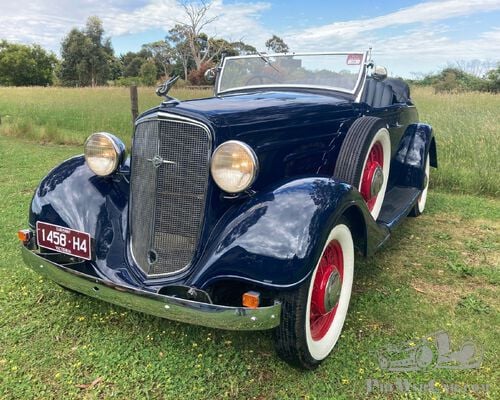
1934 Chevrolet Standard Roadster
1934 Chevrolet Standard Roadster This vehicle was delivered to Australia from Chevrolet and the body was manufactured by Holden Body Works w..
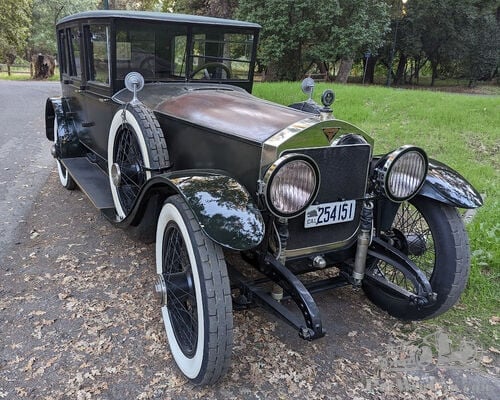
1916 Simplex, Crane model 5
1916 Simplex, Crane MODEL 5CUSTOM MADE HISTORIC PRESERVATION VEHICLE – READY TO TOUR!This Simplex recently completed th..
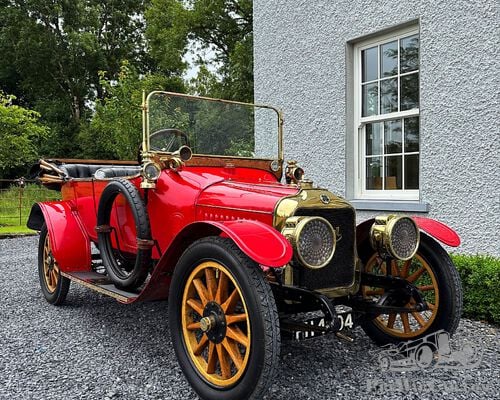
1914 Brasier
1914 Brasier Tourer 9ABrasier were a French manufacturer who were in business from 1901 until 1930, when the company became victim of the gr..