The global magazine and marketplace for classic car enthusiasts, by enthusiasts.


Filter
Classic Studebaker, Stutz for sale - Studebaker, Stutz cars for sale
-

Studebaker Commander Big Six 1928
A special and very beautiful Studebaker Commander from 1928, also known as the Big Six due to its powerful 5.8-liter 6-cylinder engine.The car was very well restored in the 1970s and subsequently won a senior award at the Hershey car show in 1973. After that, the car was purchased by a collector, well maintained, and used for several rall.. -
1914 Stutz 4E Bearcat | The Audrain Auction 2026
Chassis No. 2250 Engine No. AI-779 The 1911 Indianapolis 500 drew forty starters, most of them built by established firms with reputations to defend. Among them was a car assembled in roughly six weeks by a 34-year-old Ohio machinist who had never before sold a complete automobile, which he called the Bear Cat. It finished eleventh at .. -
1922 Stutz Series K DH Bearcat | The Quail Auction 2026
Car No. 10986 Engine No. 10986 Few American sporting cars of the Nickel Era carry the reputation of the Stutz Bearcat, and chassis number 10986 is one of the last to wear the name. Harry C. Stutz built his first racing car in just five weeks and entered it in the inaugural Indianapolis 500 in 1911, where Gil Andersen brought it home i.. -
1933 Stutz DV-32 Convertible Victoria by Rollston | RM Sotheby's | The Monterey Auction
To Be OFFERED AT AUCTION at RM Sothebys' The Monterey Auction event, 13 - 15 August 2026. $900,000 - $1,500,000 USD One of the most beautiful and important surviving Stutz automobilesThe only surviving example of this design on a DV-32 chassisFormerly owned by Harrah’s Automobile Collection, Andy Simo, and Terence E. Ad.. -
1929 STUTZ TYPE M VERTICAL EIGHT LANCEFIELD SALOON
1929 STUTZ TYPE M VERTICAL EIGHT LANCEFIELD SALOONChassis number: 40804Registration number: UX5747A very rare & desirable car; This Stutz was displayed on the Stutz stand at Olympia in 1929. The body is fabric covered in the weyman manner but was built by Lancefield & differentiates from Weymann in having four door .. -
1919 Studebaker Chummy Roadster
Model: chummy roadsterColour: soft yellow body with black mudguardsInterior: dark brown leatherEngine: in-line 6 cylinderTransmission: 3-speed manual transmissionCondition: body off restoredPrice € : 49,500,- Description:Beautifully restored car. Very special model because of its tou..


Studebaker
US/ CDN, 1902 – 1966
(1) Studebaker Corp, South Bend, Indiana, 1902 – 1954
(2) Studebaker-Packard Corp, South Bend, Indiana, 1954 – 1964
(3) Studebaker Corp of Canada Ltd, Hamilton, Ontario, 1964 – 1966
The brothers Henry and Clem Studebaker opened a blacksmith’s and wagon-building shop in South Bend in 1852, horse-drawn vehicles of their construction serving in both the American Civil War and World War 1, and production continuing until 1919. Their first Studebaker cars were electrics, made in modest numbers from 1902 to 1912: these Studebaker carwere joined in 1904 by the Model-C petrol Studebaker car, a typically American 16hp flat-twin with amidships engine, 2-speed gearbox, and chain drive. This Studebaker carwas followed a year later by a vertical 4 on more European lines, this Studebaker car was selling for $3.000. For the next few seasons, however, Studebaker electred to act as selling gents for Studebaker cars built to their order, and their more expensive offerings of Studebaker cars were built by Garford of Elyria. The cheaper machines were the EMF and Flanders built by the Everitt-Metzger-Flanders Co, and these two makes accounted for 9.700 Studebaker cars in 1910. 1913 saw a brace of Studebaker cars made at South Bend, both with sv monobloc engines, dual ignition, and electric lighting and starting: the 3-speed gearboxes on the Studebaker cars were mounted in unit with the back axles, and the 6-cylinder Studebaker car was claimed to be the first such car to retail in the USA for less than $2.000. In 1914 there was a smaller, 15/20hp Studebaker car with 3.2-litre 4 with coil ignition only. Studebaker sold over 45.000 Studebaker cars in 1915, and their sixth position in 1916 US sales was matched by a seventh place in 1920. 1919 was the last year for 4-cylinder Studebaker cars, and the 1920 Studebaker cars, while retaining separate gearboxes, abandoned the transaxle layout. Studebaker carmodels available were 6s of 4.7-litres and 5.8-litres, the latter establishing a line of really large 6-cylinder Studebaker cars which survived until 1928. An inexpensive 3.3-litre Studebaker Light 6 joined the range in 1921, and 1923 Studebaker cars had all-metal bodies with welded steel pressings. Balloon tyres were standardized on Studebaker cars in 1925, in which year contracting-type hydraulic front wheel brakes were an option: open Studebaker cars were made with permanent tops of the ‘California’ type and detachable side-curtains. Front wheel brakes were standard on the Studebaker carin 1926, but the Studebaker carcompany reverted to mechanical actuation in 1927, in which year a ‘compact’, the Studebaker Erskine, was marketed. Studebaker cars went after stock-car records in a big way in the later 1920s, an outstanding performance of a Studebaker car being 25.000 miles in 25.000 minutes. The 1929 range Studebaker cars consisted of two 6s, the ‘Studebaker Dictator’ and ‘Studebaker Commander’ (at $1.265 and $1.495 respectively), and a brace of straight-eights of 4-litres’ and 5.5-litres’ capacity. Pierce-Arrow was acquired by the Studebaker car company in 1928, but regained its independence five years later. In 1930 Studebaker cars, with Plymouth, pioneered the free wheel, offered initially on 8-cylinder Studebaker cars alone, but available throughout the range by the latter part of the year, when the cheapest Studebaker car, the Light 6, could be bought in England for £295.
Another compact Studebaker carappeared under the Rockne nameplate in 1932. Special versions of the ‘Studebaker President 8’ distinguished themselves in the Indianapolis 500-Mile Race. Cliff Bergere’s Studebaker Special finishing 3rd, while in 1933 6th to 12th places were filled by similar Studebaker cars. Studebaker cars went into receivership in 1933, but came back strongly in 1934 with an unattractively-styled three-model range of Studebaker cars – the 3.4-litre ‘Studebaker Dictator 6’, the 3.6-litre ‘Studebaker Commander 8’, and the 4.1-litre ‘Studebaker President 8 ‘, all with synchromesh, free wheel, and X-braced frames. Subsequent evolution of Studebaker cars followed accepted American lines: transverse independent front suspension, automatic overdrive, and hydraulic brakes once more in 1935: a hill-holder (modernized version of the sprag) in 1936: headlamps half-faired into the wings of the Studebaker car in 1938: and column change in 1939, when Raymond Loewy became responsible for the Studebaker car Corporation’s styling. 1939 was also the first year for one of America’s longest-lived modern economy cars, the 2.7-litre 6-cylinder sv ‘Studebaker Champion’ selling at $765. Fluid couplings was available on the 1942 Studebaker car range, which included Studebaker cars last straight-8s. The revolutionary post-war ‘coming or going’ style with wrap-around rear window on Studebaker cars was launched by Loewy on the 1946/ 1947 Studebaker cars with 2.8-litre and 3.7-litre 6-cylinder engines. Sales climbed to 239.000 Studebaker cars in 1949, and the inevitable ohv V8 – a relatively small one of 3.8-litres – replaced the bigger 6 in 1951 Studebaker cars. Studebaker car companys answer to the big battalions was the low and elegant line of the 1953 Studebaker cars, which unfortunately became more cluttered down the years, and finances were not impoved by the merger of the Studebaker car company with Packard in 1954. An interesting departure was the sporting ‘Studebaker Hawk’ coupé powered by Packard’s V8 engine and Ultramatic transmission in 1956: 1957 versions had blown Studebaker car engines, the only example of a factory-equipped super-charger (save the 1954 Kaiser) since the Graham. The Studebaker car company managed to get their ‘Studebaker Lark’ compact sedan tooled and into production in ten months in 1959, and this descendant of the old sv ‘Champion’ was the only Studebaker car now offered with the exception of the ‘Studebaker Hawk’. The small 6 Studebaker car achieved ohv at long last in 1961, and 1962 saw the exciting fiberglass-bodied ‘Studebaker Avanti’ coupé with disc brakes on the front wheels, a 4-speed gearbox, and optional supercharger. The Studebaker car annexed 29 stock-car records, including a flying mile at 168.15mph, but neither this nor the continuing ‘Lark’ range could save Studebaker cars. A wide choice of Studebaker car models – two 6s and three 8s – was listed for 1964, but early in the season South Bend stopped making Studebaker cars, and production was transferred to the Canadian plant which had been assembling Studebaker cars since 1912. Even as an ‘import’, the Studebaker car did not sell well: the last examples of the Studebaker car marque had 3.2-litre 6-cylinder and 4.7-litre 8-cylinder Chevrolet engines, but even these were abandoned in the spring of 1966. Production of the ‘Studebaker Avanti’ was continued on a small scale by an independent factory in South Bend.
Source: Georgano, encyclopedia of motorcar; MCS
The information is written with the greatest of care. However, if you have any suggested amendments please contact us at office@prewarcar.com
Stutz
US, 1911 – 1935
(1) Ideal Motor Car Co, Indianapolis, Ind., 1911 – 1913
(2) The Stutz Motor Car Co of America, Indianapolis, Ind., 1913 – 1935
The Ideal Motor Car Company was the name of the firm which made the first racing Stutz cars, but it was changed to the Stutz Motor Car Company in 1913. Harry C. Stutz’ most famous passenger Stutz car was the Stutz Bearcat speedster of 1914 – this Stutz car is probably the best known of all American sports cars. The Stutz car followed the usual recipe of a low-hung chassis, a big, slow-turning proprietary engine (in this case, a T-head, 4-cylinder Wisconsin unit, producing 60bhp at 1.500rpm), and very little else, just a bonnet, wings, raked steering column, two bucket seats, and a fuel tank behind them. A Stutz-made 3-speed gearbox was integral with the rear axle; an uncommon feature. This component had been sold by the Stutz car company before he made complete Stutz cars. A 6.2-litre 6-cylinder engine was available on the Stutz car, but seldom seen. The Stutz Bearcat was the most popular of its breed, in spite of its high price, and the appeal of the Stutz car was boosted by Stutz cars successes with ohc, 16-valve racing cars. The Stutz car was the Mercers’ greatest rival. Touring Stutz cars were made as well, but these Stutz cars were comparatively little known. Total production grew from 759 Stutz cars in 1913 to 2207 Stutz cars in 1917. Two years later, Stutz left to make another car, the HCS, although the cheaper Stutz cars of the 1915 period were also known as H.C.S. The gearbox was moved back on the Stutz car to the normal position in 1921, and shortly after this Stutz cars began making their own engines: an sv four giving 88bhp and a 75bhp ovh six. The latter was developed to give 80bhp in the 4.7-litre Speedway Six Stutz car of 1924, the last Stutz car of the old line.
In 1926, there was a change of management within the Stutz car company, and Frederick E. Moskovics, the new president, initiated a radiacally new Stutz car policy. Paul Bastien, who had designed the splendid 2-litre Métallurgique from Belgium, was responsible for the Stutz AA, or Vertical Eight Stutz car. This Stutz car was a beautifully-made fast tourer, more typical of Europe than America. Its specification embraced a straight-8 4.7-litre engine with a single overhead camshaft, and dual ignition, including two plugs per cylinder. Power output of this Stutz car was 92bhp at 3.000rpm. This was a modern, reasonably efficient engine by any standards, and the Stutz car was distinctly advanced in these respects by American standards. There were, however, only 3 forward speeds on the Stutz car. The hydraulic brakes were very good indeed, and the underslung worm final drive allowed the fitting of low-built, good-looking bodies on Stutz cars. Centralized chassis lubrication and safety glass were provided. Glamorous though the AA Stutz car was, the Stutz car was sold on the slogan of ‘The Safety Stutz’, and a year’s free passenger insurance was given with each Stutz car. In 1927, the engine of the Stutz car was enlarged to 4.9-litres, now giving 95bhp, and a speedster option, the Stutz Black Hawk, was added. In the following year, Weymann fabric body construction was adopted on Stutz cars; another European touch. The engine of the Stutz car was enlarged again in 1929 and this made 113bhp available. Better still, this Stutz car had 4-forward speeds. Special Stutz Black Hawk speedsters were 2nd at Le Mans in 1928, but the Stutz cars came no higher than 5th in 1929. These Stutz cars had Roots superchargers and vacuum servo brakes. This Stutz car was put on sale as the Stutz Bearcat, reviving a famous name. Stutz cars also competed at Le Mans in 1930, 1931 and 1932. Unfortunately, a Stutz car lost a well-publicized challenge match at Indianapolis with a Hispano-Suiza, and Frank Lockhart was killed at Daytona Beach while trying to take the World Land Speed Record with a Miller-engined car built by the Stutz car company, both setbacks taking place in 1928.
Sales of Stutz cars fell, and a range of cheaper Stutz carmodels with, it was hoped, wider appeal was introduced for the next year, alongside the existing Stutz car range. These Stutz cars had little in common with the classic models, so were called Black Hawks, not Stutz cars. One used a 6-cylinder, ohc engine of 4 litres’ capacity made by Stutz car company, and the other a straight-8 sv unit by Continental. At the other end of the scale, there appeared in 1931 the superb DV (dual valve) 32 Stutz car, to compete with the new multi-cylinder Stutz cars being brought out by Lincoln, Cadillac, Marmon, and others. The Stutz car design was basically similar to that of the SV16 Stutz car, still current, but there were two overhead camshafts and four valves per cylinder: 32 Stutz cars in all. The DV32 Stutz car was listed in speedster form, as the Stutz Bearcat, and, on the shorter chassis, as the Stutz Super Bearcat. These stubby, formidable Stutz cars were guaranteed to exceed 100mph. The expensive, high-quality, specialist Stutz went the way of most of its kind in the Depression years. Intead, the Stutz car company sold, and later made a light delivery van, called the Pak-Age car. This had a rear engine and all-independent suspension, and was current from 1928 to 1938, after which manufacture was taken over by Diamond T.
US, 1970 to date
Stutz Motor Car of America, New York, N.Y.
Unlike replica cars such as the Auburn and Cord, the makers of the Stutz Blackhawk coupé merely borrowed the name of the pre-war Stutz car for their machine. The Stutz car was powered by a 6½-litre Pontiac V8 engine stripped and modified so that the original output of 365bhp was raised to 425bhp. This was mounted in a modified Pontiac chassis, and the Virgil Exner-designed body was hand-built by Carrozzeria Padana of Modena, Italy, where the final assembly of the Stutz cars was done. The first Stutz car model, the 2-door hardtop, was priced at $22.500; a new Stutz car model for 1972 was a 4-door saloon using an long wheel base Cadillac chassis, and selling for $31.250.
Source: Georgano, encyclopedia of motorcar; TRN, GNG
The information is written with the greatest of care. However, if you have any suggested amendments please contact us at office@prewarcar.com


Featured
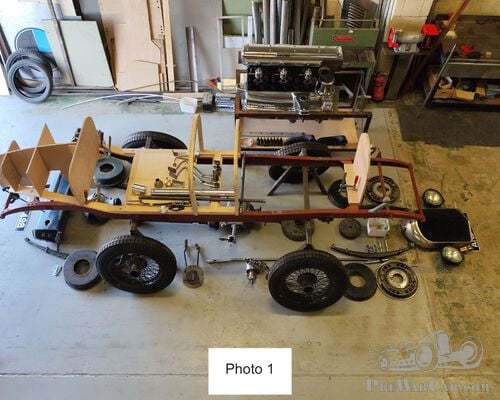
Bentley 3/6 litre sports racing car kit with V5C
I am a specialist vintage and classic car restorer with decades of hands-on experience. For some time I have been collecting parts for a special pr..
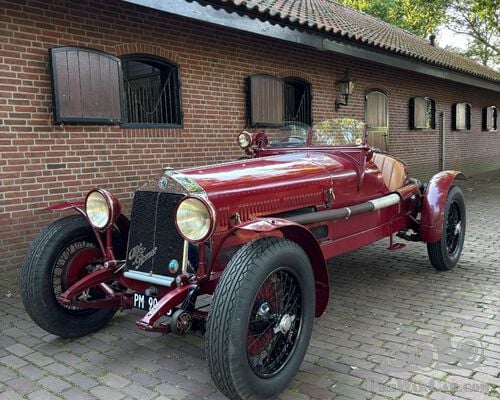
1930 Alfa Romeo 6C 1750 Spider
1930 Alfa Romeo 6C 1750 Spider with complete history from delivery to first owner in 1930 in Firenze till today with copy Libretto/license plate.
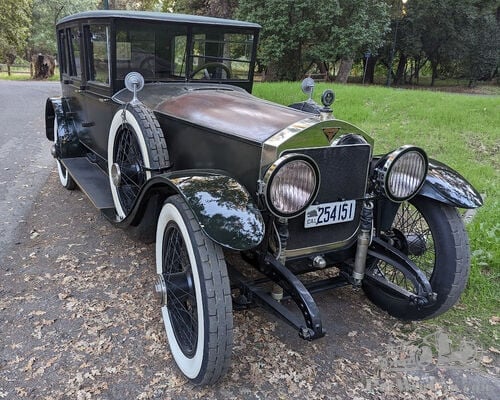
1916 Simplex, Crane model 5
1916 Simplex, Crane MODEL 5CUSTOM MADE HISTORIC PRESERVATION VEHICLE – READY TO TOUR!This Simplex recently completed th..