The global magazine and marketplace for classic car enthusiasts, by enthusiasts.


Filter
Classic Sunbeam, Studebaker for sale - Sunbeam, Studebaker cars for sale
-

1924 Sunbeam 4.5 litre 24/70 tourer
1924 Sunbeam 4.5 litre 24/70 tourer Chassis Number: 7079DRegistration number: BF7480 A magnificent late 4.5 litre Sunbeam tourer. The car was first supplied to the antipodes in engine & chassis form, prior to receiving its current Australian body. It is featured in the recognised authority o.. -
Studebaker Commander Big Six 1928
A special and very beautiful Studebaker Commander from 1928, also known as the Big Six due to its powerful 5.8-liter 6-cylinder engine.The car was very well restored in the 1970s and subsequently won a senior award at the Hershey car show in 1973. After that, the car was purchased by a collector, well maintained, and used for several rall.. -
1919 SUNBEAM 24HP 4 1/2 LITRE TOURER BY BREWSTER.
1919 Sunbeam 24hp 4 1/2 Litre Tourer by Brewster. Chassis number: 24/5124/19 Registration Number: DA3651 TRULY EXCEPTIONAL & LIKE NEW!!! The recipient of a massive £160,000 restoration over four years with the majority of the mechanical works being undertaken by noted vintage specialists VBE restorations. A massive sheaf of.. -
1926 Sunbeam Super-Sports 3 Litre Twin Cam
Year: 1926 Chassis No:4163GF Engine No:4017F Car No: 18689 U.K. Registration No: YM4066 Coachwork: Original Open Touring Factory The Wolverhampton based Sunbeam Motorcar Company traded from 1899-1935. During that short 36 year period they produced some of the most important and well engineered motorcars ever to be designed and built in G.. -
1919 Studebaker Chummy Roadster
Model: chummy roadsterColour: soft yellow body with black mudguardsInterior: dark brown leatherEngine: in-line 6 cylinderTransmission: 3-speed manual transmissionCondition: body off restoredPrice € : 49,500,- Description:Beautifully restored car. Very special model because of its tou..


Sunbeam
GB, 1899 – 1937, 1953 to date
(1) John Marston Ltd, Wolverhampton, Staffs., 1899 – 1905
(2) Sunbeam Motor Car Co Ltd, Wolverhampton, Staffs., 1905 – 1935
(3) Sunbeam Motors Ltd, London W.11, 1936 – 1937
(4) Sunbeam-Talbot Ltd, Ryton-on-Dunsmore, Warwickshire, 1953 – 1970
(5) Chrysler United Kingdom Ltd, Ryton-on-Dunsmore, Warwickshire, 1970 to date
John Marston’s tinplate and japanware firm, which had been making bicycles since 1887, built its first 4hp belt-driven prototype Sunbeam car in 1899, followed by another machine with a twin-cylinder engine in 1901. The first model Sunbeam car to see series production was, however, the diamond-formation and allegedly skidproof Sunbeam-Mabley voiturette with 2¾hp De Dion engine, a number of which were sold for £130 in the 1901-1904 period. More conventional was the 12hp Sunbeam car marketed under T.C. Pullinger’s direction in 1903, which was based on a Berliet design and had a flitch-plate frame, chain drive with Sunbeam cars patent oil-bath chain cases, and a 2.4-litre 4-cylinder engine with automatic inlet valves. A 3.6-litre 6-cylinder Sunbeam car was on the market briefly in 1904, but Sunbeam cars soon progressed to Shaw-designed T-head fours, though another short-lived six Sunbeam car appeared in 1907. Sunbeam cars great years started in 1909 when Louis Coatalen joined the Sunbeam car firm from Hillman. In that season the Sunbeam car company was offering three L-head fours with chain drive, and capacities of 3.4, 4.5 and 6.3-litres, plus an odd 3.2-litre twin-cylinder Station Cart Sunbeam car. Coatalen’s first effort was a T-headed 14/18hp Sunbeam car, available with either shaft or chain drive. This Sunbeam car was followed a year later by a 2.4-litre 12/16 on similar lines, but with pressure lubrication and on overdrive gearbox, while overhead valves were tried out on a racing Sunbeam car, the Nautilus, at Brooklands in 1910. An improved 12/16 Sunbeam car of 3-litres’ capacity with monobloc engine ran in the 1911 Coupe de l’Auto race, foreshadowing an immensely successful touring development which Sunbeam car sold initially for £375. This Sunbeam car had an L-head engine and was made up to 1921. In 74bhp racing guise the Sunbeam car scored 1-2-3 victory in the 1912 Coupe de l’Auto, following this up with a 3rd place in 1913. In 1914 Sunbeam car company built Henri-inspired twin-ohc 4-cylinder racers both for the Tourist Trophy and for the French Grand Prix, and at the outbreak of World War 1 the Sunbeam car range consisted of the 12/16 in standard and sporting forms, a 4-litre 16/20 Sunbeam car of similar general design, and a 6.1-litre 6-cylinder Sunbeam car rated at 25/30hp, all offered with electric lighting. The Sunbeam car company concentrated on aero engines during the war years, though a 4.9-litre twin-ohc 6-cylinder Sunbeam ca was sent to Indianapolis in 1916 and took 3rd place, while Rovers took over production of the 12/16 for the Flighting Services. Renamed the 16, this Sunbeam car reappeared in civilian form with full electrical equipment at £790, along with a smaller vesion of the pre-war 25/30 Sunbeam car powered by a 4½-litre engine.
The Sunbeam car company amalgamated with Talbot and Darracq in 1920 to form the STD combine, and the next five years saw an energetic racing programme of Sunbeam cars. Twin-ohc 108bhp straight-8 Sunbeam cars were made for the 3-litre formula of the immediate post-war years, followed by some unsuccessful 2-litre fours, and finally the twin-ohc 6-cylinder ‘Fiats in green paint’, designed by Bertarione, which won the French and Spanish GPs in 1923, and this Sunbeam car ran supercharged in 1924, as well as having a long and distinguished competition career in later years. Chassagne won the Tourist Trophy on a 3-litre straight-8 Sunbeam car in 1922, while one of the regular 3-litre sports Sunbeam cars finished 2nd at Le Mans in 1925. Sunbeam cars took the World’s Land Speed Record five times in the 1922-1927 period: Lee Guiness started with 133.75mph on the 350hp V12 sprint Sunbeam car, a figure which Campbell subsequently raised, first to 146mph on the 4-litre V12, a Sunbeam car which was also used for road racing, and the following year he became the first man to exceed 200mph on land with the twin-engined chain-drive 45-litre Sunbeam car. Sunbeam cars last record car, the Silver Bullet of 1930, was unsuccessful.
Touring Sunbeam carss of the 1920s were cars of great refinement if not outstanding performance. The basic 16 and 24hp types Sunbeam cars were redesigned with push-rod overhead valves in 19222, ohc sporting versions being also listed, while a more modest 2-litre 14hp Sunbeam car with unit gearbox was available at £725. Front-wheel brakes arried on the 6-cylinder 16/50 Sunbeam car in 1924, and were optional also on the 14/40 Sunbeam car which replaced the 14hp model. An impressive 3-litre 6-cylinder twin-ohc sports Sunbeam car with dry-sump engine was made in small numbers between 1925 and 1930, but the Sunbeam car was ‘too fast for its chassis’ as well as being expensive to make and buy. A big straight-8 Sunbeam car with a push-rod engine, available in 4.8-litre and 5.4-litre forms, was introduced in 1926 at prices from £1.295 up and front-wheel brakes became standard on all Sunbeam cars. All Sunbeam cars had the V-radiator by 1927, when the fours were dropped, and the standard touring sixes were the 2-litre 16hp at £550, the 2.9-litre 20hp Sunbeam car at £750, and the 3.6-litre 25hp at £950, all with plate clutches, spiral bevel final drive, and cantilever rear suspension. Thereafter Sunbeam car design changed little, and sales of Sunbeam cars declined though quality was maintained. Semi-elliptic springs were found at the rear of the smaller 1930 Sunbeam carmodels, in 1931 the Sunbeam cars acquired hydraylic brakes and radiator shutters, and the 16’s engine was enlarged to 2.2-litres. The 1932 Sunbeam cars’ silent-third gearboxes gave way to synchromesh on 1933 16 and 20hp Sunbeams. That year there was also a 2.9-litre Speed Model Sunbeam car with crash box at £745, though its main competitor was STD’s other fast tourer, the Talbot 105. The old Sunbeam car firm’s last new model was a ponderous 1.6-litre ohv four, the Sunbeam Dawn of 1934, with preselector gearbox and independent front suspension. This Sunbeam car was offered again in 1935, along with the 20, the 25, and the Speed Model, but the collapse of the STD combine brought receivership and purchased by Rootes, and an ohv Roesch-designed 4½-litre straight-8 Sunbeam car announced for 1937 never went into production. There were no Sunbeams in 1938, and when the Sunbeam-Talbot range was announced for 1939 the Sunbeam car was based on the later Rootes Talbots.
The name of Sunbeam cars did not reappear until 1953, when it was given to a sports two-seater Sunbeam car of the 2.3-litre ohv 4-cylinder Sunbeam-Talbot 90, the Sunbeam Alpine, which sold for £1.269, and this Sunbeam car collected four Coupes des Alpes in that year’s Alpine Rally, following this up with a Gold Cup (for Stirling Moss) and a Coupe des Dames (for Sheila Van Damm) in 1954. In 1955 the basic 90 saloon Sunbeam car was marketed as the Sunbeam MK III, and further laurels included the Malling/ Fadum win in that year’s Monte Carlo rally. The type Sunbeam car was listed until 1957, being joined in 1956 by a Hillman Minx-based sports saloon, the Sunbeam Rapier, with a 1.4-litre square 4-cylinder 62bhp engine, unitary construction, and overdrive as standard equipment, at £986. This Sunbeam car did well in subsequent Alpines and Monte Carlo Rallies, as well as winning its class in the 1956 Mille Miglia, and by 1958 the Sunbeam car had grown up to 1½-litres and 68bhp, acquiring a less Hillman-like grill in the process, though overdrive was now an extra. A sports two-seater Sunbeam car, another Alpine, with integral construction, was listed for 1960, and subsequent evolution was on regular Rootes lines: diaphragm clutches in 1964, with the option of automatic on the Alpine, all-synchromesh gearboxes in 1965, and 1.7-litre 5-bearing engines in 1966. 1964 brought two new developments of the basic theme Sunbeam car, an Italian-bodied Venezia sports saloon based on the Humber Sceptre, and the Tiger Sunbeam car, which was an Alpine with rack-and-pinion steering and a 4.3-litre, 164bhp Ford V8 engine, this despite the Rootes-Chrysler conncection. In 1966, the Rapier V, Alpine V, and Tiger comprised the Sunbeam car name. A 51bhp Sunbeam car-version of the Imp was available in the home market in 1967, and this Sunbeam car was followed by the more sporting Stiletto coupé for 1968.
An entirely new Rapier Sunbeam car on Hillman Hunter lines was announced for that year, its fastback styling inspired by Plymouth’s Barracuda. It had an 88bhp engine, a close-ratio gearbox, and overdrive as standard.
During 1968 the old Sunbeam Alpine was discontinued (the Tiger had already gone), and the Rapier range was rounded out, first by the H120 of 1969 with twin-carburettor Holbay-tuned engine giving 105bhp and Rostyle wheels, and then by the Alpine, a simplified version of the basic theme introduced for 1970. These three fastback Sunbeam cars were still being made in 1973, along with the Sunbeam Sport based on the Imp saloon. The Stiletto was discontinued during 1972.
Source: Georgano, encyclopedia of motorcar; MCS
The information is written with the greatest of care. However, if you have any suggested amendments please contact us at office@prewarcar.com
Studebaker
US/ CDN, 1902 – 1966
(1) Studebaker Corp, South Bend, Indiana, 1902 – 1954
(2) Studebaker-Packard Corp, South Bend, Indiana, 1954 – 1964
(3) Studebaker Corp of Canada Ltd, Hamilton, Ontario, 1964 – 1966
The brothers Henry and Clem Studebaker opened a blacksmith’s and wagon-building shop in South Bend in 1852, horse-drawn vehicles of their construction serving in both the American Civil War and World War 1, and production continuing until 1919. Their first Studebaker cars were electrics, made in modest numbers from 1902 to 1912: these Studebaker carwere joined in 1904 by the Model-C petrol Studebaker car, a typically American 16hp flat-twin with amidships engine, 2-speed gearbox, and chain drive. This Studebaker carwas followed a year later by a vertical 4 on more European lines, this Studebaker car was selling for $3.000. For the next few seasons, however, Studebaker electred to act as selling gents for Studebaker cars built to their order, and their more expensive offerings of Studebaker cars were built by Garford of Elyria. The cheaper machines were the EMF and Flanders built by the Everitt-Metzger-Flanders Co, and these two makes accounted for 9.700 Studebaker cars in 1910. 1913 saw a brace of Studebaker cars made at South Bend, both with sv monobloc engines, dual ignition, and electric lighting and starting: the 3-speed gearboxes on the Studebaker cars were mounted in unit with the back axles, and the 6-cylinder Studebaker car was claimed to be the first such car to retail in the USA for less than $2.000. In 1914 there was a smaller, 15/20hp Studebaker car with 3.2-litre 4 with coil ignition only. Studebaker sold over 45.000 Studebaker cars in 1915, and their sixth position in 1916 US sales was matched by a seventh place in 1920. 1919 was the last year for 4-cylinder Studebaker cars, and the 1920 Studebaker cars, while retaining separate gearboxes, abandoned the transaxle layout. Studebaker carmodels available were 6s of 4.7-litres and 5.8-litres, the latter establishing a line of really large 6-cylinder Studebaker cars which survived until 1928. An inexpensive 3.3-litre Studebaker Light 6 joined the range in 1921, and 1923 Studebaker cars had all-metal bodies with welded steel pressings. Balloon tyres were standardized on Studebaker cars in 1925, in which year contracting-type hydraulic front wheel brakes were an option: open Studebaker cars were made with permanent tops of the ‘California’ type and detachable side-curtains. Front wheel brakes were standard on the Studebaker carin 1926, but the Studebaker carcompany reverted to mechanical actuation in 1927, in which year a ‘compact’, the Studebaker Erskine, was marketed. Studebaker cars went after stock-car records in a big way in the later 1920s, an outstanding performance of a Studebaker car being 25.000 miles in 25.000 minutes. The 1929 range Studebaker cars consisted of two 6s, the ‘Studebaker Dictator’ and ‘Studebaker Commander’ (at $1.265 and $1.495 respectively), and a brace of straight-eights of 4-litres’ and 5.5-litres’ capacity. Pierce-Arrow was acquired by the Studebaker car company in 1928, but regained its independence five years later. In 1930 Studebaker cars, with Plymouth, pioneered the free wheel, offered initially on 8-cylinder Studebaker cars alone, but available throughout the range by the latter part of the year, when the cheapest Studebaker car, the Light 6, could be bought in England for £295.
Another compact Studebaker carappeared under the Rockne nameplate in 1932. Special versions of the ‘Studebaker President 8’ distinguished themselves in the Indianapolis 500-Mile Race. Cliff Bergere’s Studebaker Special finishing 3rd, while in 1933 6th to 12th places were filled by similar Studebaker cars. Studebaker cars went into receivership in 1933, but came back strongly in 1934 with an unattractively-styled three-model range of Studebaker cars – the 3.4-litre ‘Studebaker Dictator 6’, the 3.6-litre ‘Studebaker Commander 8’, and the 4.1-litre ‘Studebaker President 8 ‘, all with synchromesh, free wheel, and X-braced frames. Subsequent evolution of Studebaker cars followed accepted American lines: transverse independent front suspension, automatic overdrive, and hydraulic brakes once more in 1935: a hill-holder (modernized version of the sprag) in 1936: headlamps half-faired into the wings of the Studebaker car in 1938: and column change in 1939, when Raymond Loewy became responsible for the Studebaker car Corporation’s styling. 1939 was also the first year for one of America’s longest-lived modern economy cars, the 2.7-litre 6-cylinder sv ‘Studebaker Champion’ selling at $765. Fluid couplings was available on the 1942 Studebaker car range, which included Studebaker cars last straight-8s. The revolutionary post-war ‘coming or going’ style with wrap-around rear window on Studebaker cars was launched by Loewy on the 1946/ 1947 Studebaker cars with 2.8-litre and 3.7-litre 6-cylinder engines. Sales climbed to 239.000 Studebaker cars in 1949, and the inevitable ohv V8 – a relatively small one of 3.8-litres – replaced the bigger 6 in 1951 Studebaker cars. Studebaker car companys answer to the big battalions was the low and elegant line of the 1953 Studebaker cars, which unfortunately became more cluttered down the years, and finances were not impoved by the merger of the Studebaker car company with Packard in 1954. An interesting departure was the sporting ‘Studebaker Hawk’ coupé powered by Packard’s V8 engine and Ultramatic transmission in 1956: 1957 versions had blown Studebaker car engines, the only example of a factory-equipped super-charger (save the 1954 Kaiser) since the Graham. The Studebaker car company managed to get their ‘Studebaker Lark’ compact sedan tooled and into production in ten months in 1959, and this descendant of the old sv ‘Champion’ was the only Studebaker car now offered with the exception of the ‘Studebaker Hawk’. The small 6 Studebaker car achieved ohv at long last in 1961, and 1962 saw the exciting fiberglass-bodied ‘Studebaker Avanti’ coupé with disc brakes on the front wheels, a 4-speed gearbox, and optional supercharger. The Studebaker car annexed 29 stock-car records, including a flying mile at 168.15mph, but neither this nor the continuing ‘Lark’ range could save Studebaker cars. A wide choice of Studebaker car models – two 6s and three 8s – was listed for 1964, but early in the season South Bend stopped making Studebaker cars, and production was transferred to the Canadian plant which had been assembling Studebaker cars since 1912. Even as an ‘import’, the Studebaker car did not sell well: the last examples of the Studebaker car marque had 3.2-litre 6-cylinder and 4.7-litre 8-cylinder Chevrolet engines, but even these were abandoned in the spring of 1966. Production of the ‘Studebaker Avanti’ was continued on a small scale by an independent factory in South Bend.
Source: Georgano, encyclopedia of motorcar; MCS
The information is written with the greatest of care. However, if you have any suggested amendments please contact us at office@prewarcar.com


Featured
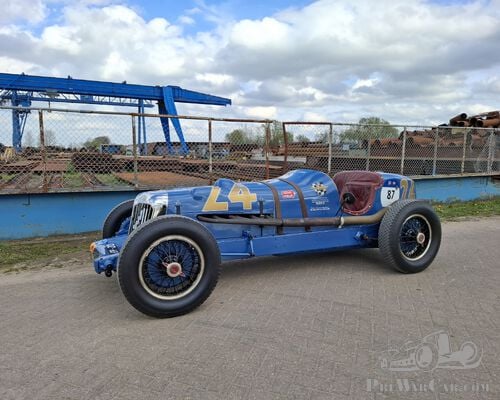
1932 - Graham " Lucenti " Indianapolis
Original participant of the 1932, 1934 and 1935 Indy 500. Best result: finishing 10th overall in the 1934 Indy 500 with driver “Herb” Ardinger...
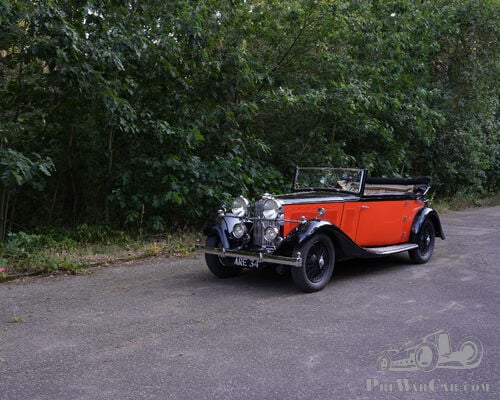
1934 Talbot AV105 Three Position Drophead Coupé
Registration no. ARE 34Chassis no. 35488 Much supporting paperworkRestored exampleVery usa..
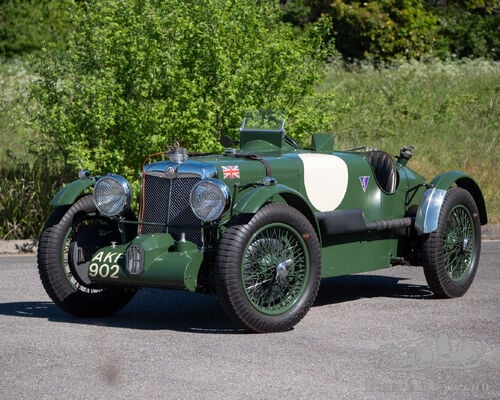
K3 Replica on KN Chassis
"The K3 Magnette must rank in the history books as the most famous and successful of all the record breaking MGs. With only 33 examples produced durin..