The global magazine and marketplace for classic car enthusiasts, by enthusiasts.


Filter
Classic Stutz, Vulcan for sale - Stutz, Vulcan cars for sale
-

1929 STUTZ TYPE M VERTICAL EIGHT LANCEFIELD SALOON
1929 STUTZ TYPE M VERTICAL EIGHT LANCEFIELD SALOONChassis number: 40804Registration number: UX5747A very rare & desirable car; This Stutz was displayed on the Stutz stand at Olympia in 1929. The body is fabric covered in the weyman manner but was built by Lancefield & differentiates from Weymann in having four door .. -
1933 Stutz DV-32 Convertible Victoria by Rollston | RM Sotheby's | The Monterey Auction
To Be OFFERED AT AUCTION at RM Sothebys' The Monterey Auction event, 13 - 15 August 2026. $900,000 - $1,500,000 USD One of the most beautiful and important surviving Stutz automobilesThe only surviving example of this design on a DV-32 chassisFormerly owned by Harrah’s Automobile Collection, Andy Simo, and Terence E. Ad..


Stutz
US, 1911 – 1935
(1) Ideal Motor Car Co, Indianapolis, Ind., 1911 – 1913
(2) The Stutz Motor Car Co of America, Indianapolis, Ind., 1913 – 1935
The Ideal Motor Car Company was the name of the firm which made the first racing Stutz cars, but it was changed to the Stutz Motor Car Company in 1913. Harry C. Stutz’ most famous passenger Stutz car was the Stutz Bearcat speedster of 1914 – this Stutz car is probably the best known of all American sports cars. The Stutz car followed the usual recipe of a low-hung chassis, a big, slow-turning proprietary engine (in this case, a T-head, 4-cylinder Wisconsin unit, producing 60bhp at 1.500rpm), and very little else, just a bonnet, wings, raked steering column, two bucket seats, and a fuel tank behind them. A Stutz-made 3-speed gearbox was integral with the rear axle; an uncommon feature. This component had been sold by the Stutz car company before he made complete Stutz cars. A 6.2-litre 6-cylinder engine was available on the Stutz car, but seldom seen. The Stutz Bearcat was the most popular of its breed, in spite of its high price, and the appeal of the Stutz car was boosted by Stutz cars successes with ohc, 16-valve racing cars. The Stutz car was the Mercers’ greatest rival. Touring Stutz cars were made as well, but these Stutz cars were comparatively little known. Total production grew from 759 Stutz cars in 1913 to 2207 Stutz cars in 1917. Two years later, Stutz left to make another car, the HCS, although the cheaper Stutz cars of the 1915 period were also known as H.C.S. The gearbox was moved back on the Stutz car to the normal position in 1921, and shortly after this Stutz cars began making their own engines: an sv four giving 88bhp and a 75bhp ovh six. The latter was developed to give 80bhp in the 4.7-litre Speedway Six Stutz car of 1924, the last Stutz car of the old line.
In 1926, there was a change of management within the Stutz car company, and Frederick E. Moskovics, the new president, initiated a radiacally new Stutz car policy. Paul Bastien, who had designed the splendid 2-litre Métallurgique from Belgium, was responsible for the Stutz AA, or Vertical Eight Stutz car. This Stutz car was a beautifully-made fast tourer, more typical of Europe than America. Its specification embraced a straight-8 4.7-litre engine with a single overhead camshaft, and dual ignition, including two plugs per cylinder. Power output of this Stutz car was 92bhp at 3.000rpm. This was a modern, reasonably efficient engine by any standards, and the Stutz car was distinctly advanced in these respects by American standards. There were, however, only 3 forward speeds on the Stutz car. The hydraulic brakes were very good indeed, and the underslung worm final drive allowed the fitting of low-built, good-looking bodies on Stutz cars. Centralized chassis lubrication and safety glass were provided. Glamorous though the AA Stutz car was, the Stutz car was sold on the slogan of ‘The Safety Stutz’, and a year’s free passenger insurance was given with each Stutz car. In 1927, the engine of the Stutz car was enlarged to 4.9-litres, now giving 95bhp, and a speedster option, the Stutz Black Hawk, was added. In the following year, Weymann fabric body construction was adopted on Stutz cars; another European touch. The engine of the Stutz car was enlarged again in 1929 and this made 113bhp available. Better still, this Stutz car had 4-forward speeds. Special Stutz Black Hawk speedsters were 2nd at Le Mans in 1928, but the Stutz cars came no higher than 5th in 1929. These Stutz cars had Roots superchargers and vacuum servo brakes. This Stutz car was put on sale as the Stutz Bearcat, reviving a famous name. Stutz cars also competed at Le Mans in 1930, 1931 and 1932. Unfortunately, a Stutz car lost a well-publicized challenge match at Indianapolis with a Hispano-Suiza, and Frank Lockhart was killed at Daytona Beach while trying to take the World Land Speed Record with a Miller-engined car built by the Stutz car company, both setbacks taking place in 1928.
Sales of Stutz cars fell, and a range of cheaper Stutz carmodels with, it was hoped, wider appeal was introduced for the next year, alongside the existing Stutz car range. These Stutz cars had little in common with the classic models, so were called Black Hawks, not Stutz cars. One used a 6-cylinder, ohc engine of 4 litres’ capacity made by Stutz car company, and the other a straight-8 sv unit by Continental. At the other end of the scale, there appeared in 1931 the superb DV (dual valve) 32 Stutz car, to compete with the new multi-cylinder Stutz cars being brought out by Lincoln, Cadillac, Marmon, and others. The Stutz car design was basically similar to that of the SV16 Stutz car, still current, but there were two overhead camshafts and four valves per cylinder: 32 Stutz cars in all. The DV32 Stutz car was listed in speedster form, as the Stutz Bearcat, and, on the shorter chassis, as the Stutz Super Bearcat. These stubby, formidable Stutz cars were guaranteed to exceed 100mph. The expensive, high-quality, specialist Stutz went the way of most of its kind in the Depression years. Intead, the Stutz car company sold, and later made a light delivery van, called the Pak-Age car. This had a rear engine and all-independent suspension, and was current from 1928 to 1938, after which manufacture was taken over by Diamond T.
US, 1970 to date
Stutz Motor Car of America, New York, N.Y.
Unlike replica cars such as the Auburn and Cord, the makers of the Stutz Blackhawk coupé merely borrowed the name of the pre-war Stutz car for their machine. The Stutz car was powered by a 6½-litre Pontiac V8 engine stripped and modified so that the original output of 365bhp was raised to 425bhp. This was mounted in a modified Pontiac chassis, and the Virgil Exner-designed body was hand-built by Carrozzeria Padana of Modena, Italy, where the final assembly of the Stutz cars was done. The first Stutz car model, the 2-door hardtop, was priced at $22.500; a new Stutz car model for 1972 was a 4-door saloon using an long wheel base Cadillac chassis, and selling for $31.250.
Source: Georgano, encyclopedia of motorcar; TRN, GNG
The information is written with the greatest of care. However, if you have any suggested amendments please contact us at office@prewarcar.com
Vulcan
GB, 1902 – 1928
(1) Vulcan Motor Manufacturing and Engineering Co Ltd, Southport, Lancs., 1902 – 1906
(2) Vulcan Motor and Engineering Co Ltd, Southport, Lancs., 1906 – 1928
The Vulcan car firm was better known for commercial vehicles. Private Vulcan cars stemmed from experiments conducted in the 1897-1899 period by the brothers Thomas and Joseph Hampson. A belt-driven single-cylinder voiturette Vulcan car with lateral radiators was shown in 1902, being replaced a year later by a 6hp Vulcan car with armoured wood frame, mechanically-operated inlet valves, and shaft drive. This Vulcan car was listed at only £105, and this Vulcan car was soon followed by a 10hp twin, also T-headed but with a steel frame, selling for £200. 4-cylinder Vulcan cars of 12 and 16hp, still modestly priced, were available in 1905, while the biggest 1906 Vulcan cars, with capacities of 3.1- and 5.2-litres, had gate change. No 2-cylinder Vulcan cars were catalogued after 1908, but a year previously Vulcan cars had joined the ranks of 6-cylinder manufacturers with a 4.8-litre T-headed machine featuring dual ignition and cone clutch, at £600 for a Vulcan car chassis. Unlike other makers, Vulcan cars retained their interest in this type, which Vulcan car had acquired a 4-speed box and had grown to 6-litres by 1908, and the 1909 Vulcan car range consisted of four 4-cylinder cars and the six, all shaft-driven and still with T-heads; the smallest Vulcan car, rated at 12hp, had a 3-speed gearbox and worm drive. A new 3.6-litre six Vulcan car with unit gearbox and worm drive followed in 1911, along with an L-head 2.4-litre fifteen. Worm drive was standardized on the 1912 Vulcan cars, when the bigger Vulcan cars had T-heads, and a 1.8-litre, 2-cylinder with an Aster engine was offered. All but the smallest Vulcan car had detachable wheels as standard in 1913, and by the outbreak of World War 1 the Vulcan car company was well established with a range of solidly-built Vulcan cars: a 2.4-litre 10/15, a 2.6-litre 15.9, and a 3-litre monobloc 15/20 Vulcan car at £375. All these Vulcan cars had L-heads and bull-nose radiators, though the similarly styled six retained the older Vulcan car configuration. A 1½-litre Vulcanette with a 3-speed rear-axle gearbox and full electrical equipment was announced for 1915 but the war intervened.
After 1918 the Vulcan car company concentrated increasingly on trucks, and a brief association with the Harper Bean Group (1919-1920) did no good to finances. Some odd experiments by Vulcan cars included a worm-drive 3½-litre V8 tourer Vulcan car intended to sell for £625 (1919), and two Vulcan cars in 1922 with Howard sleeve-valve engines, a big 3.6-litre sports-touring four Vulcan car and a 10hp 1.4-litre flat-twin listed at £315. However, none of these Vulcan cars reached the public, the regular Vulcan car lines being a 1.8-litre ohv 12 and a 2.6-litre sv 16/20, both with Dorman engines. There was also a conservative 20hp Vulcan carmodel with the Vulcan car company’s own 3.3-litre sv fixed-head engine and 4-speed separate gearbox, this Vulcan car was selling for £850 in 1921; by this time flat radiators were again being used on Vulcan cars. The Vulcan 20 was available to military order with full wireless equipment in 1923, in which year C.B. Wardman effected a liaison of Vulcan cars and Lea-Francis. The two companies pooled their dealer network, Vulcan cars became responsible for certain Lea-Francis power units and bodies, and Lea-Francis made gear and steering boxes for Vulcan cars. A 1½-litre sv Dorman-engined Vulcan 12 was listed at £295 in 1925, followed a year later by an ohv worm-driven derivative, also with Dorman engine, and looking very like a Lea-Francis. 4-wheel brakes were available on Vulcan cars in 1925 and standardized in 1926. Last of the line Vulcan cars were the 14/40 and 16/60, with the disastrous twin ohc 6-cylinder engines of their own make. Short-chassis Vulcan cars were worm-driven, but bevel drive was adopted for long-chassis versions. Vulcan cars wore artillery wheels, but were otherwise identical to their Lea-Francis counterparts which Vulcan cars were made alongside them at Southport. Not many of these Vulcan cars were made, and after 1928 only commercial vehicles were produced. The Vulcan car firm subsequently amalgamated with Tilling-Stevens and thus were abrorbed into the Rootes Group after World War 2. Truck production ceased in 1953.
US, 1913 – 1914
(1) Vulcan Motor Car Co, Painesville, Ohio, 1913
(2) Vulcan Manufacturing Co, Painesville, Ohio, 1913 – 1914
This Vulcan car was a cleanly-designed light car with a 27hp 4-cylinder engine. A two-seater speedster Vulcan car on an 8ft 9in wheelbase with electric lights sold for $750. A five-seater version of this Vulcan car with the same engine, but on a longer wheelbase, cost $850.
Source: Georgano, encyclopedia of motorcar; MCS, GMN
The information is written with the greatest of care. However, if you have any suggested amendments please contact us at office@prewarcar.com


Featured
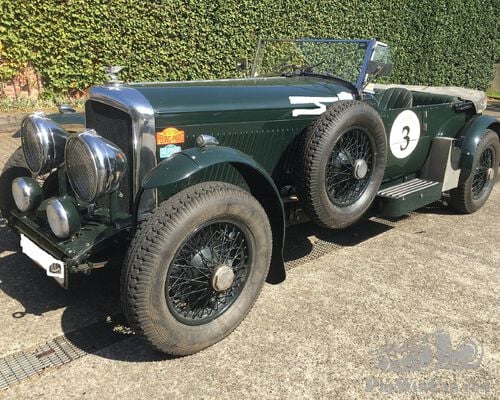
Bentley Derby Special Open Rally Car
This Bentley Derby, manufactured in 1935, has been rebuilt into a short and long-distance rally car. Full rebuilt engine in 2021, Since 2021 low mi..
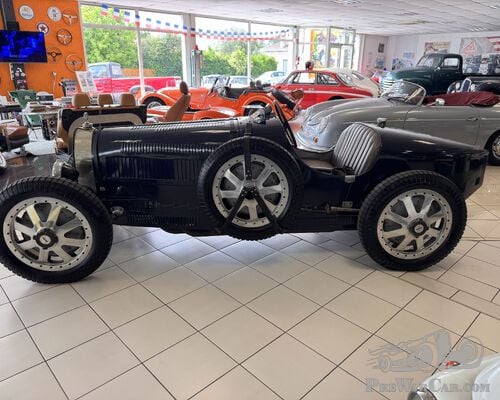
Bugatti 35 B Pur Sang
Bugatti 35 B Pur Sang,importée par un membre délégué de la FFVE il y’a une quinzaine d années.Participation à de nombreux Rallyes Bug..

Alfa 6C1750 Spider
Alfa 6C1750 Spider with complete history from delivery in 1930 to first owner in Firenze till today with copy Libretto/license plate all the years