The global magazine and marketplace for classic car enthusiasts, by enthusiasts.


Filter
Classic Chalmers, Swift for sale - Chalmers, Swift cars for sale
-

1904 Swift 7HP - VCC Dated
1904 Swift 7HPRegistration No - BS8487Chassis No - 176Engine No - 2886 - VCC Dated - Electric starting- 4 seat London to Brighton vehicle - Rare English Marque- Many time London to Brighton Finisher - Ready for use Swift of Coventry gained and adapted its skills ..

Chalmers / Chalmers-Detroit
US, 1908 – 1924
Chalmers Motor Car Co, Detroit, Mich.
The Chalmers was one of the most popular automobiles made in the United States for more than a decade. The Chalmers was the successor to the Thomas-Detroit which was built by a company which had been founded in 1906 by E.R. Thomas (builder of the Thomas car in Buffalo, N.Y.), Roy D. Chapin and Howard Earle Coffin; the two latter had previously served at Oldsmobile. The Thomas-Detroit of which some 500 were sold during the first year of production, was marketed through the parent firm in Buffalo which manufactured a larger line of cars under the Thomas emblem. The Thomas-Detroit was a medium priced four-cylinder car which had been designed by Coffin. In 1907, Hugh Chalmers, vice president of the National Cash Register Co and a noted salesman, entered the firm. Shortly after, he bought a half of E.R. Thomas’ stock and became president of the company which became the Chalmers-Detroit Motor Company. The Thomas-Detroit became the Chalmers-Detroit in 1908 and in 1910, the Chalmers. Open and closed Chalmers models in two lines comprised the Chalmers four-cylinder cars, with self-starters appearing in 1912. Chalmers (as Chalmers-Detroit) had distinguished itself in road races as early as 1908 when W.R. Burns won the Motor Parkway Sweekstakes at Jericho, N.Y., averaging 48.7mph in the six-lap 140.76 mile run.
In 1913, the Chalmers brought out its first 6-cylinder model, as well as the four and apart from small mechanical and design changes, continued both until 1914. The Chalmers four was dropped from the 1915 line, however, and sixes were to be used exclusively in Chalmers until the ending of manufacture. By 1915, some 20.000 Chalmers cars per year were coming off the Chalmers production line and would even exceed that figure before the advent of World War 1. In 1917, an L-head motor replaced the earlier overhead-valve type and on August 4th, Chalmers again headed racing news when Joe Dawson won the 24-hour stock Car Endurance Run at Sheepshead Bay, N.Y. Sales flagged following the end of the war and Hugh Chalmers, always the salesman, and with the realization that a competitor, Maxwell, wasn’t faring well either, arranged to lease his Chalmers plants to Maxwell, using his salesmanship to promote the two concerns and getting the benefit of Maxwell tooling and manufacturing equipment. By the early 1920s, however, many makes of cars were in financial difficulties due to over-expansion and recession, and Walter P. Chrysler was called in to try and reorganize Maxwell. Chrysler was at this time planning his own corporation and in 1922 Chalmers was taken over by Maxwell which had become a Chrysler subsidiary. The last Chalmer cars for sale were equipped with Lockheed hydraulic brakes but 1923 was the last year of Chalmers production with some 9000 units leaving the factories. The Maxwell survived until 1925 when it became the Chrysler Four.
Source: Georgano, encyclopedia of motorcar; KM
The information is written with the greatest of care. However, if you have any suggested amendments please contact us at office@prewarcar.com
Swift
GB, 1900 – 1931
(1) Swift Motor Co Ltd, Coventry, Warwickshire, 1900 – 1919
(2) Swift of Coventry Ltd, Coventry, Warwickshire, 1919 – 1931
Swift progressed from sewing-machines through bicycles, motor tricycles and quadricycles to cars. Their first Swift car was a voiturette with a tubular chassis, powered by an MMC single-cylinder engine of De Dion type, but with an original transmission system. There was direct drive on both the 2-forward speeds of the Swift car, provided by two rings of teeth on the crown wheel and two pinions. The design of the Swift car was unreliable, for the rear axle was unsprung and attached to a flexible chassis. This was soon dropped on the Swift car in favour of normal transmission, and the axle was sprung from 1903. These single-cylinder Swift cars, with various makers’ engines installed, were the only Swift car offerings until 1904, when an excellent Swift-made twin of 10hp was added. Bigger 3- and 4-cylinder Swift cars were made at the time, and in 1909 a short-lived single-cylinder 7hp Swift car, also sold by Austin was added, but most sales came from the 2-cylinder light Swift car. In 1912 this Swift car was replaced by a 7hp 2-cylinder cyclecar with shaft drive, made by the Swift Cycle Co Ltd. For 1914 the Swift Light Car, which Swift car was virtually the cyclecar with a pressed steel, in place of tubular, chassis, was offered by the Swift Motor Co Ltd. The Cycle Co made no further Swift cars, and the formation of Swift of Coventry in 1919 merged the two companies. An 1.100cc 4-cylinder Swift Ten replaced the 2-cylinder car in 1914. This Ten Swift car was continued after World War 1, with a new 2-litre Swift Twelve beside it. The latter Swift car had 4 forward speeds but was otherwise similar. After this, only 4-cylinder Swift cars were made, irrespective of current fashions. These Swift cars were immensely strong and simple, inefficient in terms of power output but not utility. The Swift Ten was redesigned on more modern lines in 1923. A slightly smaller engine with detachable head and coil ignition was made in unit on the Swift car with a 3-speed gearbox, though the model Swift car reverted to a magneto in 1925. As the 12/35hp Swift car, the Swift Twelve was brought up-to-date with the same features, becoming the 14/40hp Swift car in 1926. In the same year the Ten’s engine was enlarged to 1.200cc. Wire wheels were optional on Swift cars from 1927, and 4-speed gearboxes came in 1929. The 1930 Ten Swift car had a narrow ‘ribbon’ radiator shell, and was available with Swallow 2-door saloon coachwork as well as fabric saloon and tourer styles. This Swift car was supplemented in 1931 by the 8hp Cadet 2-door saloon which in its cheapest form the Swift car cost only £149. Swift cars could not compete with the mass-producers, however, and the Swift car make died shortly after.
CDN, 1911
Swift Motor Car Company of Canada Limited, Chatham, Ont.
One prototype Swift car, possibly based on the US Anhut, was produced by this Swift car firm of marine-engine builders.
Source: Georgano, encyclopedia of motorcar; TRN, HD
The information is written with the greatest of care. However, if you have any suggested amendments please contact us at office@prewarcar.com


Featured

Alfa 6C1750 Spider
Alfa 6C1750 Spider with complete history from delivery in 1930 to first owner in Firenze till today with copy Libretto/license plate all the years
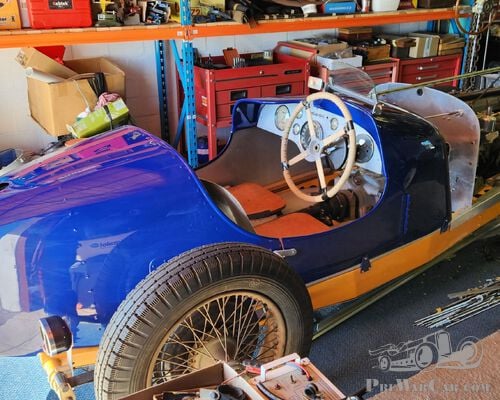
Riley TT Sprite
1935 6-cylinder TT Sprite replica. Chassis # 46A2722. Engine # 6A2722. Original Ulster Imp body. Restoration nearing completion. Engine, Ge..
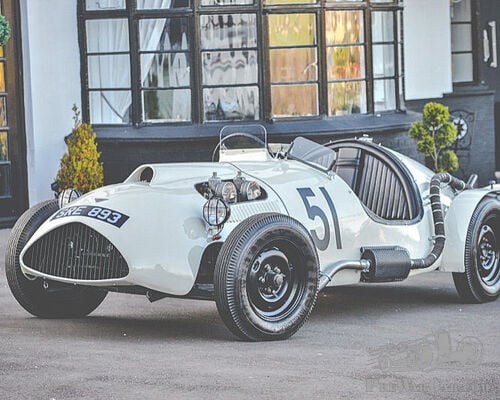
1933 Alvis 3.0 Special - One-Off Alloy Body | Period Competition Car | Featured in “Alvis – A Century of Drivers”
1933 Alvis 3. 0 Special - One-Off Alloy-Body | Period Competition Car | Featured in “Alvis – A Century of Drivers”