The global magazine and marketplace for classic car enthusiasts, by enthusiasts.


Filter
Classic Rolland-Pilain, Tatra for sale - Rolland-Pilain, Tatra cars for sale
-

Rolland Pilain
I am selling a 1913 Rolland Pilain RP 10HP in very good condition. It has a standard registration document in my name, and the MOT will be carried out prior to the sale. -
Tatra T-12 black 1928 for sale
Ready for tender loving care and restoration 1928 Tatra. Four door, crank start, two cylinder cast aluminum, air cooled engine. PA title, manual as well as original shipping document come with this car. Large steering wheel on the right site of the car Research indicates that few of these models exist in the world. Interesting historical facts a.. -
1924 Tatra 11 Roadster – Authentic Survivor with Running Boxer Engine | Rare Opportunity for Discerning Pre-War Collectors
An Exceptional Piece of Automotive HistoryOffered for sale is a remarkably rare 1924 Tatra 11 Roadster, one of the most important and innovative European automobiles of the pre-war era. The Tatra 11 was revolutionary for its time, featuring Hans Ledwinka’s pioneering backbone chassis and an air-cooled flat-twin engine—engine..


Rolland-Pilain
France, 1906 – 1931
SA des Etablissements Rolland-Pilain, Tours
Unusual among French marques of its period, Rolland Pilain cars made their greatest impact after World War 1. Their first product was a 20hp 4-cylinder model Rolland Pilain cars with a monobloc engine, though smaller 2.2-litre shaft-driven Rolland Pilain cars were available in 1909 and a 3-speed 1½-litre Rolland Pilain 8/10CV in 1910, in which year the Rolland Pilain car company was also experimenting with ‘valveless’ engines and 4-wheel brakes. Though racing was in the doldrums, the Rolland Pilain car company went to the trouble of building a big chain-driven Rolland Pilain car for the 1911 Grand Prix de France, and a complex 1912 range started with a Rolland Pilain 9CV of 1.7-litres and went up to a chain-driven 4-cylinder 60 Rolland Pilain car of 130x270mm. The 6-cylinder Rolland Pilain 18CV had a ‘valveless’ engine, and even in 1913 chain drive was still optional on the biggest fours of 20CV and 24CV Rolland Pilain cars. Only 1.9-litre and 4-litre 4-cylinder Rolland Pilain cars with sv monobloc engines and unit gearboxes were listed in 1914.
These basic types of Rolland Pilain cars, still with pedal-operated transmission brakes, were available again after World War 1, but far more advanced was the 2.2-litre Rolland Pilain 14/16 of 1921, which boasted not only overhead valves and a detachable head, but also front-wheel brakes (hydraulic at the front and mechanical at the rear). This Rolland Pilain car was still catalogued in 1926. Even more ambitious was the 2-litre twin ohc straight-8 GP Rolland Pilain car of 1922, with desmodromic valves, ball-bearing crankshafts and 4-wheel hydraulic brakes. A victory of a Rolland Pilain car at San Sebastian in 1923 was the limit of the success of Rolland Pilain cars on the circuits, but the type found its way into the catalogue as the Type A22 Rolland Pilain car at 90.000fr, and one of the racers also ran with a 2-litre, 6-cylinder cuff-valve Schmid engine. In 1925 came a 2-litre ohv 4-cylinder Rolland Pilain car with 4-wheel mechanical brakes, selling for £725 in England, while a 1½-litre development, the Rolland Pilain D26, was introduced for 1927. In 1929 Rolland-Pilain car, along with several other French firms, tried a Franco-American theme by introducing a range of big luxury chassis with sv Continental engines. Both the 6-cylinder, 3-litre, and the 4-litre straight-8 Rolland Pilain cars had centralized chassis lubrication, though the elegant bodywork of the Rolland Pilain car was marred by the use of artillery wheels. At the 1930 Paris Salon the Rolland Pilain car company shared a stand with the BNC (also going through a Franco-American phase), but this was the end, though the Rolland Pilain car firm’s Paris depot was still advertising spare parts for Bignan as well as Rolland Pilain cars in 1934.
Source: Georgano, encyclopedia of motorcar; MCS
The information is written with the greatest of care. However, if you have any suggested amendments please contact us at office@prewarcar.com
Tatra
CS, 1923 to date
(1) Tatra-Werke AG, Koprivnice, 1923 – 1935
(2) Ringhoffer-Tatra-Werke AG, Koprivnice, 1935 – 1941
(3) Tatra, np, Koprivnice, 1945 to date
At first the Tatra car was a continuation of the Nesselsdorf, producing the pre-war Types T and U Tatra cars, the latter a 6½-litre ohc 6-cylinder. The first real Tatra car of 1923 was completely different from the last Nesselsdorf models. After his return from Steyr, Hans Ledwinka produced a car which became one of the classics in the history of automobile design. This Tatra car was characterized by an air-cooled opposed-twin engine of 1.056cc developing 12bhp, a central tubular frame, and special rear swing axles and differential. It was known as the Type 11, and was the basis of later Tatra car models, commercial vehicles as well as private Tatra cars. Type 12 was identical with the Type 11, but this Tatra car had 4-wheel brakes. The Tatra car design was not intended for sporting events, but nevertheless two of these Tatra cars participated in the 1925 Targa Florio and gained 1st and 2nd place in the 1.100cc class, driven by Fritz Hückel and Kart Sponer. These were standard production Tatra cars, except that two inlet valves instead of one were fitted, and the front transverse-leaf springing was replaced by swinging half axles. Josef Vermirovsky was another competition driver on the small Tatra carmodel; his successes with Tatra cars included winning a 5.000 kilometre (3.107 miles) trial from Leningrad via Tiflis to Moscow in 1925. About 25.000 Tatra cars of Types 11 and 12 were built up to 1930. Some 4-cylinder Tatra cars followed, built on the same lines with air-cooled opposed engines, central tubular frames and swing axles: the Tatra 30 (1.680cc, 40bhp) and Tatra 52 (1.910cc, 40bhp). There were also the in-line 6-cylinder Type 70 Tatra car of 3.400cc and 60bhp, and the 6-litre V12 Type 80 Tatra car with 100bhp, both featuring the same frame construction and swing axles. The Type 80 Tatra car was built only in limited numbers, like the single-cylinder, 528cc 3-wheeler Tatra car (Type 49).
The next important development was the Tatra 57 which appeared in 1932. This Tatra car had the central tubular frame and swing-axles which were traditional by this time, and an air-cooled opposed 4-cylinder engine of 1.160cc developing 22bhp. Engine capacity of the Tatra car was later increased to 1.690cc, and this Tatra car was built until 1938. The German Röhr Junior was the Tatra 57 design built under licence. Under the name of Austro-Tatra the light Tatra cars were also manufactured in Vienna.
Ledwinka and Tatra were destined to make automobile history again with the Tatra Type 77 of 1934. The all-enveloping body of the Tatra car was built strictly to aerodynamic principles. A central box-type frame was used, and in its forked rear end – behind the rear axle – an air-cooled V8 engine of 3.400cc was placed. It developed 70bhp and gave the Tatra car a maximum speed of 95mph. The 1937 Tatra 87 incorporated the same technical principles and this Tatra car used a basically similar body. Engine capacity of the Tatra car was reduced to 2.960cc; output was 75bhp – a result of weight reduction. This Tatra car was capable of 100mph. In the same year the Tatra 97 was introduced with the same body, but an opposed 4-cylinder unit of 1.760cc and 40bhp was fitted. After the district of Koprivnice had come under German occupation, and the restriction of numbers of types which had been introduced in Germany in the 1930s was enforced in Czechoslovakia too, production of the Tatra 97 ceased and only the 87 Tatra car was continued until about 1941. In 1945, after the war, the Tatra car factory were nationalized by the Czechoslovak government, and production of Tatra cars was devoted to the front-engined Type 57B Tatra car and the rear-engined Tatra Type 87. These Tatra car were replaced in 1948 by a single model, the 2-litre rear-engined Tatraplan, derived from the pre-war Type 97 Tatra car. This Tatra car was made until 1954, after which there was a three-year period when no private Tatra cars were made. In 1957 the Tatra 603 was introduced; this Tatra car again had an air-cooled V8 engine of 2.472cc mounted in the rear. The Tatra car is still in production today as the T3-603, with twin-carburettor engine, servo-assisted disc brakes, and powere assisted steering, although Tatra concentrate on commercial vehicles and railway carriages. In preparation for 1973 was the 3.4-litre T613, a development of the existing theme.
Source: Georgano, encyclopedia of motorcar; HON
The information is written with the greatest of care. However, if you have any suggested amendments please contact us at office@prewarcar.com


Featured
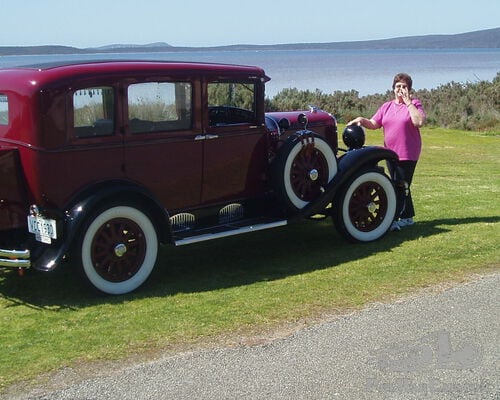
1930 Chrysler 66 Six-Wheel Equipped Royal Sedan
An exceptionally well restored and highly awarded Chrysler 66 Royal Sedan, with only two owners in nearly 97 years.The present owner ..
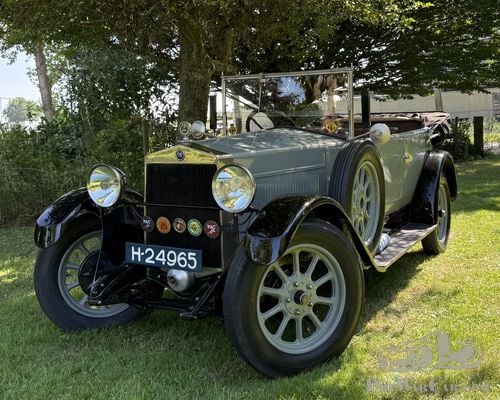
Fiat 509 Torpedo / Spider – Exceptionally Original and Complete
A Rare and Highly Original Example with Long-Term Dutch HistoryOffered for sale is an exceptionally original and remarkably complete Fiat 50..
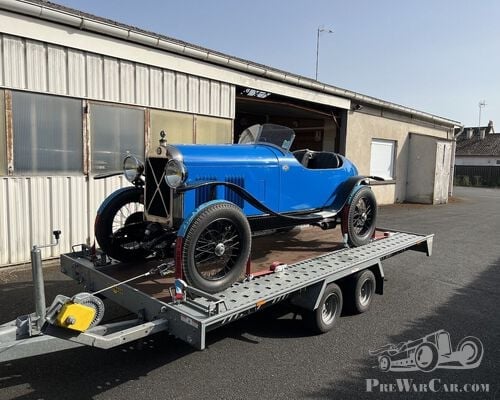
Salmson VAL 3 Séries 7
1927 Salmson VAL3 Series 7. Completely restored a few years ago, in very good overall condition, both bodywork and mechanics. Bordino-style bodywor..