The global magazine and marketplace for classic car enthusiasts, by enthusiasts.


Filter
Classic Vauxhall, DeSoto for sale - Vauxhall, DeSoto cars for sale
-

1923 Vauxhall Type OD 23-60 Malvern Tourer.
1923 Vauxhall Type OD 23-60 Malvern Tourer Registration no. SV7736Chassis no. OD720 This Vauxhall 23-60 Malvern tourer was delivered new to Australia and comes with a list of owners in that country dating back to 1932. In May 1998 the car was imported into the UK by Andrew Booth (Orchid Cars), registered as '.. -
1925 Vauxhall 30-98 OE Velox
The Vauxhall Ironworks was based near Vauxhall Bridge in London before the factory relocated to Luton in 1905, by which time the company had established its reputation for building high quality motorcars. The 30-98 name appeared in 1913 - the ‘30’ is thought to be a reference to the power produced at 1000 rpm and ‘98’ being the max.. -
1925 VAUXHALL 14/40 Princeton Tourer
1925 VAUXHALL 14/40 Princeton Tourer. Chassis Number: LM2614 Registration Number: SV7947 The Vauxhall 14-40 made its debut at the 1921 London Motor Show, with the first deliveries reaching the public the following year. Designed by Clarence King, this new model featured a 2. 3 l.. -
1924 Vauxhall 30-98 OE Velox
The Vauxhall Ironworks was based near Vauxhall Bridge in London before the factory relocated to Luton in 1905, by which time the company had established its reputation for building high quality motorcars. The 30-98 name appeared in 1913 - the ‘30’ is thought to be a reference to the power produced at 1000 rpm and ‘98’ being the max.. -
1921 Vauxhall 30/98 Velox Tourer
1921 Vauxhall 30/98 Velox Tourer.Chassis Number E232Registration number: XC5494 1922 Vauxhall 30/98 E type , velox four seater alloy tourer body. It is 1 of only 27 left today out of 274 E types produced and last year this car set the fastest ever time recorded by an Vauxhall 30/98 E type up Prescott hill.. -
1931 Vauxhall Hurlingham 20-60
1931 Vauxhall Hurlingham Chassis Number: T1772 Registration Number: GN3275 Body RA.548 Engine TRA.1798 Very few of these were made (just 52) when new & even fewer remain with some 20 known to be in existance world wide. This rare Vauxhall ..


Vauxhall
GB, 1903 to date
(1) Vauxhall Iron Works Ltd, London, 1903 – 1904
(2) Vauxhall Iron Works Ltd, Luton, Beds., 1905 – 1906
(3) Vauxhall and West Hydraulic Engineering Co Ltd, Luton, Beds., 1906 – 1907
(4) Vauxhall Motors Ltd, Luton, Beds., 1907 to date
This marine engineering concern’s first Vauxhall cars were horizontal-engined single-cylinder runabouts in the American idiom with chain drive and tiller steering, rated at 6hp and the first Vauxhall car was selling for £150. In 1904, when 76 Vauxhall cars were sold, wheel steering and a reverse gear featured in the specification, and the singles were joined by 3-cylinder models Vauxhall cars of 1.4- and 2.4-litres’ capacity, with mechanically-operated inlet valves and vestigial flutes on their bonnets. In 1905 the Vauxhall car works were moved to Luton, and the first attempt at competitions was made with the entry in the Tourist Tophy of a 3-cylinder Vauxhall car with overdrive gearbox. The classic Vauxhall radiator with its flutes appeared on a 3.3-litre T-head 4-cylinder Vauxhall car introduced in 1906. This Vauxhall car was followed by a smaller shaft-drive 12/16, still T-headed, and the Pomeroy-designed L-head 20hp, which gave 40bhp and this Vauxhall car won the 2.000 Mile Trial of 1908. Pomeroy’s 4-cylinder Vauxhall cars were among the classic British designs of the next six years, boasting 5-bearing crankshafts and monobloc engines, and, from 1912, Hele-Shaw multi-plate clutches. In 1910 the first of the Prince Henry Vauxhall cars with 3-litre engine won its spurs in the German Trials of that name: these round-nose sporting Vauxhall cars later grew up into 4-litres’ with 70bhp, capable of 75mph and this Vauxhall car was selling for only £615 in 1913. The Vauxhall car company’s bread-and-butter car was the smaller and staider A-type on similar lines, joined in 1913 by a 4-litre D-type Vauxhall car with close affinities to the Prince Henry Vauxhall cars, while the B-type, a 6-cylinder formal Vauxhall carriage with its cylinders cast in threes, was made in small numbers from 1910 onwards. A Linley preselective gearbox was listed as an option on Vauxhall cars in 1911, in which year Vauxhall cars started racing in earnest. Already a 3-litre Vauxhall car with single-seater streamlined bodywork had recorded 100.08mph over the flying kilometer, and Vauxhall cars were entered for the Coupe de l’Auto voiturette races of 1911, 1912 an 1913. These Vauxhall cars were followed by twin-ohc designs in 1914 for the French Grand Prix and the Tourist Trophy. The GP models Vauxhall cars with 4½-litre engines developed 130bhp. The prototype of Vauxhall cars best known sporting model, the Vauxhall 30/98, appeared in 1913. The capacity of the Vauxhall car was 4½-litres and it was listed at £925 in 1915, though only 13 Vauxhall 30/98 cars were made before the outbreak of World War 1.
D-types Vauxhall car were made at the rate of eight a week for the Fighting Services during the war years, and both this model Vauxhall car and the E-type Vauxhall 30/98 were available again in 1919 with full electrical equipment. The latter Vauxhall carwas one of the greatest of all fast tourers, this Vauxhall car was offering superb flexibility and a top speed of over 80mph for £1.600, though brakes were never its strong suit. 1922 saw Vauxhall, like Sunbeam, offering a smaller and cheaper Vauxhall car, the 2.3-litre M-type 14/40 Vauxhall car with detachable head, 3-speed unit gearbox in place of the 4-speed separate type on the big Vauxhall cars, single-plate clutch and all brakes on the rear wheels (supplanting a foot transmission brake), at £750. The last serious competition Vauxhall cars were a team of 3-litre twin ohc machines for the 1922 Tourist Trophy, which Vauxhall cars had 110bhp and air-pressure operated brakes, but could manage no better than a 3rd place. Both the D- and E-types Vauxhall cars acquired overhead valves in the summer of 1922, the later emerging as the 120bhp OE which had 4-wheel brakes of rather dubious efficacy by 1923. Capacity of the engine was now 4.2-litres. Vauxhall sold 1.400 Vauxhall cars in 1924. 1925 Vauxhall 14/40hp models had 4 forward speeds, but finances were uncertain, and the Vauxhall car company was bought by General Motors in December of that year. 1926 Vauxhall cars were still on traditional lines, the Vauxhall 14/40 acquiring front wheel brakes, and being supplemented by a new luxury 6-cylinder Vauxhall car, the S-type with 3.9-litre single-sleeve valve engine and hydraulic brakes at £1.250. The Vauxhall 30/98 survived into 1927, also now with hydraulics: only about 600 of both types Vauxhall cars, the E and OE were made, and three-fifths of these Vauxhall cars were exported to Australia. The Vauxhall 14/40 in its last year could be had with a Wilson preselective gearbox. The first GM Vauxhall car was introduced for 1928: this Vauxhall car was a rather American-looking 20/60hp ohv six with coil-ignition and central change, but the Vauxhall car was still with a 4-speed box, at £475. This R-type Vauxhall car was steadily increased in capacity, ending its production run as the 3.3-litre T80 in 1932. A really inexpensive Vauxhall Six, the 2-litre Cadet at £280, was offered in 1931, in which year a range of Chevrolet-based Bedford trucks helped to boost Vauxhall Motors’ overall sales. The Vauxhall Cadet pioneered synchromesh in Britain in 1932, a few months ahead of Rolls-Royce, but the need for smaller horsepower cars resulted in the introduction of a couple of light sixes Vauxhall cars of 12 and 14hp in the summer of 1933. These Vauxhall cars and their companion 2.4-litre and 3.2-litre Big Sixes of 1934 had Fisher no-draught ventilation, but boasted 4-forward speeds in place of the Cadet’s 3. Prices of the smaller Vauxhall cars started at £195, and in 1935, in which year a record 25.000 Vauxhall cars were sold, they also had General Motors’ ‘knee action’ independent front suspension. In 1937 the Big Six Vauxhall car gave way to a 3.2-litre, 80bhp 25 with independent front-suspension and hydraulic brakes, selling for £298, and also available in long-chassis limousine form. All 1937 Vauxhall cars had stylized grilles in place of radiators, with headlamps attached to the shell, though the flutes survived until 1962. In 1938 came the 1.2-litre Vauxhall Ten with 3-speed gearbox and unitary construction, also made as a coupé with separate chassis, while the 25 Vauxhall car now had a 3-speed box as well. Hydraulic brakes were standard on all Vauxhall cars in 1939, in which year the 12/60 Vauxhall car gave way to a unitary-construction 3-speed 4-cylinder Vauxhall car at £189, and the 14 also went over to unitary construction.
With the discontinuation of the Vauxhall 25 after World War 2, Vauxhall cars with separate chassis were no longer made for the home market, though certain export versions Vauxhall cars were thus made until 1954. Post-war production of Vauxhall cars started with revised editions of the 1940 model Vauxhall Ten, Vauxhall Twelve, and Vauxhall Fourteen, but in 1948 a new model Vauxhall car with bigger boot, a standardized hull, and steering-column change was introduced, with a choice of two long-stroke ohv engines – the Vauxhall Velox had a 54bhp 2.3-litre 6-cylinder unit, and the Wyvern the old 35bhp Twelve Vauxhall car of 1.4-litres’ capacity. Lowered and restyled versions Vauxhall cars with hypoid back axles were introduced for 1952, short-stroke engines replacing the earlier type during the season. These Vauxhall cars were in production until 1957 with relatively little change, though a de luxe 6-cylinder edition, the Vauxhall Cresta, appeared in 1955. A very American 1½-litre Vauxhall car saloon, the Vauxhall Victor, with Chevrolet-like wrap-around windscreen and 3-speed all-synchromesh gearbox, was announced in 1957 at £729, and the 6-cylinder Vauxhall car received similar treatment in 1958. Though the styling of these Vauxhall cars was critically received, this was a record year for the Vauxhall car company, with 114.177 Vauxhall cars sold. Overdrive was an option on the 1959 6-cylinder line Vauxhall cars, followed by automatic in 1960, while the flutes were gone from the 1962 Vauxhall Victor, a better-looking Vauxhall car with a 56bhp engine, and the choice of a 3- or 4-speed box. A faster twin-carburettor 71bhp version, the VX 4/90, had front disc brakes. The Vauxhall Velox and Vauxhall Cresta were restyled on similar lines in 1963, also with discs at the front, and power of the Vauxhall car was increased in 1965, Vauxhall Victors having 1.6-litres and 70bhp, and the 6-cylinder engines being enlarged to 3.3-litres. 1964 produced a new small Vauxhall car, the 1.057cc Vauxhall Viva which was almost identical with the German Opel Kadett. The Vauxhall car sold for £566, but by 1967 had been replaced by the more attractive 1.159cc HB series Vauxhall car, with such options as a 69bhp SL model and automatic transmission. The van-based Beford Beagle estate Vauxhall car, however, retained the original HA shape into 1973. In 1966 there was a prestige version of the Vauxhall Cresta, the Vauxhall Viscount at £1.483, on which automatic transmission, power windows and a vinyl roof were standard.
A new phase in Vauxhall car design was heralded in 1968 by an all-new Vauxhall Victor. The 4-cylinder engines of the Vauxhall car, of 1.599cc and 1.975cc, had 5-bearing crankshafts and belt-driven ohc, and also featured were 4-speed gearboxes, rack-and-pinion steering, and all-coil suspension with rigid axles at the rear. The costliest estate-car version used the 3.3-litre 6-cylinder engine, as did a new sports-compact introduced during the year, the Vauxhall Ventora saloon. Next to appear was a Vauxhall Viva GT, combining a Viva hull with 2-litre Victor mehcanics and, in 1970, an updated version of the sporting VX 4/90. In 1971 came Vauxhall cars answer to the best-selling Ford Capri, the Vauxhall Firenza coupé with front disc brakes and a choice of Viva or Victor engine. The former unit of the Vauxhall car was enlarged to 1.256cc for 1972, and in the spring of that year came new, more elegant Vauxhall Victors and Vauxhall Ventoras, the fours now having 1.8-litre or 2.3-litre engines. Twin-carburettor editions of the latter now developed 122bhp. They were fitted to the Sport SL Firenza Vauxhall car as well as to the VX 4/90, which came with overdrive as standard and to the fiercest of the Viva family, retailing for £1.218 in 2-door saloon form. Top of the range of Vauxhall cars was now the Ventora. The Cresta and Viscount, unchanged since 1966, disappeared in September 1972. Viva mechanical elements were used in the Grumett, a Uruguayan coupé-utility in the Australian-Japanese idiom, and also in a new light truck evolved in 1972 by the parent General Motors for sale in emergent countries. In 1972 Vauxhall car of the Viva/ Firenza range with 2-litre ohc engines were sold under the name Pontiac Firenza by General Motors of Canada.
Source: Georgano, encyclopedia of motorcar; MCS
The information is written with the greatest of care. However, if you have any suggested amendments please contact us at office@prewarcar.com
DeSoto
US, 1913 – 1916
DeSoto Motro Car Co, Auburn, Ind.
The DeSoto appears to have succeeded the Zimmerman. This was a large car with a 55hp, 6-cylinder engine, which was furnished with a compressed-air starter. The DeSoto model Six-55 five-seater touring car sold for $2185.
US, 1928 – 1960
Chrysler Motors Corp, Detroit, Mich.
The DeSoto was launched in 1928 as a 3.2-litre side valve six to compete with Oldsmobile, Pontiac and the cheaper Nashes. Styling and general design of the DeSoto were in line with the 1929 Chryslers, and at $885 for a DeSoto sedan 90.000 were sold in the first twelve months. A 3.4-litre straight-8 DeSoto on a 9ft 6in wheelbase was announced for 1930 as the world’s cheapest 8-cylinder car. However, DeSoto suffered badly in the Depression, and in 1932, when flexible rubber engine mountings and free wheels were made available, sales dropped to 26.000 DeSoto cars.
The DeSoto disappeared from the British market about this time, though certain ‘Chrysler’ models listed in England (the Mortlake, Croydon, and some of the Richmonds) were in fact DeSoto cars in all but name. A 6-cylinder version of Chrysler’s advanced unitary-construction Airflow, the SE-type with a 4-litre engine, was brought out in 1934, but was an unsuccessful as its bigger sister. Later DeSotos followed regular Chrysler lines closely though in later years there was a tendency for DeSoto to move into a higher price class than Dodge; by 1952 DeSotos started $300 higher than the companion make.
By 1939 the DeSoto cars for sale were being made with independent front suspension, hypoid back axles and column change. There was a choice at DeSoto of two 6-cylinder engines and three wheelbase lengths, the longest of these being reserved for seven-seater bodywork – DeSoto continued to offer a really roomy family car right up to 1954. A 4-speed semi-automatic Vacumatic transmission became an option in 1941, but DeSoto’s big post-war change of models did not take place until 1952, when the division followed Chrysler’s lead in adopting the oversquare ohv V8; the DeSoto version was of 4½-litre capcity and developed 16-bhp. With the advent of Chrysler’s ‘flight sweep’ styling in 1955, the side-valve sixes were dropped and the standard engine in a DeSoto was now a 4.8-litre eight, giving 185bhp in Firedome guise, and 200bhp in Fireflite form. Though this redesigning saved Chrysler sales generally, the slump in the medium-price class had an adverse effect on DeSoto and in 1959 the DeSoto division was merged with Plymouth. Last of the DeSotos were the 1961 models, unitary-construction cars with a choice of three engines: Plymouth’s 145bhp ohv ‘slant six’ as used in the Valiant, and V8s of 230 and 265bhp, the two former only in Canadian DeSotos. Production of DeSoto cars ceased in November 1960 after only a few had been delivered.
Source: Georgano, encyclopedia of motorcar; MCS
The information is written with the greatest of care. However, if you have any suggested amendments please contact us at office@prewarcar.com


Featured
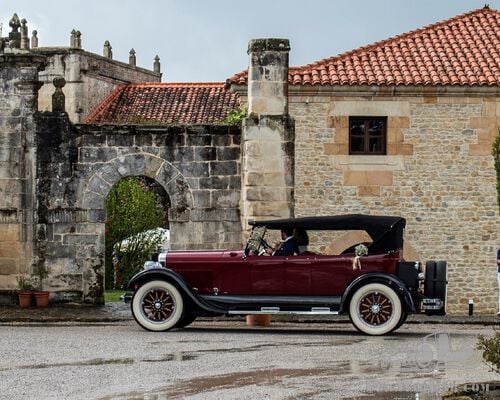
1925 Lincoln Model L Phaeton by Brunn - Excellent provenance
Retaining its original matching-numbers engine and chassis (both numbered 24576), the car benefits from an extensively documented history and..
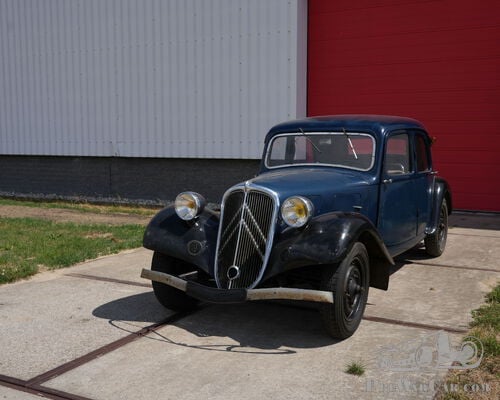
1935 Citroën Traction Avant
Early-production Traction AvantExceptionally original, unrestored conditionRecently part of a major museum collection
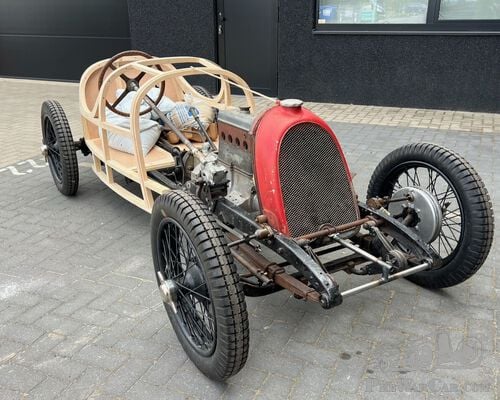
BNC 527 (Scap engine & Cozette blower) —Restoration Project
appealing restoration project based on an original 1927 BNC 527 chassis (No. 270**), retaining its matching-number front and rear axles.Orig..