The global magazine and marketplace for classic car enthusiasts, by enthusiasts.


Filter
Classic Vinot for sale - Vinot cars for sale
-

Chenard & Walcker Model G
The Chenard & Walcker is a 1905 Model G, equipped with a 5-liter, four-cylinder engine producing 20 horsepower, enabling the car to reach a top speed of approximately 85 km/h | 50 mp/h. The body is a Double Phaeton and was crafted by the renowned coachbuilder Jean-Henri Labouredette. In addition to the radiator b.. -
Highly Awarded 1936 Delahaye 135 Competition Streamlined Disappearing Top Convertible, Figoni-Falaschi Masterpiece
This is the 1936 "Talk of Paris" car, the beginning of the famed Figoni Streamlined Teardrop Period, an objet d'artFigoni et Falaschi Centennial One of one; pièce unique Figoni streamlined Design #581One of the most highly awarded cars in the world....Best of.. -
rare Peerless for sale
The Peerless Motor Corporation of Cleveland, Ohio, manufactured high-quality cars between 1900 and 1931. Peerless, along with Packard and Pierce-Arrow, became known as the ‘Three P’s of Motordom’ (top-of-the-range cars) in the United States. The car offered for sale is one of the very few vehicles still in existence today. The new car was import.. -
Lancia Lambda 3rd Series Short-Chassis Torpedo
With a monocoque body, four-wheel brakes, independent front suspension and V4 overhead camshaft engine, many enthusiasts view the Lancia Lambda as one of the great and innovative automobiles of all time. The Lambda was also successful in competition with privately entered cars finishing fourth and fifth behind the works OMs in the first Mille Migli.. -
1930 Packard 745 Deluxe Eight Roadster | RM Sotheby's | Private Sales
Asking | $550,000 USD A superb example of one of the most desirable Classic PackardsReportedly purchased new by Philadelphia sporting icon John ShibeFormerly owned by noted collectors Mark Smith, Robert Thayer, and Joseph Cassini IIIAward-winning restoration by RM Auto Restoration; extensive cosmetic freshening .. -
1932 Rolls-Royce Phantom II Continental Drophead Coupe by Carlton
Vintage and Prestige are proud to offer this 1932 Rolls-Royce Phantom II Continental Drophead Coupe by Carlton For Sale. Previous UK Registration: 544 YUS Chassis no: 32MS Engine no: HD 55 Mileage shown: 22,480 32MS was first ordered by the Duke of Sutherland; Sir G.. -
1928 Packard 533 Golfers Coupe
1928 Packard 533 Golfers Coupe Chassis number 144148RRegistration number: UC1064 Vintage and Prestige Fine Motor Cars are proud to be offering this 1928 Packard 533 Golfers Coupe for sale. A spectacular Packard in mint order throughout. This right hand drive example was sold new to the UK in 1928 and has remained here since... -
Sehr authentischer Packard Single Six 133 von 1922
Wir verkaufen unseren Packard Single Six, der sich seit mehr als 30 Jahren in unserer Familie befindet. Der Packard gehört zu der Baureihe, die ab 1922 mit 6 Zyl., 4.400 ccm, 40 kW und einem Radstand von 3.378 mm ausgestattet wurde. Das Fahrzeug verfügt über 7 Sitze (incl. 2 Notsitze). Das Dach läßt sich zusammenfalten und die Seitenteile abnehm.. -
1935 Mercedes-Benz 500 K Normal Roadster by Sindelfingen | RM Sotheby's | The Monterey Auction
To Be OFFERED AT AUCTION at RM Sothebys' The Monterey Auction event, 13 - 15 August 2026. $1,500,000 - $1,700,000 USD One of five known surviving examples among a very limited number of cars originally builtDelivered new to Colombo, Ceylon (Sri Lanka)Benefits from a high-level sympathetic restoration conducted over the .. -
1938 Bugatti Type 57 Cabriolet by D'Ieteren | RM Sotheby's | The Monterey Auction
To Be OFFERED AT AUCTION at RM Sothebys' The Monterey Auction event, 13 - 15 August 2026. $900,000 - $1,500,000 USD The only example built in this three-seater, Aravis-inspired design by D’Ieteren of BelgiumBeautifully sculpted and distinctive coachwork with unique featuresRetains many original components, including eng..


Vinot
France, 1901 – 1926
(1) Vinot et Deguingand, Puteaux, Seine, 1901 – 1926
(2) Vinot et Deguingand, Nanterre, Seine, 1919 – 1926
More correctly designated the Vinot-Deguingand, this make was invariably known as plain Vinot once it had become firmly established. The first Vinot cars (sold in England under the name La Silencieuse) had 1½-litre vertical twin aiv engines rated at 5½hp, coil ignition, pressed steel frames, and belt-and-chain transmission. An unusual feature of the Vinot car which persisted for many years was the vertical gate gear change. By 1903 Vinot cars had conventional side-chain drive and armoured wood frames, an improved 10hp twin Vinot car at 6.000fr being available alongside a pair of 4-cylinder Vinot cars (the 14hp 3.3-litre Type H and the 18hp Type F Vinot car) with mechanically-operated side valves in a T-head, and a 4-speed gearbox. Other features of the Vinot car included pump cooling, coil ignition, and sight-feed lubrication. Honeycomb radiators were introduced on Vinot cars in 1905, when the pressed steel frame reappeared on the larger Vinot cars, and there was a 5.8-litre 30hp Vinot car with dual ignition. A 3.3-litre 4-cylinder Vinot car finished 3rd in that year’s Tourist Tophy. Steel frames were standardized in 1906, when a 6-cylinder Vinot car made its appearance; this Vinot car was available in 6.5-litre form with pair-cast cylinders the following year, other regular features that season being exhaust-pressure fuel feed and high-tension magneto ignition. A 16/20hp 4-cylinder Vinot car sold at £525, and shaft drive came to VInot et Deguingang in 1908 with a L-head 10/14CV (sold as the 12/16 in Britain) of 2.1-litres’ capacity. The 3.7-litre Vinot car, now rated at 16/24hp, was also shaft-driven, and slowly live axles spread up the Vinot carrange, though as late as 1911 four chain-driven Vinot cars were still listed.
In 1909 Vinot took over Gladiator, and from 1910 to 1920 two parallel and identical ranges were on offer, even the catalogued prices being the same. The only difference was that the 24hp of just over 4-litres (with shaft drive from 1909) remained peculiar to VInot cars. In 1911 came a more modern monobloc 12hp Vinot car with pressure lubrication, town-carriage versions being available with a double-reduction back axle. In 1912 the Vinot car company took a brief interest in racing with some short-stroke 3-litres for the Coupe de l’Auto: these Vinot cars had overhead inlet valves and remarkably well streamlined tails in an era of slab tanks. The 1.7-litre Vinot car (which sold for £280 in 1912) was offered without the famous vertical gate, but this feature was retained on the next type Vinot car to go monobloc, a 15/20hp Vinot car with the classic cylinder dimensions of 80x130mm. 1914 Vinot cars were 4-cylinder cars with pressure-fed crankshafts, and came in 1.7-litre, 2.1-litre, 2.6-litre, and 4.2-litre sizes, all with wire hweels. The two smaller models Vinot car had 3-speed gearboxes and pair-cast cylinders were retained on the big 25/30hp Vinot car at £745. Apart from full electrical equipment, the Vinot cars announced in 1919 resembled pre-war models Vinot cars, though inflation had pushed the price of the 4-speed 15/20 up from £465 to £915, and VInot cars, like De Dion and Delaunay-Belleville, were not destined to recover their pre-war standing in the market. There were no Gladiators after 1920, but all Vinot could do in the way of a new model was the 11/25hp Vinot car of 1921, an ohv 1.8-litre with aluminium pistons, straight bevel final drive, cone clutch, and 4-speed gearbox with right-hand ball change. The price of this Vinot car was £685, and a year later the old-established 15.9hp Vinot car acquired overhead valves as the Vinot Type BO. In 1924 the 1.8-litre Vinot car, now rated at 12/25hp, was given front-wheel brakes, but Vinot cars were now in serious financial trouble, and few, if any Vinot cars, were made thereafter. The Nanterre works were acquired by Donnet, and the last races of a once popular Vinot car make were seen in 1928, now under the Deguingand name; this was a 2-stroke cyclecar from the drawing-board of the prolific Violet.
Source: Georgano, encyclopedia of motorcar; MCS
The information is written with the greatest of care. However, if you have any suggested amendments please contact us at office@prewarcar.com


Featured
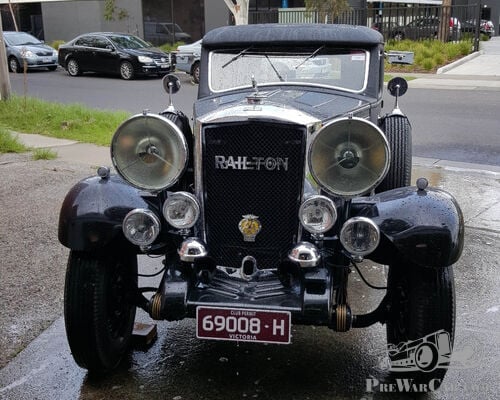
Railton straight 8 sports coupe for rallying REDUCED PRICE run with the bentleys at a fraction of the price
1934 Railton Sports CoupeBuilt for long distance rallyingRebuilt 2017built up at a cost of $160,000AUD, OFFERED FOR SALE AT A ..
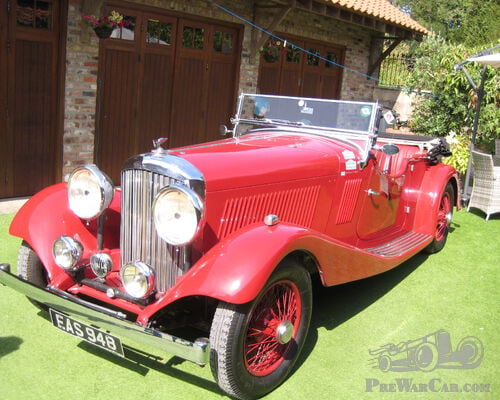
1935 Bentley 3.5 ltr. VDP 4str. Tourer
Chassis B 123 CW was first registered 14th March 1935, and in the late eighties underwent a " body-off" restoration and fitted with VANDEN PLAS
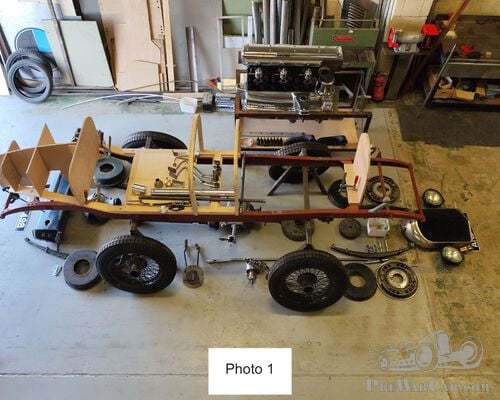
Bentley 3/6 litre sports racing car kit with V5C
I am a specialist vintage and classic car restorer with decades of hands-on experience. For some time I have been collecting parts for a special pr..