The global magazine and marketplace for classic car enthusiasts, by enthusiasts.


Filter
Classic Armstrong Siddeley, Avions-Voisin for sale - Armstrong Siddeley, Avions-Voisin cars for sale
-

1934 Avions Voisin C23/24 Roadster by Saliot | RM Sotheby's | The Monterey Auction
To Be OFFERED AT AUCTION at RM Sothebys' The Monterey Auction event, 13 - 15 August 2026. $2,500,000 - $3,000,000 USD Best of Show at the 2002 Pebble Beach Concours d’EleganceBest of Show at the 2004 Amelia Island Concours d’EleganceA one-off creation by Parisian Avions Voisin impresario Raymond SaliotMeticulou..

Armstrong Siddeley
GB, 1919 – 1960
Armstrong Siddeley Motors Ltd, Coventry, Warwickshire
The Armstrong-Siddeley firm came into being through the fusion of Armstrong-Whitworth’s carmaking activities with Siddeley-Deasy of Coventry. Apart from the abortive Stoneleigh light car of 1922, their products were always solidly-built family vehicles emphasizing good workmanship, comfort and ease of driving rather than high high performance. Up to 1939 the Armstrong-Siddeley cars for sale were readily identifiable by their massive V-radiators (except on certain smaller and cheaper versions), multi-stud disc wheels (though wire was also used in the 1930s) and Sphinx mascots. The first Armstrong-Siddeley design was a 5-litre ohv bi-block six of 30hp. This was joined by a smaller but equally massive 2.3-litre ‘Armstrong-Siddeley 18’ in 1922, and by a 2-litre 4-cylinder ‘Armstrong-Siddeley 14’ – also ohv, but with the first of the flat radiators – late in 1923; this was quite cheap at £360. Front-wheel brakes were available on the 6-cylinder Armstrong-Siddeley cars in 1924, and these also had Monobloc engines by 1926. In 1928 a sv 1.9-litre 15hp six was introduced, followed by an even smaller one of 12hp and 1236cc in1929. Also in 1929 the Wilson preselector gearbox (already tried by Vauxhall) made its debut, first as an optional extra adding £35-£50 to the price, but as standard equipment on all types from 1933 on. The 1930 range consisted of the ‘Armstrong-Siddeley 12’, the ‘Armstrong-Siddeley 15’, a 2.9-litre ‘Armstrong-Siddeley 20’ in owner- and chauffeur-driven versions from £485, an the big ‘Armstrong-Siddeley 30’, now listed with formal coachwork only at £1450.
Armstrong Siddeley production was always on a modest scale, running at about 1.000 a year; one of the best seasons was 1932, at the height of the Depression. An interesting departure for 1933 was the sporting 5-litre Siddeley Special with hiduminium alloy engine. This 90mph machine was catalogued from £950 upward, and some 140 Armstrong-Siddeley cars were sold over the next four seasons, while in 1934 there was a handsome Armstrong-Siddeley sports coupé on the latter (1.4-litre) 12hp chassis for ‘daughters of gentlemen’. After the ‘Armstrong-Siddeley 12’ was dropped at the end of 1936, all Armstrong Siddeleys were ohv sixes and in 1939 these came in 1.7-litre, 2-litre, 2.4-litre, 2.9-litre and 3.7-litre sizes, generally with formal saloon or limousine bodywork. Despite the ‘unsporting’ character of the Armstrong-Siddeley cars, he company’s preselector boxes found many applications on competition machines, noted users being E.R.A., H.W.M. and Connaught. The last Burney Streamlines of 1932-33 used the 20hp Armstrong Siddeley engine.
Armstrong Siddeley were among the first makers to announce a programme after World War 2. These Armstrong-Siddeley cars used the pre-war 16hp 2-litre (enlarged to 2.3 litres in 1949) engine in a new independent front suspension chassis with advanced and attractive styling. For the first time in many years a sliding-type gearbox (with synchromesh) was available as an alternative to the Wilson. The various models were named after famous aircraft produced during the war by the parent Hawker Siddeley Group: Armstrong-Siddeley Hurricane, Armstrong-Siddeley Lancaster, Armstrong-Siddeley Typhoon and, from 1949-1950, the Armstrong-Siddeley Whitley. In 1953 the firm went over to a square 3.4-litre engine with hemispherical head, the result being the Armstrong-Siddeley Sapphire with a choice of synchromesh or electrically-selected preselector. A twin-carburetor 100mph version followed in 1954, automatic transmission was optional on the 1955 Armstrong-Siddeley models for sale and power-assisted steering in 1956 when the range was extended by a brace of smaller Armstrong-Siddeley models. These were the ‘Armstrong-Siddeley 234’ for sale with a 4-cylinder 2.3-litre engine based on the Armstrong-Siddeley Sapphire, and the ‘Armstrong-Siddeley 236’ for sale using the old long-stroke six of similar capacity. Neither sold (or looked) well and they lasted only a couple of seasons. Last of all came the 4-litre Armstrong-Siddeley Star Sapphire, made only with automatic gearbox, though like the latter 3.4-litre cars, it was offered as a limousine as well as a saloon. In the meantime, Hawker Siddeley had amalgamated with another aircraft group, Bristol. The Bristol cars were taken over by an independent company, but Armstrong Siddeley were less fortunate and the last Armstrong-Siddeley Sapphire left the works in the summer of 1960.
Source: Georgano, encyclopedia of motorcar; MCS
The information is written with the greatest of care. However, if you have any suggested amendments please contact us at office@prewarcar.com
Voisin
France, 1919 – 1939
SA des Aéroplanes G. Voisin, Issy-les-Moulineaux, Seine
Gabriel Voisin was first famous for his aircraft. Voisin was one of the earliest and most important pioneers, claiming to have developed a practical aeroplane before the Wright brothers; the controversy still rages. Voisin was always a spectacular character, and so were his Voisin cars. However, like his aircraft, the Voisin cars were efficient machines as well. With the post-World War 1 depression in the aircraft industry, Voisin cars entered motor manufacture by acquiring the rights in a Citroën model which was never made as such. This Voisin car was the Voisin 18CV of 1918, which Voisin car used a Knight double-sleeve engine. Sold as the Type C1 Voisin, this Voisin car had 4-cylinders and a capacity of 4-litres. The Voisin car was a fine car, and henceforth Voisin cars used only sleeve-valve engines, developed by himself to a high degree. The 4-litre Voisin car had aluminium pistons, to permit higher engine speeds, and was eventually capable of 80mph. In spite of an excellent performance, the 4-litre was an immensely strong, refined and silent motor car – all characteristics of Voisin cars in general. A sports version Voisin carwas also offered, with 90bhp. The 4-litre was made until 1926. Alongside this Voisin car, from 1921, was the smaller Voisin C4, an 8CV of 1¼-litres that was later enlarged to 10CV and 1½-litres. In its final form, the 10CV engine of the Voisin car produced 44bhp at 4.000rpm – so much for the opponents of sleeve valves, who claimed that high revolutions could not be combined with reliability – and the Voisin car was capable of 70mph. The Voisin car had Dewandre vacuum servo brakes, as had all Voisin cars from late 1925. The 10CV Voisin car, too, survived in basic form until 1928. All the same, Voisin cars had to follow fashion in one respect, and introduced three 6-cylinder Voisin cars for 1927. The best-known Voisin car was the 13CV, providing 2.3-litres, the first Knight-engined six to be sold in France. Even in normal form, this was a 66bhp, 75mph vehicle, but a sports model Voisin car was also available. From 1928, this six, known as the Voisin Charmant, had alternative final-drive ratio for fast cruising.
Apart from sleeve valves, to which a number of famous manufacturers were wedded at the time, Voisin cars had three other enthusiasms that were considerably less common. One was truly easy gear-changing, which many makers sought, but few actually incorporated in their production cars. The Sensaud de Lavaud system of infinitely variable gears was applied on Voisin cars in 1929, first to the 10CV which, in the following year, had been superseded by a Cotal electric epicyclic gearbox. To this interest was related Voisin cars fondness for multi-cylinder engines, which aimed at giving the utmost flexibility, thereby avoiding gear-changing altogether. Voisin made a V-twelve luxury car as early as 1921. The layout of this Voisin car was revived in 1930 for the Voisin Type C18 Diane. This Voisin car was a 4.8-litre car with a 115bhp engine that needed only 3 forward speeds. The Voisin Simoun and Voisin Sirocco were two low chassis models Voisin cars with striking razor edge saloon and coupé bodies which were made in very small numbers in 1930. Identical except for their engines, the Voisin Simoun used a 5.8-litre six, and the Sirocco the V12. The Voisin Diane was still listed for 1938. The other Voisin cars of the 1930s were sixes, the Voisin Charmant continuing to 1934.
Voisin cars had a reputation for putting into practice ideas which remained ideals for most manufacturers. For example, he was dedicated to weight reduction, and to this end produced notably light patent bodies whose only drawback was their extreme ugliness. Of wood and aluminium, they were entirely practical, being cheap to make, compact, and strong, as well as light. A 2-door, four-seater saloon body on the 10CV Voisin car chassis weighed only 1.060lb, keeping the weight of the whole Voisin car down to 22cwt. The most unprepossessing were the convertible Voisin cars and those with detachable hard tops. Because of their looks, the Voisin cars, with their maker’s patent bodies, never sold well – a deplorable waste of well-directed ingenuity. However, fabric Weymann-type and other normal bodies were also supplied on the Voisin car. From 1931 to 1934, some Imperia cars from Belgium were made under licence. In 1936 a most unusual Voisin car was made in the shape of the straight-12; this Voisin car had two 3-litre, 6-cylinder engines in line, the rear part of the hindmost engine projecting into the driving compartment. 180bhp and 125mph were claimed, but the Voisin car was not put in production. The last Voisin cars, introduced in 1937, used the 6-cylinder 3½-litre Graham engine, though without the supercharger. These Voisin cars were not the work of Gabriel Voisin, but were made by a syndicate that had acquired the Voisin car name. After World War 2, Voisin designed a car which was as complete a contrast to his former work as can be imagined – the Spanish-built Biscuter.
Source: Georgano, encyclopedia of motorcar; TRN
The information is written with the greatest of care. However, if you have any suggested amendments please contact us at office@prewarcar.com


Featured

Daimler Flat six 15 Saloon - Fluid Flywheel / pre-selector
The E20 was manufactured between 1935 and 1939. It offered the choice of a coachbuilt saloon, Sports Saloon, Fixedhead Coupé and Drophead Coupé bod..
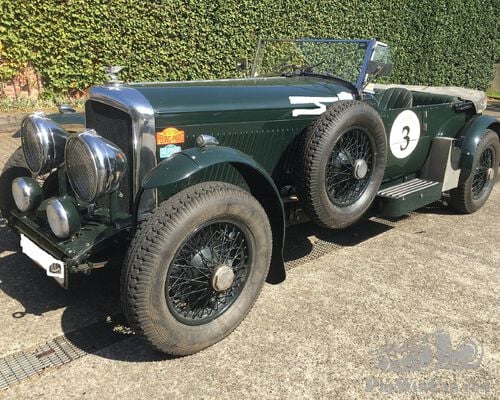
Bentley Derby Special Open Rally Car
This Bentley Derby, manufactured in 1935, has been rebuilt into a short and long-distance rally car. Full rebuilt engine in 2021, Since 2021 low mi..

K3 Replica on KN Chassis
"The K3 Magnette must rank in the history books as the most famous and successful of all the record breaking MGs. With only 33 examples produced durin..