The global magazine and marketplace for classic car enthusiasts, by enthusiasts.


Filter
Classic Franklin, Avions-Voisin for sale - Franklin, Avions-Voisin cars for sale
-

1934 Avions Voisin C23/24 Roadster by Saliot | RM Sotheby's | The Monterey Auction
To Be OFFERED AT AUCTION at RM Sothebys' The Monterey Auction event, 13 - 15 August 2026. $2,500,000 - $3,000,000 USD Best of Show at the 2002 Pebble Beach Concours d’EleganceBest of Show at the 2004 Amelia Island Concours d’EleganceA one-off creation by Parisian Avions Voisin impresario Raymond SaliotMeticulou.. -
1927 Franklin 11-B Tandem Sport
1927 Franklin 11-B Tandem Sport Chassis Number: 164935-17 Registration Number: OFL27H (Germany.) Body Number: 58 A rare & unusual air cooled Franklin as used in a similar model by Charles Lindburgh in peiod. Air cooled 3.3l, 6 cyli..


Franklin
US, 1901 – 1934
(1) H.H. Franklin Mfg Co, Syracuse, N.Y., 1901 – 1917
(2) Franklin Automobile Co, Syracuse, N.Y., 1917 – 1934
Probably the world’s most successful air-cooled car before the advent of the Volkswagen, the Franklin inspired an intense make-loyalty. H.H. Franklin had founded a factory for the manufacture of die castings in 1895, and in 1901 he was introduced to John Wilkinson’s air-cooled designs by Messsrs Brown and lipe, later well known as manufacturers of proprietary transmissions. The New York Motor Co had already made three prototypes before the first Franklin car went on sale in 1902. These Franklin featured transversely-mounted 1.7-litre 4-cylinder air-cooled engines – the valves were overhead, with mechanically operated inlet valves from 1905 – float-feed carburetors, 2-speed planetary gearboxes, central change, full-elliptic suspension and the wooden frames which were to be standard on all Franklin cars up to the end of 1927. A push-on handbrake was used until 1906. Although a Franklin version with water-jacketed engine was projected, the Franklin company remained faithful to air-cooling until they closed down. Sales rose from 13 in 1902 to 184 in 1903, when wire wheels gave way to the wood artillery type, and in 1904 a Franklin broke the San Francisco-New York record. The transverse-engined Franklin cars were catalogued until the end of 1906, but from 1905 onwards new Franklin models with conventionally-located engines made their appearance. These had auxiliary exhaust valves, shaft drive, 3-speed sliding-type gearboxes and round bonnets modelled on the Delaunay-Belleville. A 4-cylinder Franklin sold for $1800, but there was also a 6-cylinder Franklin Model H with a 7-bearing crankshaft and a 9ft 6in wheelbase for $4.000: all subsequent 6-cylinder Franklin cars had seven main bearings. A straight-8 appeared without success in the 1905 Vanderbilt Cup Eliminating Trials. Franklin’s full-elliptic suspension was continued. This gave an excellent ride and resulted in tyre mileages in the region of 20.000: this is why the Franklin company was refusing to fit detachable rims as standard equipment as late as 1922. In 1907 an automatic advance-and-retard was fitted on the Franklin and in 1908 a gear-driven fan. The 1910 Franklin cars used a suction-driven sirocco fan incorporated in the flywheel. Smallest of the 1909 range was the 18hp Franklin Model G, a 2.3-litre 4-cylinder car with quadrant change sold at $1850. Selective change was used on the bigger Franklin fours and sixes which had oversquare cylinder dimensions and cost $2800 and $3750 respectively. With the 1912 Franklin models came a Renault-type bonnet and full pressure lubrication, and a 4-cylinder was still available at $2.000, or $1.500 less than the big 38.4hp 6-cylinder.
In 1914 only a 6-cylinder car, the ‘Franklin 6/30’, was offered, and Franklin fell into line with the rest of the American industry by going over to left-hand drive, central change and full electrical equipment. A year later aluminium pistons were adopted. A stunt drive by Franklin from Walla Walla, Washington, to San Francisco in bottom gear demonstrated the car’s ability to keep cool. The 1917 models had electric chokes, while imitators arose in the industry to try and cash in on Franklin’s success with air-cooling. One of these firms, Holmes, was headed by former vice-president of the Franklin Automobile Co. By the end of World War 1 a 6-cylinder Franklin could be bought for $2.050, reduced two years later to $2.000. 8.648 Franklin cars were sold in 1920. Late in 1922, came a redesigned Franklin car with a ‘horse-collar’ bonnet allegedly modelled on the Fiat, pressure air-cooling with frontal blower, unit gearbox, single dry-plate clutch, 6-volt instead of 12-volt electrics and detachable rims. Sales rose to 11.000 and the Franklin company which had pioneered series-production closed cars as early as 1913 was offering a Franklin sedan at $2.850. During 1925 the design was face-lifted once again and the De Causse-styled Franklin Series 11 introduced. Cylinder capacity remained a modest 3.3-litres, but appearance was entirely changed with a 9ft 11in wheelbase and a vertical-barred ‘radiator’. This revolutionary step so appalled John Wilkinson that he resigned from the Franklin company forthwith. Some of the semi-custom body styles – especially the boat-taled sports coupé at $3.150 – were remarkably attractive. Subsequently some excellent and expensive custom bodywork was designed for Franklin by such firms as Derham, Willoughby, Holbrook, and (especially) Dietrich. Over 13.000 Franklin Series 11s were sold between mid-1925 and the end of 1926, among those who favoured Franklins being Colonel Charles Lindbergh. Yet even the ‘Franklin 11B’ of 1927 retained the wooden frame, full-elliptic suspension and foot transmission brake. Front-wheel brakes did not arrive until the introduction of the 1928 3.9-litre Franklin Airman, which boasted internal-expanding Lockheed hydraulics at a time when the contracting type was generally favoured in America. In 1928 long-chassis models were given steel frames, standardized in 1929, and a standard sedan sold for £885 in England. All but the cheapest Franklin cars now had silent 2nd gearboxes. This was the period in which Dietrich introduced their delightful speedster (actually a 4-door convertible sedan) and a 4½-litre 6-cylinder Franklin engine actually took to the air in a Waco biplane. Prices were generally in the $2.200 - $3.500 range, with custom Franklin models running up to $7.200.
The 1930 Franklin Series 14 introduced a new radiator and side-blast cooling, an the elegant Pirate models had concealed running-boards as well. The unconventional, however, could no longer sell in America, and only 2.851 Franklin cars were delivered in 1931. In 1932 came synchromesh, free wheels and ‘Startix’ devices, as well as a magnificent Dietrich-styled 6.8-litre supercharged V12 (Franklin Series 17) on a 12ft wheelbase. Unfortunately this was re-engineered to incorporate proprietary axles and semi-elliptic suspension, and in production form it weighed nearer three tons than the two tons of the prototype. It combined elegance, 95mph, and 150bhp for $4.400, but few were sold, though a dratic price cut to $2.885 was made for 1933. The last new Franklin was the Franklin Olympic, an inexpensive 6-cylinder using a Franklin engine wedded to a REO chassis and body. The Franklin factory closed down in 1934. The patents were, however, taken over by the Air-Cooled Motors Corporation (now Franklin Engine Co.), whose Syracuse factory has specialized in light horizontally-opposed aircraft engines: a 6-cylinder Franklin helicopter engine, converted to water-cooling, powered the Tucker of 1947. 2-, 4-, and 6-cylinder untis up to 5.7 litres’ capacity were being produced in 1972.
Source: Georgano, encyclopedia of motorcar; MCS
The information is written with the greatest of care. However, if you have any suggested amendments please contact us at office@prewarcar.com
Voisin
France, 1919 – 1939
SA des Aéroplanes G. Voisin, Issy-les-Moulineaux, Seine
Gabriel Voisin was first famous for his aircraft. Voisin was one of the earliest and most important pioneers, claiming to have developed a practical aeroplane before the Wright brothers; the controversy still rages. Voisin was always a spectacular character, and so were his Voisin cars. However, like his aircraft, the Voisin cars were efficient machines as well. With the post-World War 1 depression in the aircraft industry, Voisin cars entered motor manufacture by acquiring the rights in a Citroën model which was never made as such. This Voisin car was the Voisin 18CV of 1918, which Voisin car used a Knight double-sleeve engine. Sold as the Type C1 Voisin, this Voisin car had 4-cylinders and a capacity of 4-litres. The Voisin car was a fine car, and henceforth Voisin cars used only sleeve-valve engines, developed by himself to a high degree. The 4-litre Voisin car had aluminium pistons, to permit higher engine speeds, and was eventually capable of 80mph. In spite of an excellent performance, the 4-litre was an immensely strong, refined and silent motor car – all characteristics of Voisin cars in general. A sports version Voisin carwas also offered, with 90bhp. The 4-litre was made until 1926. Alongside this Voisin car, from 1921, was the smaller Voisin C4, an 8CV of 1¼-litres that was later enlarged to 10CV and 1½-litres. In its final form, the 10CV engine of the Voisin car produced 44bhp at 4.000rpm – so much for the opponents of sleeve valves, who claimed that high revolutions could not be combined with reliability – and the Voisin car was capable of 70mph. The Voisin car had Dewandre vacuum servo brakes, as had all Voisin cars from late 1925. The 10CV Voisin car, too, survived in basic form until 1928. All the same, Voisin cars had to follow fashion in one respect, and introduced three 6-cylinder Voisin cars for 1927. The best-known Voisin car was the 13CV, providing 2.3-litres, the first Knight-engined six to be sold in France. Even in normal form, this was a 66bhp, 75mph vehicle, but a sports model Voisin car was also available. From 1928, this six, known as the Voisin Charmant, had alternative final-drive ratio for fast cruising.
Apart from sleeve valves, to which a number of famous manufacturers were wedded at the time, Voisin cars had three other enthusiasms that were considerably less common. One was truly easy gear-changing, which many makers sought, but few actually incorporated in their production cars. The Sensaud de Lavaud system of infinitely variable gears was applied on Voisin cars in 1929, first to the 10CV which, in the following year, had been superseded by a Cotal electric epicyclic gearbox. To this interest was related Voisin cars fondness for multi-cylinder engines, which aimed at giving the utmost flexibility, thereby avoiding gear-changing altogether. Voisin made a V-twelve luxury car as early as 1921. The layout of this Voisin car was revived in 1930 for the Voisin Type C18 Diane. This Voisin car was a 4.8-litre car with a 115bhp engine that needed only 3 forward speeds. The Voisin Simoun and Voisin Sirocco were two low chassis models Voisin cars with striking razor edge saloon and coupé bodies which were made in very small numbers in 1930. Identical except for their engines, the Voisin Simoun used a 5.8-litre six, and the Sirocco the V12. The Voisin Diane was still listed for 1938. The other Voisin cars of the 1930s were sixes, the Voisin Charmant continuing to 1934.
Voisin cars had a reputation for putting into practice ideas which remained ideals for most manufacturers. For example, he was dedicated to weight reduction, and to this end produced notably light patent bodies whose only drawback was their extreme ugliness. Of wood and aluminium, they were entirely practical, being cheap to make, compact, and strong, as well as light. A 2-door, four-seater saloon body on the 10CV Voisin car chassis weighed only 1.060lb, keeping the weight of the whole Voisin car down to 22cwt. The most unprepossessing were the convertible Voisin cars and those with detachable hard tops. Because of their looks, the Voisin cars, with their maker’s patent bodies, never sold well – a deplorable waste of well-directed ingenuity. However, fabric Weymann-type and other normal bodies were also supplied on the Voisin car. From 1931 to 1934, some Imperia cars from Belgium were made under licence. In 1936 a most unusual Voisin car was made in the shape of the straight-12; this Voisin car had two 3-litre, 6-cylinder engines in line, the rear part of the hindmost engine projecting into the driving compartment. 180bhp and 125mph were claimed, but the Voisin car was not put in production. The last Voisin cars, introduced in 1937, used the 6-cylinder 3½-litre Graham engine, though without the supercharger. These Voisin cars were not the work of Gabriel Voisin, but were made by a syndicate that had acquired the Voisin car name. After World War 2, Voisin designed a car which was as complete a contrast to his former work as can be imagined – the Spanish-built Biscuter.
Source: Georgano, encyclopedia of motorcar; TRN
The information is written with the greatest of care. However, if you have any suggested amendments please contact us at office@prewarcar.com


Featured
Rolls-Royce
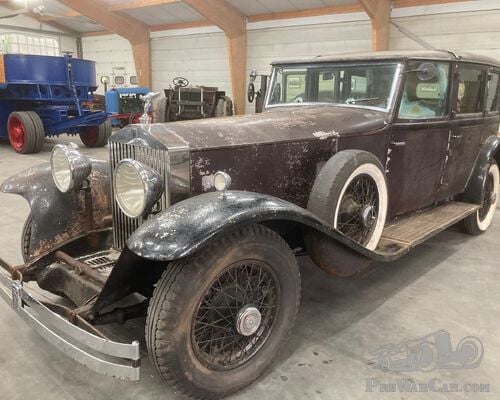
Rolls-Royce Phantom ll chassisnummer 287 AJS. bouwjaar 1932, Links gestuurd, Brewster Keswick Sedance Towncar

1915 Rolls-Royce Silver Ghost Barker Tourer
⁃ An exceptionally rare original bodied pre-war Silver Ghost⁃ Desirable Barker tourer in exciting barn find condition⁃ ..
1932 - Graham " Lucenti " Indianapolis
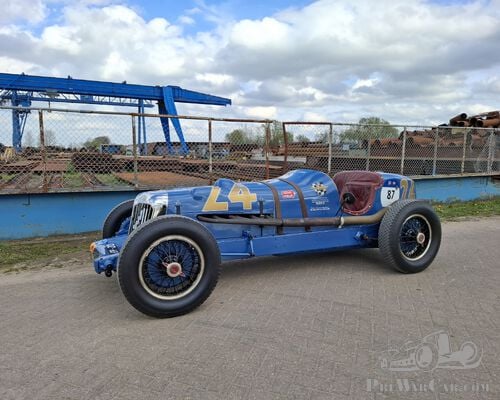
Original participant of the 1932, 1934 and 1935 Indy 500. Best result: finishing 10th overall in the 1934 Indy 500 with driver “Herb” Ardinger...