The global magazine and marketplace for classic car enthusiasts, by enthusiasts.


Filter
Classic Vermorel, White for sale - Vermorel, White cars for sale
-

1936 Bentley Derby 4.25 Sedanca by Thrupp & Maberly
1936 Bentley Derby 4.25 Sedanca by Thrupp & Maberly Chassis number: B-36-GA Registration Number: CXE213 A stunningly beautiful car which wows onlookers wherever it is seen, this 4.25 Litre Derby Bentley Sedanca Coupe has fabulous and possibly unique aluminium Sedanca coachwork by Thrupp and Maberly... -
Cadillac V16 - Series 452 - 1930 - Imperial Sedan 4330
Offers invited a round € 200.000 - This ONE of 4 Survivors of Serie 4330 body style - book C.W. Cummings - 2014) ***excellent driving car, the V16 gives you a special experience, no other car has***https://www.prewarcar.com/a-stately-cadillac-v16-in-the-netherlandsBuilt; no 9 of 50 - Engine no. 700163Lengt.. -
Bugatti Type 30 short chassis roadster. Fully restored on a replica chassis
This car has had a full restoration and is build from a lot of original parts on a replice chassis built in Germany, It has chassis number BC 189 from the UK Bugatti Owners Club. Car has done only about 500km since restoration but health problems dictate that it must go. Please email for fullest details of the source of all the parts and a vide.. -
1930 Bentley Speed Six
1930 Bentley Speed Six Chassis Number: SB2774 Engine Number: SB2772 Reistration Number: GH8974 New to market & freshly restored to perfection. This car has over the past two years been fully rebuilt & built up as a LeMans style tourer by noted Rolls Royce &.. -
1936 Cadillac Series 60 Convertible Coupe | RM Sotheby's | The Hershey Auction
To Be OFFERED AT AUCTION WITHOUT RESERVE at RM Sothebys' The Hershey Auction event, 7 - 8 October 2026. Offered Without Reserve | $50,000 - $70,000 USD Please check back soon as our dedicated cataloguing team is preparing the description for this lot. To view this car and others currently consigned to this auction, please visit the RM website a.. -
Renault NN Torpedo Commerciale (1926)
Highlights Complete, coherent, unmodified exampleExcellent base for a full restorationAttractive 1920s torpedo body styleVery accessible entry priceIdeal for workshops or enthusiasts looking for a rewarding project Restoration project – Complete car – Solid base but major work r.. -
Renault 12 HP Coupé de Ville Carrosserie Kellner Type CB – 1911
HighlightsExceptional original conditionRare Kellner coachworkComplete, authentic, coherent exampleOriginal paint and interiorMuseum‑grade preservationIdeal for concours preservation class Kellner Coupé de Ville – Exceptional original condition This.. -
De Dion‑Bouton Type D (1899)
HighlightsRare early De Dion‑Bouton, highly collectibleBeautiful presentation and coherent historyEligible for major international veteran eventsA centrepiece for any prestigious collection Vis‑à‑vis “La Petite Voiture” – High‑quality restoration – Veteran car eligible .. -
1940 Buick Super Convertible Coupe | RM Sotheby's | The Hershey Auction
To Be OFFERED AT AUCTION WITHOUT RESERVE at RM Sothebys' The Hershey Auction event, 7 - 8 October 2026. Offered Without Reserve | $50,000 - $60,000 USD Please check back soon as our dedicated cataloguing team is preparing the description for this lot. To view this car and others currently consigned to this auction, please visit the RM website a.. -
1938 Rolls Royce Wraith Gurney Nutting Sedanca Coupe
1938 Rolls Royce Wraith Gurney Nutting Sedanca Coupe Chassis number: WRB2 Registration number: FLH5 This car may be paid for in Bitcoin. Approx 3 BTC Simply the best of the best & a Pebble Beach/Villa D'Este quality car. This wrait..


Vermorel
France, 1908 – 1930
Etablissements V. Vermorel, Villefranche, Rhone
These makers of woodworking machinery were established in 1850 and were experimenting with Vermorel cars as early as 1902, though production of Vermorel cars did not start until 1908. Early Vermorel cars were conventional 1.8-litre T-head machines with 4-speed gearboxes and three-quarter-elliptic rear suspension. 2.2-litre and 3.3-litre cars of this type were listed in 1912, but 1913 saw the beginning of a more modern trend with the introduction of new L-head monobloc Vermorel carmodels, the 1½-litre 8/10hp Vermorel carand the 2.8-litre 16/20. The bigger Vermorel cars had V-radiators and were said to be capable of 72mph. A year later the last of the T-head Vermorel cars had been replaced by a 2.3-litre L-head 15/18, which Vermorel car reappeared after World War 1 in much the same guise. Also rather old-fashioned was the 1.7-litre 8/16CV Vermorel car of 1922, with its sv fixed-head engine, foot transmission brake, and cone clutch, though a dunamotor was fitted, the 4-speed gearbox had central change, and 4-wheel brakes were available. An ohv sports version Vermorel car with wire wheels was offered in 1923, and these two parallel Vermorel cars acquired full-pressure lubrication in 1925, and coupled brakes and plate clutches a year later. 1924 saw an ohc 16/60hp 4-cylinder Vermorel car with a 2.6-litre engine and detachable head, but this Vermorel car was clearly intended for formal coachwork with its 11ft 3in wheelbase. In 1927 the ZX type 1.7-litre Vermorel car was still being made, and there was also an undistinguished 1.100cc sv 4-cylinder Vermorel car on conventional lines. The last of the Vermorel cars was the type AH3 of 1929, a straightforward ohv 2-litre 6-cylinder with 12-volt coil ignition, a 4-speed unit gearbox with central change, semi-elliptic springs, and spiral bevel final drive. The Etablissements Vermorel abandoned Vermorel car manufacture in 1930.
Source: Georgano, encyclopedia of motorcar; MCS
The information is written with the greatest of care. However, if you have any suggested amendments please contact us at office@prewarcar.com
White
US, 1900 – 1918
(1) White Sewing Machine Co, Cleveland, Ohio, 1900 – 1906
(2) The White Co, Cleveland, Ohio, 1906 – 1918
Rollin H. White of the Cleveland sewing-machine concern produced their first White steam car in 1900. This White steam car was a light chain-drive Stanhope with tiller steering and a simple 2-cylinder under-floor engine. The White steam car had an underslung frontal condenser, and 193 White steam cars were sold in 1901, the first year of full production. This gave way in 1903 to a White steam car model with a front-mounted compound engine under a bonnet, condenser in the normal ‘radiator’ position, wheel steering, and shaft drive.
These White car and subsequent White steam cars used a semi-flash type of boiler, and could run a hundred miles between fillings of water. Frames of the White steam cars were of armoured wood, and a tonneau White car cost $2.000.
The White steam cars did well in early Glidden Tours, and racing versions, such as Webb Jay’s Whistling Billy with an underslung frame, were also successful; this White steam car covered a mile at 74.07mph. Theordore Roosevelt used a White steam car during his tenure of the White House. 1905 White steam cars had a 2-speed back axle, and also a ‘free engine’ enabling the pumpt to work without manufal assistance when the White car was stationary in traffic. 1906 was the best sales year for the White car company, with 1.534 White cars devlivered, but steam-car production was held at over 1.000 White steam cars a year to the end. By 1908, the White steam car company was offering two models, a 20hp White Model L at $2.500, and the big seven-seater Model K White car with a 10ft 2in wheelbase at $3.700. Joy valve motion replaced the Stephenson link type on 1909 White steam cars, which had both sets of brakes working on the rear wheels of the White car.
White steam cars continued to be listed into 1911, though the 1910 White MM and White OO were the last new White steam cars. For the 1910 season the White car company offered a 3½-litre sv petrol car with a monobloc engine inspired by the Delahaye; the 4-speed gearbox of the White car had a geared-up top. This White car was joined in 1912 by a really big six rated at 60hp, and this White car was selling for $5.000, still with 4 forward speeds. Electric lighting and starting were added on these White cars during the year, and these 4- and 6-cylinder White cars were continued until 1916.
The 1917 models White cars were 16-valve fours of over 6½-litres’ capacity, with magneto ignition, these White cars were selling at $5.000 upwards.
By this time the White car company was firmly established in the truck field, and after 1918 private White cars and White steam cars were made to special order only, and in very small numbers. The last of these ‘special White cars’ was made in 1936.
Rollin White was subsequently responsible for the Rollin car in 1923, while the White car firm also absorbed two truck-makers who had previously built private cars, Autocar and ReO.
US, 1909
George White Buggy Co, Rock Island, Ill.
This White car was a high-wheel buggy, but the mounting of the engine at the front under a bonnet gave the White car more the appearance of an ordinary car than many of its kind. The engine of this White car was a 2-cylinder 12/14hp unit which drove via a 2-speed epicyclic gear and propeller shaft. Two- and four-seater bodies were available on White cars.
US, 1914
White Manufactuing Co, Waterloo, Iowa
The White car was a cyclecar and used a 9hp ohv V-twin engine. This White car had chain final drive.
Source: Georgano, encyclopedia of motorcar; MCS, GNG
The information is written with the greatest of care. However, if you have any suggested amendments please contact us at office@prewarcar.com


Featured
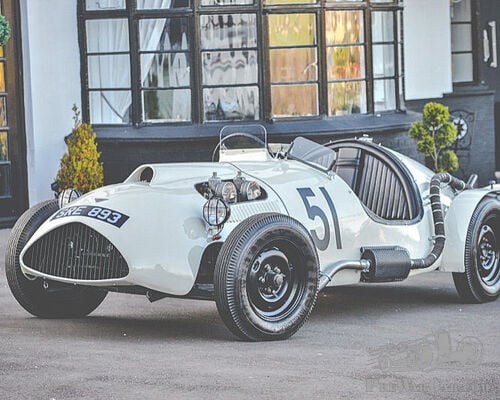
1933 Alvis 3.0 Special - One-Off Alloy Body | Period Competition Car | Featured in “Alvis – A Century of Drivers”
1933 Alvis 3. 0 Special - One-Off Alloy-Body | Period Competition Car | Featured in “Alvis – A Century of Drivers”
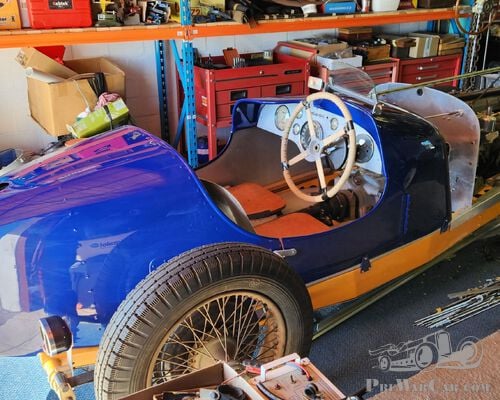
Riley TT Sprite
1935 6-cylinder TT Sprite replica. Chassis # 46A2722. Engine # 6A2722. Original Ulster Imp body. Restoration nearing completion. Engine, G..
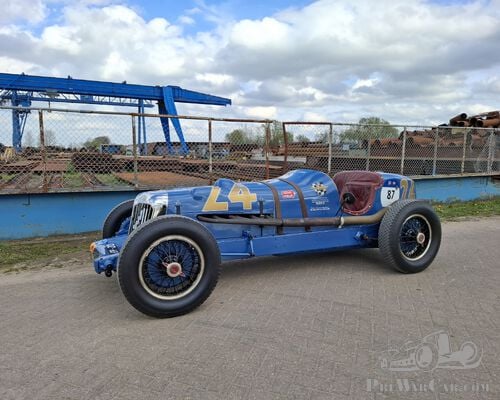
1932 - Graham " Lucenti " Indianapolis
Original participant of the 1932, 1934 and 1935 Indy 500. Best result: finishing 10th overall in the 1934 Indy 500 with driver “Herb” Ardinger...