The global magazine and marketplace for classic car enthusiasts, by enthusiasts.


Filter
Classic Léon Bollee, Wolseley (-Siddeley) for sale - Léon Bollee, Wolseley (-Siddeley) cars for sale
-

1913 Wolseley 24/30HP Two-Seater
1913 Wolseley 24/30HP Two-Seater Chassis no. 20034Registration no. J1296Engine no. 34/1134 1913 Wolseley 24/30HP Two-Seater for sale: A large and imposing Edwardian two seat tourer, this 24/30hp model sports Wolseleys large 5 litre six cylinder engine giving ample power and easy modern day cruising spe.. -
Wolseley Hornet - 1935
This beautiful Wolseley Hornet began life as a closed saloon. in 2009, the car was extensively restored in Germany by a marque specialist. During the restoration, the saloon body was replaced by an old ‘Daytona’ body fromt Eustace Watkins (London, UK), which was also fully restored. The Hornet is powered by the original (rebuilt) and very smooth.. -
Wolseley Nine 2+2 seater Sports 1935 for sale
Attractive Wolseley "Nine". Very sound chassis with original overhead cam 4 cylinder /1018cc engine. New wooden body frame and floor made by Dennis Compter coachbuilder. Comes complete with frontscreen, bucket seats, dashboard, rear guards, running boards and all instruments. Ask for more photos. The panel work can be completed in our workshop..


Léon Bollee
France, 1895 – 1933
(1) Automobiles Léon Bollée, Le Mans, 1895 – 1924
(2) Morris Motors Ltd, Usines Léon Bollée, Le Mans, 1925 – 1931
(3) Sté Nouvelle Léon Bollée, Le Mans, 1931 – 1933
Leon Bollee was a son of Amédée Bolllée père, the most important pioneer of steam road vehicles in France. Leon Bollee, however, turned to really small petrol Leon Bollee cars. He was the first to do so, and therefore had to invent a new name for his Leon Bollee car of 1895 – he called it a Leon Bollee voiturette. This Leon Bollee car was a tandem two-seater 3-wheeler that was faster than any other petrol-engined vehicle on the road when the Leon Bollee car was working, thanks to a powerful 3hp engine and light weight, but the power unit was unreliable on the Leon Bollee car. The Leon Bollee car had a single air-cooled cylinder of 650cc and used hot-tube ignition. There were 3 forward speeds on the Leon Bollee car, with belt final drive. The frame was tubular. Four years after the Leon Bollee voiturette appeared, Leon Bollee superseded it with a 4-wheeler with independent front suspension by double transverse leaf springs. This Leon Bollee car had a single-cylinder, water-cooled engine. Unlike the Leon Bollee voiturette, this Leon Bollee car made no mark. The design rights were sold to Darracq, and around 1901 the name of Leon Bollee cars vanished. Meanwhile, the term voiturette had been taken up by the trade and public in general as the name for a small light car.
The Leon Bollee car reappeared in 1903 as an entirely normal, full-sized car in the more expensive class, backed by Vanderbilt money and designed for the American market. This Leon Bollee car was made in 28hp (4.6-litres) and 45hp (8-litres) versions, with four cylinders and chain drive, and led on to a 11.9-litre six Leon Bollee car in 1907, in which year the first shaft driven Leon Bollee car appeared. From 1909 there was also a small modern four, the Leon Bollee 10/14hp. The 1910 range embraced 9 Leon Bollee cars, including 2 of over 10-litres capacity. Electric lighting became available on Leon Bollee cars in 1913, but the Leon Bollee grew increasingly old-fashioned after World War 1 despite the introduction of ohv in 1922 on Leon Bollee cars and front wheel brakes in 1923. Late in 1924 Sir William Morris bought the Le Mans Leon Bollee car factory. From making a wide range of conservative French Leon Bollee fours, it turned to thinly-disguised products of Cowley, Oxford, the idea being to breach the French tariff walls from the inside. The first Morris- Leon Bollee had a 12CV 2½-litre 4-cylinder unit-construction engine made by Hotchkiss, the engine manufacturers controlled by Morris, but it had push-rod overhead valves and bore little evidence of its parentage. Not so the 18CV Morris- Leon Bollee car of 1928. This was a 3-litre straight-8 with single overhead camshaft that reflected Morris’ takeover of Wolseley two years earlier. Morris’ own new six of 1928 was mirrored in the 15CV 2.6-litre Le Mans product of 1929. The bodies for the Morris- Leon Bollee car were all made in France and were usually considerably more dashing and attractive than their British counterparts. Chassis of this Morris- Leon Bollee car were made in France, and all cars had a 4-speed gearbox. At one time, 50 12CV Morris- Leon Bollee cars were being turned out each week. However, Morris’ enterprise was not a success, and he discontinued it in the hard times of the Depression. A new syndicate was formed in September 1931 to sell the same range of cars under the name of Leon Bollee cars. This lasted for less than two years and few Leon Bollee cars were made.
Source: Georgano, encyclopedia of motorcar; TRN
The information is written with the greatest of care. However, if you have any suggested amendments please contact us at office@prewarcar.com
Wolseley (-Siddeley)
GB, 1899 – 1906, 1911 to date
(1) Wolseley Sheep Shearing Machine Co Ltd, Birmingham, 1899 – 1901
(2) Wolseley Tool and Motor Car Co Ltd, Birmingham, 1901 – 1914
(3) Wolseley Motors Ltd, Birmingham, 1914 – 1927
(4) Wolseley Motors (1927) Ltd, Birmingham, 1927 – 1948
(5) Wolseley Motors (1927) Ltd, Cowley, Oxford, 1949 – 1970
(6) Austin-Morris Division, British Leyland Motor Corp Ltd, Cowley, Oxford, 1970 to date
The first prototype Wolseley car was a 3-wheeler on Léon Bollée lines made by the Wolseley car company’s General Manager, Herbert Austin, in 1896. The Wolseley car featured two horizontal cylinders and overhead camshaft. A second improved Wolseley car model was made in 1897, but production Wolseley cars were based on the 3½hp 4-wheeler of 1899, which competed successfully in the Thousand Miles’ Trial of 1900. This Wolseley car had a single-cylinder horizontal engine mounted at the front with the head pointing forward, automatic inlet valve, coil ignition, a wrap-round tubular radiator, 3-forward speeds, tiller steering, and belt primary and chain final drive, and formed the basis for the Austin-designed Wolseley cars made under Vickers auspices for the next six years.
By 1901 wheel steering, artillery wheels and chain primary drive had been adopted on the Wolseley car, and the single, now rated at 5hp, could be bought for £260, while there was a 10hp 2.6-litre twin Wolseley car at £360, and a 4-cylinder racing Wolseley car with 5-speed gearbox available to special order. Wolseley cars were already among the biggest British producers with 327 Wolseley cars sold that year, increasing to 800 in 1903 and 3.000 Wolseley cars by 1914, when they led the national industry. A 5.2-litre horizontal-four Wolseley car was listed in 1902, from which 52mph was claimed, and the twin-cylinder Wolseley cars of 1905-1906 had mechanically-operated inlet valves.
Austin supported racing energetically, entering 3- and 4-cylinder Wolseley cars for the Paris-Vienna in 1902, while the big 11.9-litre flat-4 Beetles put up the best British performances in the Gordon Bennett Cup Races of 1904 and 1905. Queen Alexandra bought a Wolseley car in 1904, but Austin’s obstinate adherence to the horizontal engine was not appreciated by the Wolseley car company’s directors, and he resigned in 1905 to form his own company. Already Wolseley were making a 3.3-litre vertical-engined 4-cylinder Wolseley car to the designs of J.D. Siddeley (variously known as a Wolseley-Siddeley or Siddeley), and these versions dominated the Wolseley car range in 1906, though single- and twin-cylinder Wolseley cars of the Austin era survived for one more season. 1906 Wolseley-Siddeley cars were made with overhead inlet valves, and (in some cases) overdrive gearboxes, bigger Wolseley car models having oversquare engines, separately-cast cylinders, and chain drive, while the range embraced everything from a shaft-driven 12hp vertical-twin at £325 up to a touring version of Siddeley’s 1905 Gordon Bennett Trials racer, a 15.7-litre Wolseley-Siddeley car listed at £1.250. Licence-production of Wolseley cars in Italy was initiated under the name of Wolsit. Thermo-syphon cooling was introduced on the Wolseley-Siddeley Ten in 1907, in which year a shaft-driven version of the 5½-litre 4-cylinder 30 could be bought, as well as the Wolseley car company’s first six, an 8½-litre 45 with dual ignition. L-head engines were standard in 1908, and 1909 saw the end of chain drive and the introduction of a smaller 24/30hp 6-cylinder Wolseley-Siddeley car. In 1910 came the very successful monobloc 2.2-litre 4-cylinder Wolseley-Siddeley 12/16 with pressure lubrication and worm drive at £370. At the other end of the range was the big bevel-driven 6-cylinder Wolseley-Siddeley 40/50 at £660 for a chassis.
Siddeley had gone to Deasy in 1909, and for 1911 the cars became plain Wolseley cars once more. 1913 Wolseley cars had air-pressure fuel feed, the best seller being the 3.2-litre 16/20 Wolseley car with dual ignition at under £500. In this year an experimental gyrocar was made for the Russian inventor Count Schilovsky, while a worm-driven light car, the Wolseley Stellite, was being made by a subsidiary company. The 1914 Wolseley car range consisted of the 16/20, and two sixes rated at 24/30 and 30/40, all Wolseley cars with electric lighting and detachable wire wheels. The Wolseley sixes had bevel drive, and came equipped with compressed-air starters, supplanted in 1919 by conventional electrical units.
Wolseley cars made the V8 overhead-camshaft Hispano-Suiza aero engines during World War 1, and their first true post-war 1 Wolseley cars featured both overhead camshafts and detachable heads, though a 3.9-litre sv six Wolseley car was made in various forms up to 1927. The 1.3-litre 10 Wolseley car had a rear-axle gearbox, quarter-elliptic springs, worm drive, and coil ignition, and replaced the Stellite; it cost £500, and there was a companion 2.6-litre ohc 15 Wolseley car with a conventionally-mounted gearbox. In 1921 the Wolseley car company made 12.000 Wolseley cars, and numerous types were offered in ensuing years, including aluminium-bodied sports versions of the 10 and 15 Wolseley cars, an austerity edition of the 10 two-seater, and a 7hp flat-twin at £295. In 1925 the 10 grew up into a four-seater 11/22 Wolseley car, and the 15 was replaced by an sv 16/35 Wolseley car, the last new side-valve Wolseley car.
For 1927 the Wolseley car company offered a new 2-litre 16/45hp ohc Wolseley car Silent 6 with spiral bevel final drive and 4-speed gearbox, but in the meanwhile the Wolseley car company had gone bankrupt, and had been acquired by Sir William Morris (Lord Nuffield). Under new management the ohc designs Wolseley cars were developed as well as being adapted to the companion makes of Morris and MG. New Wolseley cars in 1928 were a coil-ignition 2.7-litre straight-8 at £750, and a 12/32hp 4-cylinder, also ohc, at £315. In 1929 there was a short-lived and very expensive 8-cylinder 32/90 Wolseley car and a more important 6-cylinder 21/60 Wolseley car which in export form boasted Budd welded all-steel bodywork and Lockheed hydraulic brakes, and was virtually a Wolseley car edition of the Morris Isis which followed it in the 1930 season.
That year Wolseley cars pioneered the really cheap small six in England with the 1.3-litre Wolseley Hornet; this Wolseley car shared the 21/60’s hydraulics, and resembled a Morris Minor with two extra cylinders and an elongated bonnet. The Wolseley car offered remarkable flexibility for £185, and attracted a vast diversity of inexpensive special bodywork from such firms as E.W. (Eustace Watkins) and Swallow. The 1931 stablemates of this Wolseley car were a 2-litre Wolseley Viper with Morris styling at £285, and 6- and 8-cylinder versions of the 21/60 Wolseley car, all with overhead camshafts. 1932 Wolseley Hornets had a forward engine mounting allowing of roomy 4-door saloon bodywork without lengthening the wheelbase, while a twin-carburettor sports version, the Wolseley Hornet Special, was marketed as a chassis only at £175.
In 1933 came the illuminated radiator badge on the Wolseley car, a Wolseley hallmark over since, and 1934 Wolseley cars had synchromesh, a roomy 1-litre 4-cylinder Wolseley Nine at £179 joining the Wolseley Hornet, now available with free wheel at £215. In 1935 there was a brief venture with preselector gearboxes and some new ohc 6-cylinder Wolseley cars. The Wolseley Nine gave way to the bigger Wolseley Wasp, the Wolseley Hornet grew up to 1.4-litres, and a 1.6-litre 14hp Wolseley car formed the basis for a 50bhp Wolseley Hornet Special capable of nearly 80mph, but 1936 was the last year of overhead camshafts on Wolseley cars. Already the old 21/60 had been replaced by a range of ohv push-rod Super Sixes, virtually luxury 4-speed Wolseley car derivatives of the Series II Morris with easy-clean wheels and more luxurious equipment, and by the end of the year the 4-cylinder light Wolseley cars had fallen into line with this theme. Last to go was the Wolseley Fourteen which in June, 1936 reappeared as a push-rod 1.8-litre 14/56 selling for £265.
By 1939-1940 a comprehensive Wolseley car range included a 1.140cc Wolseley Ten (the mechanical components of Morris’s Series-M mounted in a separate chassis), a 1½-litre 4-cylinder 12/48 Wolseley car, and sixes of 14, 16, 18, 21, and 25hp, the last-mentioned version of the Wolseley Super Six being also available as a sporting drophead coupé and a limousine. The 18hp model Wolseley car, introduced in 1937, was adopted by Scotland Yard and was the first Wolseley car to win general favour with police forces, a connection that has continued with subsequent 6-cylinder models into the 1960s. A 1939 18/85 Wolseley car driven by Humfrey Symons broke the London-Cape record with a time of 31 days 22 hours despite falling through a bridge in the Congo.
A rather smaller range of similar Wolseley cars went back into production in 1945, rounded out by an 8hp Wolseley car which was a de luxe, ohv development of the Series-E Morris 8. For 1949 a removal to Cowley was accompanied by two entirely new Wolseley cars with unitary construction, and hypoid final drive: these Wolseley cars were basically similar to the Morris Oxford and Six, though the smaller 4/50 had a 4-cylinder version of the ohc power unit common to the Morris and Wolseley Sixes. Coil-and-wishbone independent front suspension replaced the torsion-bar layout in the 1953 4/44 Wolseley car, powered by a detuned version of the T-type MG engine, but the effect of the Nuffield-Austin merger was soon felt in a rationalization of design.
The first Austin-engined Wolseley car was the 2.6-litre 6/90 of 1955, which Wolseley car shared a both with Riley’s Pathfinder, and was available the following year with overdrive or automatic transmission, but 1958 brought an attractive compact 1½-litre saloon, the Wolseley 1500, which was basically an expanded Morris Minor with rack-and-pinion steering and a close-ratio 4-speed gearbox. A Riley equivalent was also marketed, and BMC’s Australian factory offered variants with Austin and Morris nameplates.
This was Wolseley cars last individual effort, and subsequent Wolseley cars have been luxury editions of basic Austin/ Morris themes, a Mini variant, the Hornet, making its appearance in 1962. A luxury 1100 variant appeared in 1966, evolving into a 1300 by 1968. A year earlier Wolseley cars had announced their 18-85 or de luxe 1800, though the Hornet had gone by 1969. In 1973 the 1300, the 18-85, and a 6-cylinder front wheel drive 2200 were offered.
Source: Georgano, encyclopedia of motorcar; MCS
The information is written with the greatest of care. However, if you have any suggested amendments please contact us at office@prewarcar.com


Featured

1915 Rolls-Royce Silver Ghost Barker Tourer
⁃ An exceptionally rare original bodied pre-war Silver Ghost⁃ Desirable Barker tourer in exciting barn find condition⁃ ..
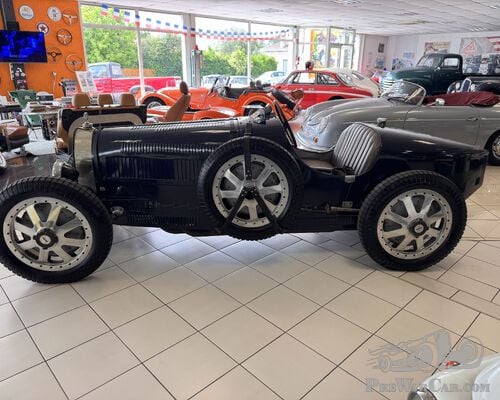
Bugatti 35 B Pur Sang
Bugatti 35 B Pur Sang,importée par un membre délégué de la FFVE il y’a une quinzaine d années.Participation à de nombreux Rallyes Bug..
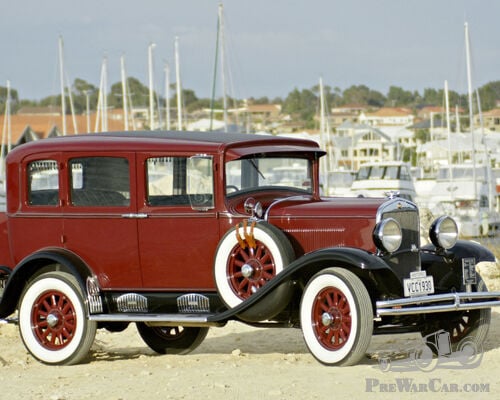
1930 Chrysler 66 Six-Wheel Equipped Royal Sedan
An exceptionally well restored and highly awarded Chrysler 66 Royal Sedan, with only two owners in nearly 97 years.The present owner ..