The global magazine and marketplace for classic car enthusiasts, by enthusiasts.


Filter
Make a choice:
- Cars
-
Make >>
- Bikes
-
Location >>
- Parts & more
-
Make of car >>
-
Manufacturer >>
-
Category >>
- Bicycles & more
-
Year >>
-
Countries


Conklin's camper: the remarkable land yacht that crossed America
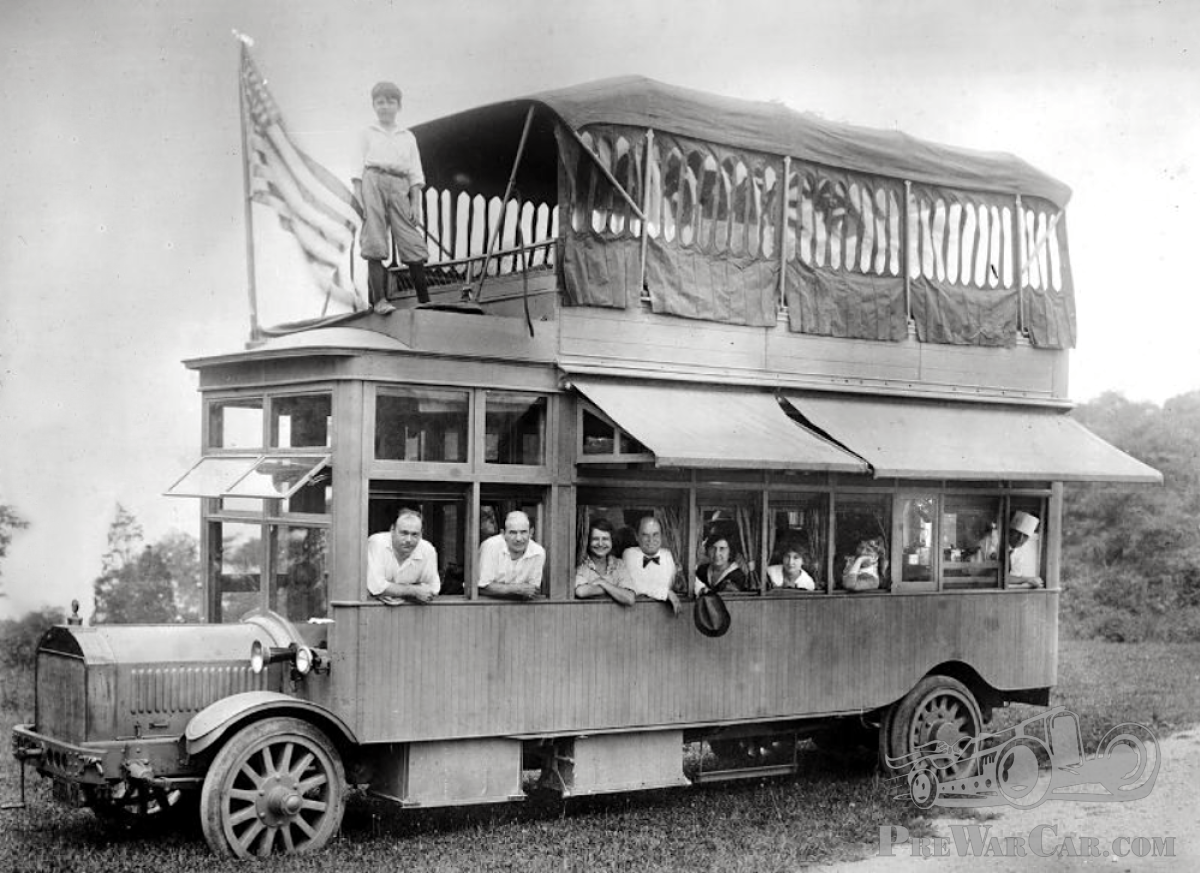

Although most of them are now still hiding in their winter storages, campervans are everywhere these days. There is little doubt that you will see them out in force on the roads in a couple of months time. Special parking places, situated on the outskirts of historic towns to keep them out of sight and stop them blocking village centres, will soon be flooded with them.
A century ago those multi-axled white lumps where nowhere to be seen. Well, there were a few early adopters. We saw the camping car of Baron Jean de Crawhez a while ago (click here), but that was plain and simple compared to the rather incredible 1915 contraption we see today. It was made by, or perhaps rather for, Roland R. Conklin, who ran a string of companies including the New York Motorbus Company, the Chicago Motorbus Company and the Roland Gas-Electric Vehicle Corporation. Naturally, it was based on an omnibus chassis.
It was, however, quite a lot larger than even the double-decker bus platform it was based on: 25 feet long, 7½ feet wide and 13 feet high, and weighing between seven and eight tons unladen. Equipment included electric lights, a vacuum cleaner, an ice box containing over 200lbs. of ice, a kitchen with a large oven and even storage for a motorcycle to be used in case the chauffeur had to go for assistance. Conklin named it the "Gypsy Van" and took his family on daring road trips with it, taking a cook, a maid, a driver and a mechanic along!
With a total of twelve passengers, the vehicle was driven on a transcontinental trip covering 5,000 miles in 1915. The vehicle and its arduous journeys over poor roads were described in detail in the newspapers and journals at the time. The New York Times noted: “The size of the great automobile ceases to dominate one’s thoughts when one investigates the comprehensiveness of its equipment. It is really a house on wheels, though it runs smoothly at moderate speed.” The Gypsy Van came with a 60hp engine of unknown origins, "especially geared for power grades." The transmission was of an unusual type, too: “The transmission is of the selective sliding dog type, with gears always in mesh. It is really a double-gear box, as it gives nine speeds forward and three in reverse.” It seems there were several very good reasons why the paper gave it the "land yacht" moniker.
Words: Jeroen Booij
Picture from Pinterest
Published:
Thursday March 13th, 2025
Facebook
LinkedIn
Twitter
WhatsApp
Email
Copy