The global magazine and marketplace for classic car enthusiasts, by enthusiasts.


Filter
Make a choice:
- Cars
-
Make >>
-
Year >>
-
- Bikes
-
Location >>
- Parts & more
-
Make of car >>
-
Manufacturer >>
-
Category >>
- Bicycles & more
-
Year >>
-
Countries


Could this 'heap' be Britain's first hot rod?


There are exceptions to the rule, but it seems that not that many pre-war car enthusiasts are terribly interested in hot rods. However, there's no denying that it's a big part of motoring history; people have modified cars since the dawn of motoring, and hot-rodding started to take shape in America in the 1920s. There are some people who say it's no different from what European special-builders were doing but, if the principle was the same, they were culturally and aesthetically different.
The British Hot Rod Association was founded in 1960, and then customising really took off in the 1970s, when there wasn't a housing estate in Britain which didn't contain a Ford Escort, jacked-up over Wolfrace wheels with a cruising light illuminating the back axle and a Greg of Akron stick-on mural proudly emblazoned across the bonnet.
It started with the '32 Ford... or did it?
But what was the first British hot rod? And is such a topic acceptable to PWC readers? Only you can be the judge of that, but the earliest ones were very true to the American pre-war tradition. In 1958, Tony Williams, a 19-year-old Teddy Boy from Peckham, turned an abandoned 1932 Ford Model B convertible coupé into an American-style 'Highboy' roadster. At the same time, an English '32 sedan (the English ones had subtle detail differences from the American ones) was under construction, and wasn't completed until very recently.
We wonder, though, if this 1937-1939 Austin 12 might not be a contender for the title. The photograph looks to have been taken in the mid-1950s, and the young chap, who might be anywhere between 18 and 30, looks extremely pleased with his creation, which he has affectionately termed 'My Heap'. We don't know the location, but from the style of the terraced houses we might guess at somewhere in the Midlands or the industrial north.
Hopped-up and couped
What claim does it have to being a hot rod? For one thing, it has been the recipient of a performance engine upgrade. Admittedly, the 2.2-litre Austin A70 engine won't win many rice pudding skin-pulling contests, but it's a start... More interesting, though, is the bodywork modifications. The young lad has gone to a great deal of trouble to turn a staid, upright saloon into a rakish-looking coupé. The metalwork involved can only have been extremely time-consuming and difficult, and the only conceivable purpose can have been to make it resemble an American coupé of the 1930s.
Like it or not, one must appreciate the lad's efforts as a skilled amateur metalworker, and something of a maverick at a time and place where interest in hot-rodding was virtually non-existent and prewar saloons were being unashamedly sent to the scrapyard. It's a pity he stoved that rear panel in...
Words and photograph: Zack Stiling / Stiling Collection
Published:
Thursday October 20th, 2022
Facebook
LinkedIn
Twitter
WhatsApp
Email
Copy
Comments
Roger Armstrong
24 October 2022, 18:34
Michael Schlenger
23 October 2022, 14:25
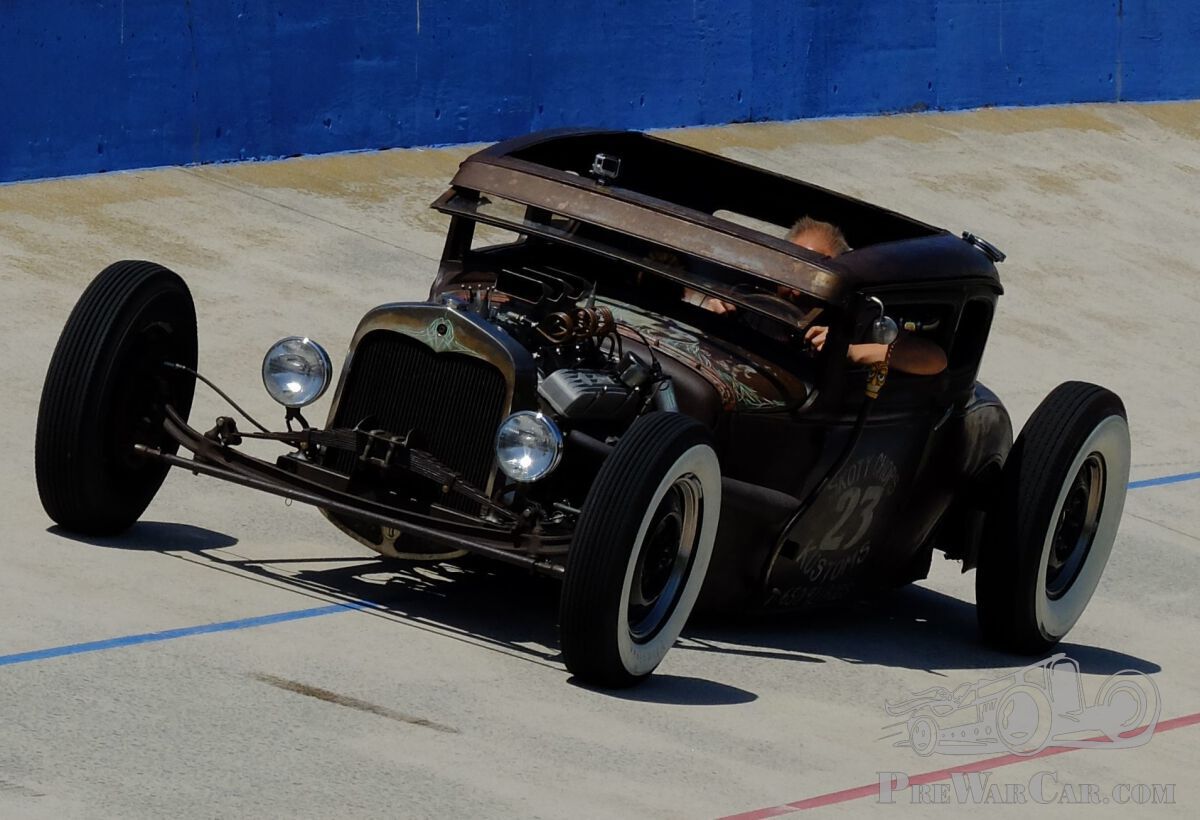
In my experience, many prewar-car enthusiasts are fond of hot-rods - because they are aware that most donor cars would have been scrapped otherwise. One also has to acknowledge the often impressive technical skills and design talent of their creators. Attached is a photo I took in 2014 not too far away from my hometown in Darmstadt (near Frankfurt, Germany). I wouldn't buy or build something like this - but I love it anyway (seems to be more something like modern art than modern art itself).
Read more
Jeroen Booij
21 October 2022, 09:12
Absolutely a big part of motoring history and more than acceptable to me!
My friend Barry Stimson converted his first car - a 1937 Ford - to what may well have been called a very early British hot rod. This was Porthsmouth in the late 1950s. I wrote about it a while ago: https://maximummini.blogspot.com/2015/01/stimsons-stories-1.html
Read more
My friend Barry Stimson converted his first car - a 1937 Ford - to what may well have been called a very early British hot rod. This was Porthsmouth in the late 1950s. I wrote about it a while ago: https://maximummini.blogspot.com/2015/01/stimsons-stories-1.html
People had been hot rodding cars for somewhat longer of course. I am attaching a picture taken in 1936 in Sleaford Lincolnshire, where a very staid and ordinary 2 seater car, a Cluley built in 1924 has been hot rodded after it reached the end of its respectable life. The radiator has been modified, windscreen cut down, dumb irons faired over, wings replaced with cycle wings, running boards removed, suspension lowered & large headlamps fitted. In this condition the car changed hands for £5 and became the new owner's first vehicle. Its life ended when it failed to proceed and it was then disposed of as scrap. One muses whether that Austin 12 might have shared a similar fate.