The global magazine and marketplace for classic car enthusiasts, by enthusiasts.


Filter
Make a choice:
- Cars
-
Make >>
-
Year >>
-
- Bikes
-
Location >>
- Parts & more
-
Make of car >>
-
Manufacturer >>
-
Category >>
- Bicycles & more
-
Year >>
-
Countries


The overturned steamer: a mystery from the past
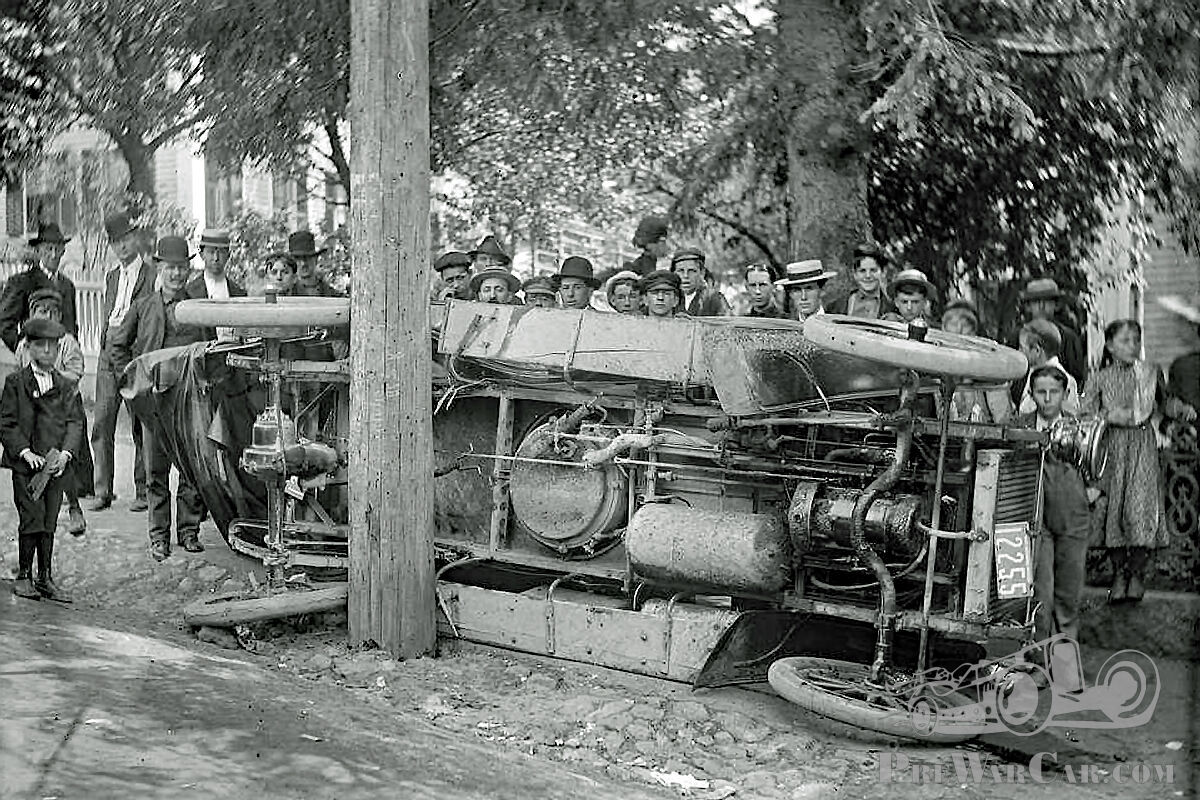

Most of the photos we receive for publication are staged—proud men, women, or families posing with their new automobiles at the dawn of the last century. And understandably so, as photography back then was a time-consuming process. The photographer of the image above had plenty of time as well.
His name was Paesiello Emerson, born in 1832. Remarkably, he only took up photography in 1902, at the age of 70. That was quite unusual, especially considering that the average life expectancy at the time was under 60 years! Emerson passed away in 1927, but in the 25 years prior, he captured a fascinating visual record of life in Massachusetts.
One of his photographs depicts an accident in Spencer, where a group of curious onlookers has gathered to observe the scene. Two details stand out. First, the unusual position of the car—or rather, the way it has landed. It seems difficult to achieve such a position by accident. Second, it’s a steam-powered vehicle. Wouldn't it have caught fire upon crashing?
Perhaps you can shed some light on this mystery. And maybe you even recognize the make and model of the overturned car. We’d love to hear your insights!
Photo: Longmeadow Historical Society
Published:
Monday March 24th, 2025
Facebook
LinkedIn
Twitter
WhatsApp
Email
Copy
Comments
Mitchell Gross
30 March 2025, 14:57
The car is a 1906 White Model F steam car. You can tell because the gas tank in in the middle of the car, and it has a 1906 Model F burner only used on the Model F. Model E burners from 1905 have through-holes and 1907 Model H burners have an oval venturi. Also, it did not catch fire because the White gas tank has a rollover valve which shuts off fuel if car turns over or there is sudden rush of fuel.
Read more


Ace Zenek
30 March 2025, 14:34
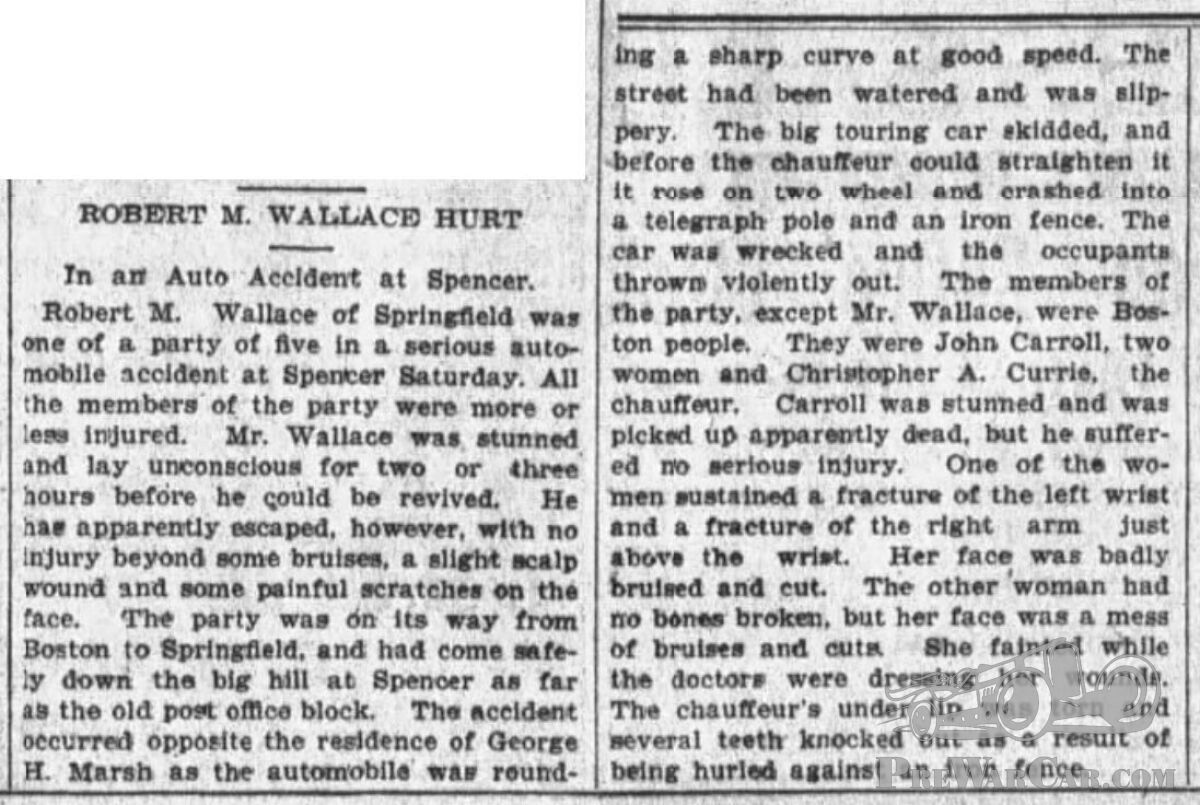
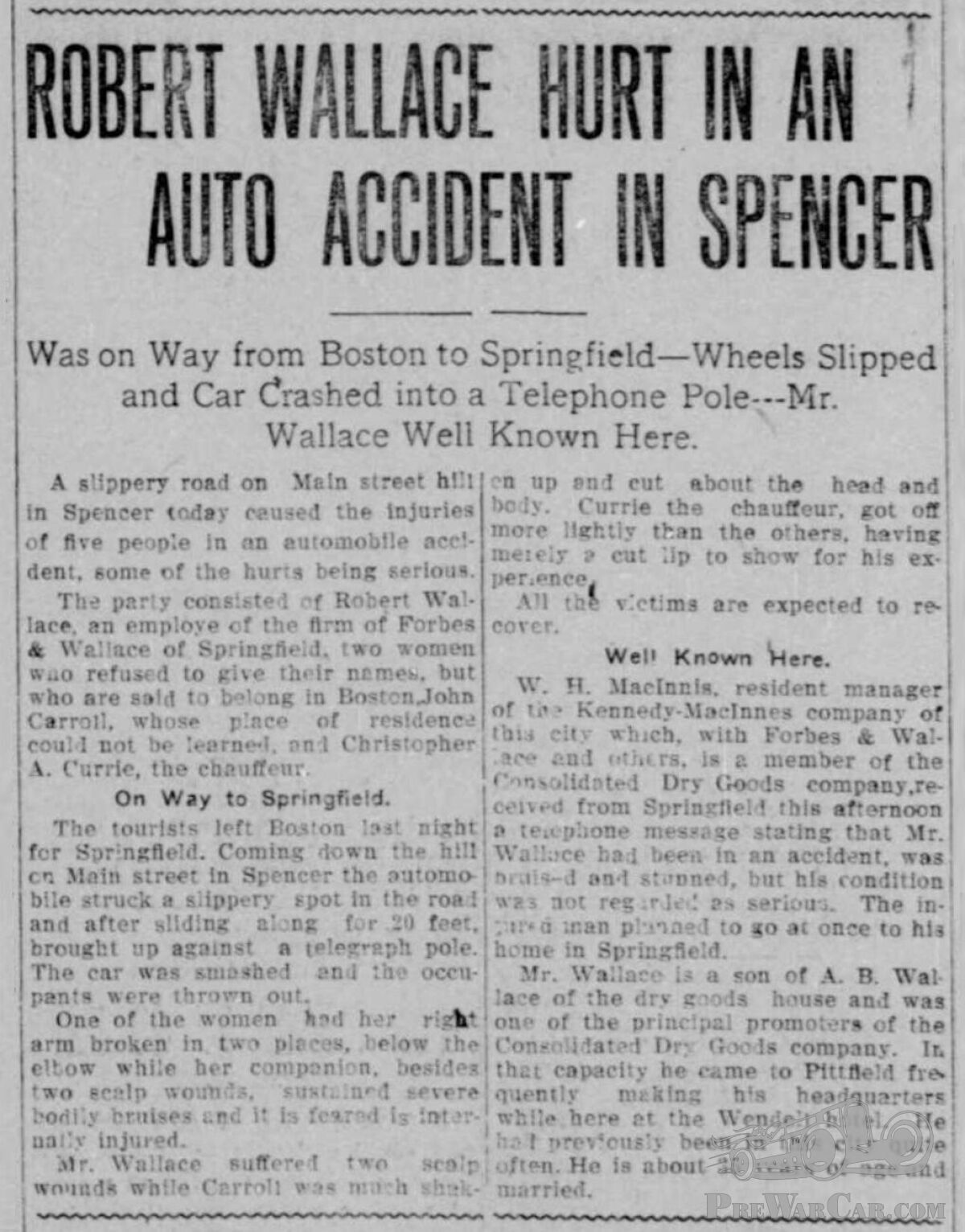
I believe the attached articles provide the details of the accident which took place on June 2nd, 1906. The Massachusetts license plate was issued in March, 1906, and would have been used until the end of 1907, so that helped to narrow the time period the accident happened. From there it was a simple search of a couple newspaper websites to find the articles. The exact location is likely near 154, Main Street, Spencer, Massachusetts. The larger of the two articles is from the Berkshire Evening Eagle on June 2nd, 1906, Page 1, and the other is from the Holyoke Transcript Telegram on June 4th, 1906, which even mentions the iron fence that can be seen at the far right of the photo. The boy at the far left may have a piece of broken wood from the car in his hand.
Read more
Mike Dyke
30 March 2025, 10:55
The car is definitely a White steam car, made specifically between 1906 and 1908, (I think a Model L 20hp). Whites developed new models every two years, the earlier cars and later cars were quite different mechanically, which means the photographer was even older when he took the picture—at least 74 years of age!
It’s impossible to tell exactly how the accident occurred without more information, but the missing propshaft and the twisted back axle does suggest that the shaft broke dropping the front end into the road causing the car “pole vault” then slide on its side to a stop against the post.
Read more
It’s impossible to tell exactly how the accident occurred without more information, but the missing propshaft and the twisted back axle does suggest that the shaft broke dropping the front end into the road causing the car “pole vault” then slide on its side to a stop against the post.
David Grimstead
27 March 2025, 22:23
The missing propeller shaft, ripped-out radius rod and twisted-up axle are evidence of the possible cause of this accident: a known risk of breakage of the cardan/propeller shaft joints of White steamers due to their engine’s steam valve operation, revealed by the American “Motor” magazine in its November, 1905, edition.
“Rattle in the Propeller Shaft. If your car has a propeller shaft drive, avoid extreme looseness in the cardan joints and other portions of the transmission. Anything that causes a rattle, as, for example, clutching and unclutching, and applying the transmission brake, is liable to hammer the pivot pins to pieces. And if one of these pins breaks, its mate will immediately follow. If the bevel driving pinion is loose on its key or if the cardan joint forging on the bevel pinion shaft is loose, the hammering will play hob with that shaft's bearings especially if, as is usual, they are ball bearings. In the White steamer there is especial need of preventing looseness in the cardan joints, since with the throttle nearly closed the low-pressure cylinder is driven by the high, resulting in a very irregular turning movement and a pronounced rattle if anything in the transmission is loose. There is always a little rattle, mainly in the bevel gears, but if the cardan pins are loose, they are likely to be broken.”
In the previous month’s edition, the same writer reported suffering a dropped cardan, it seems fortunately at the axle’s end first, on an unnamed car with a gearbox: “The other day one pin in the rear cardan unscrewed and dropped out, whereupon, of course, the forging wrenched itself free from the cross, breaking the opposite pin. The propeller shaft, from the square slip joint at its front end to the rear cardan, dropped into the road. Investigation showed that the strain of wrenching free had spread the yoke forging and cracked one of its prongs.”
Cardan shaft drive was not then well developed or trusted, particularly in America, with chain drive still considered more reliable, particularly for higher horsepower. Contemporary propeller shafts were solid chrome or nickel steel, typically no larger in diameter than one and a quarter inch (32mm). The propeller shaft of a 1905-6 White Model F or later G was perhaps two-thirds of their c.120-inch wheelbase—potentially a near seven-foot vaulting pole!
Read more
“Rattle in the Propeller Shaft. If your car has a propeller shaft drive, avoid extreme looseness in the cardan joints and other portions of the transmission. Anything that causes a rattle, as, for example, clutching and unclutching, and applying the transmission brake, is liable to hammer the pivot pins to pieces. And if one of these pins breaks, its mate will immediately follow. If the bevel driving pinion is loose on its key or if the cardan joint forging on the bevel pinion shaft is loose, the hammering will play hob with that shaft's bearings especially if, as is usual, they are ball bearings. In the White steamer there is especial need of preventing looseness in the cardan joints, since with the throttle nearly closed the low-pressure cylinder is driven by the high, resulting in a very irregular turning movement and a pronounced rattle if anything in the transmission is loose. There is always a little rattle, mainly in the bevel gears, but if the cardan pins are loose, they are likely to be broken.”
In the previous month’s edition, the same writer reported suffering a dropped cardan, it seems fortunately at the axle’s end first, on an unnamed car with a gearbox: “The other day one pin in the rear cardan unscrewed and dropped out, whereupon, of course, the forging wrenched itself free from the cross, breaking the opposite pin. The propeller shaft, from the square slip joint at its front end to the rear cardan, dropped into the road. Investigation showed that the strain of wrenching free had spread the yoke forging and cracked one of its prongs.”
Cardan shaft drive was not then well developed or trusted, particularly in America, with chain drive still considered more reliable, particularly for higher horsepower. Contemporary propeller shafts were solid chrome or nickel steel, typically no larger in diameter than one and a quarter inch (32mm). The propeller shaft of a 1905-6 White Model F or later G was perhaps two-thirds of their c.120-inch wheelbase—potentially a near seven-foot vaulting pole!
Daniel Reuben
27 March 2025, 11:39
As far as the accident, there is damage to the bodywork and a crack in the running board which are facing up. The bend in the body seems to match the position of the pole. The terrain has a downward incline as well. I wonder if there was a slick patch or loss of brakes and the driver slid sideways into the pole. The asymmetric weight of the car and momentum potentially rotated the chassis around the pole 90 degrees and lifted it up. The rear wheel has failed which would drop the opposite side and allow some lift of the contacting side. Potentially he was turning into a driveway just ahead of this? However it is unclear why more damage is not seen.
Read more
Bres Dominique
24 March 2025, 10:46
It's a staged performance... The pole was put there after the reversal.
Read more
Ariejan Bos
24 March 2025, 09:47
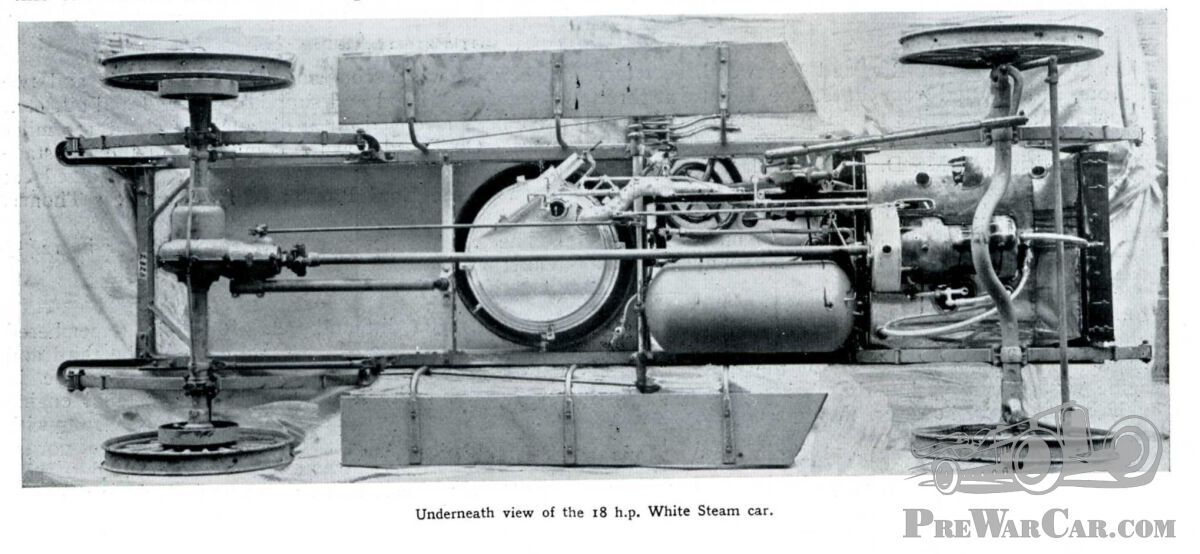
Here is a 1905 White chassis photographed from more or less the same position (from The Autocar). Apart from some bent parts it is identical. I have no clue however to what could have happened. It almost looks like an impossible accident.
Read more
Wilfried Brunner
24 March 2025, 08:16
Interesting photo. The drive to the rear axle is not immediately apparent. Is there perhaps something like a single-cylinder crankshaft with a connecting rod and piston installed in the differential housing, facing upwards? Does anyone know more about this drive?
---------------------------------
Interressantes Foto. Der Antrieb der Hinterachse ist nicht sofort ersichtlich. Ist da vielleicht im "Differentialgehäuse" soetwas wie eine einzylinderkurbelwelle mit pleuel und Kolben nach oben eingebaut? Wer weiss mehr über diesen Antrieb??
Read more
---------------------------------
Interressantes Foto. Der Antrieb der Hinterachse ist nicht sofort ersichtlich. Ist da vielleicht im "Differentialgehäuse" soetwas wie eine einzylinderkurbelwelle mit pleuel und Kolben nach oben eingebaut? Wer weiss mehr über diesen Antrieb??
Wilfried Brunner
25 March 2025, 09:28
Ah, now it's clear, the cardan shaft is missing; maybe the Hardy disc is cracked and the cardan shaft has lifted the car onto its side, because the differential also faces upwards and not forwards.
---------------------------------------------------------------------
Ahhh, jetzt ist klar, die Kardanwelle fehlt, vielleicht ist ja die Hardyscheibe gerissen und die Kardanwelle hat das Auto auf die Seite gehieft, weil das Differential schaut ja auch nach oben und nicht nach vorne.
Read more
---------------------------------------------------------------------
Ahhh, jetzt ist klar, die Kardanwelle fehlt, vielleicht ist ja die Hardyscheibe gerissen und die Kardanwelle hat das Auto auf die Seite gehieft, weil das Differential schaut ja auch nach oben und nicht nach vorne.
Ariejan Bos
24 March 2025, 20:51
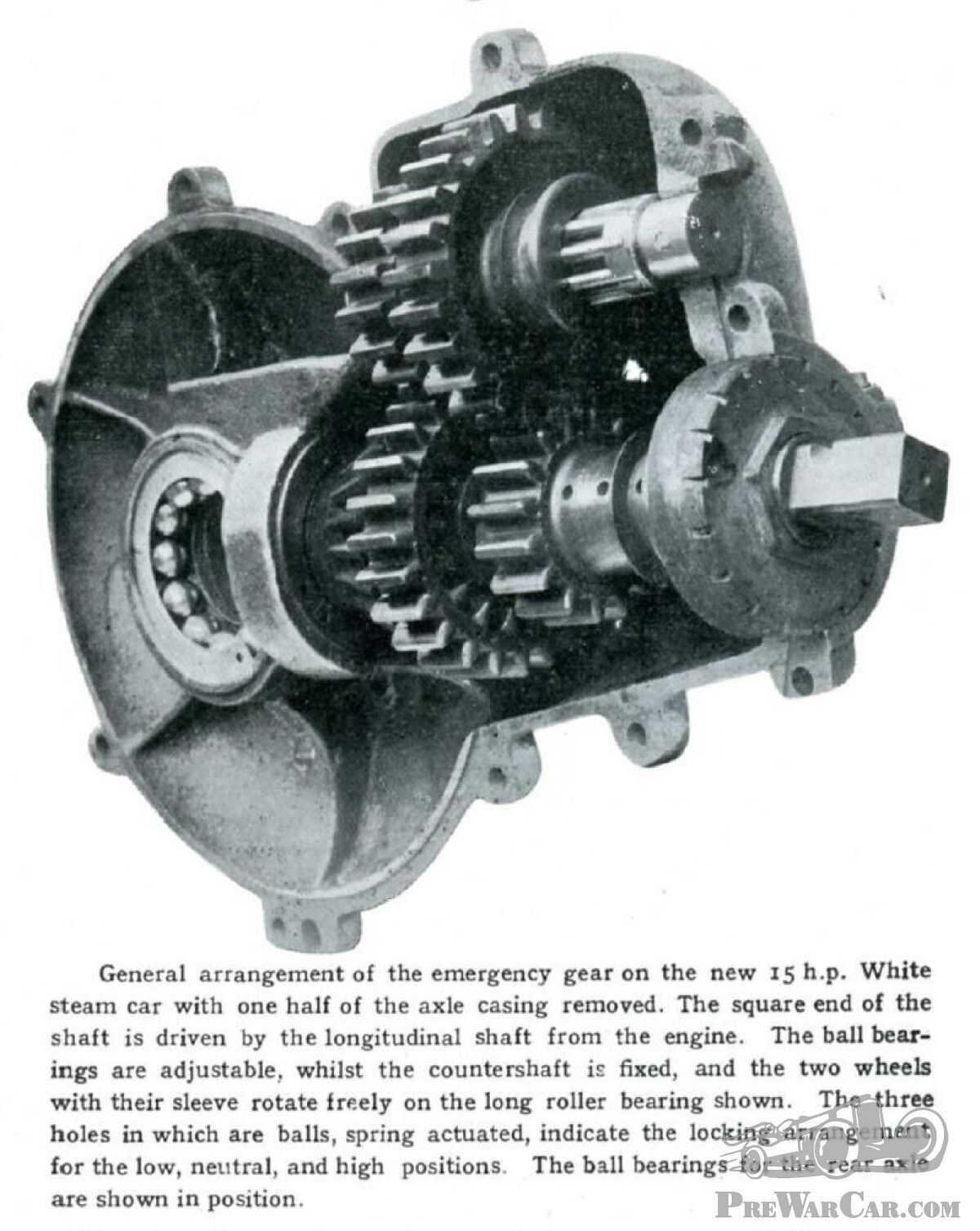
What you see just in front of the differental gear housing is the housing of the emergency gear, used to decouple the engine from the rear axles. A picture is shown above. The gears can have three different positions, which can be controlled from the driver's seat. In one of the positions the engine can run freely. A complete description is given in The Autocar of December 3rd, 1904, p. 710.
Read more