The global magazine and marketplace for classic car enthusiasts, by enthusiasts.


Filter
Make a choice:
- Cars
-
Make >>
-
Year >>
-
- Bikes
-
Location >>
- Parts & more
-
Make of car >>
-
Manufacturer >>
-
Category >>
- Bicycles & more
-
Year >>
-
Countries


Fighting the saline menace: the pre-war solution to winter motoring
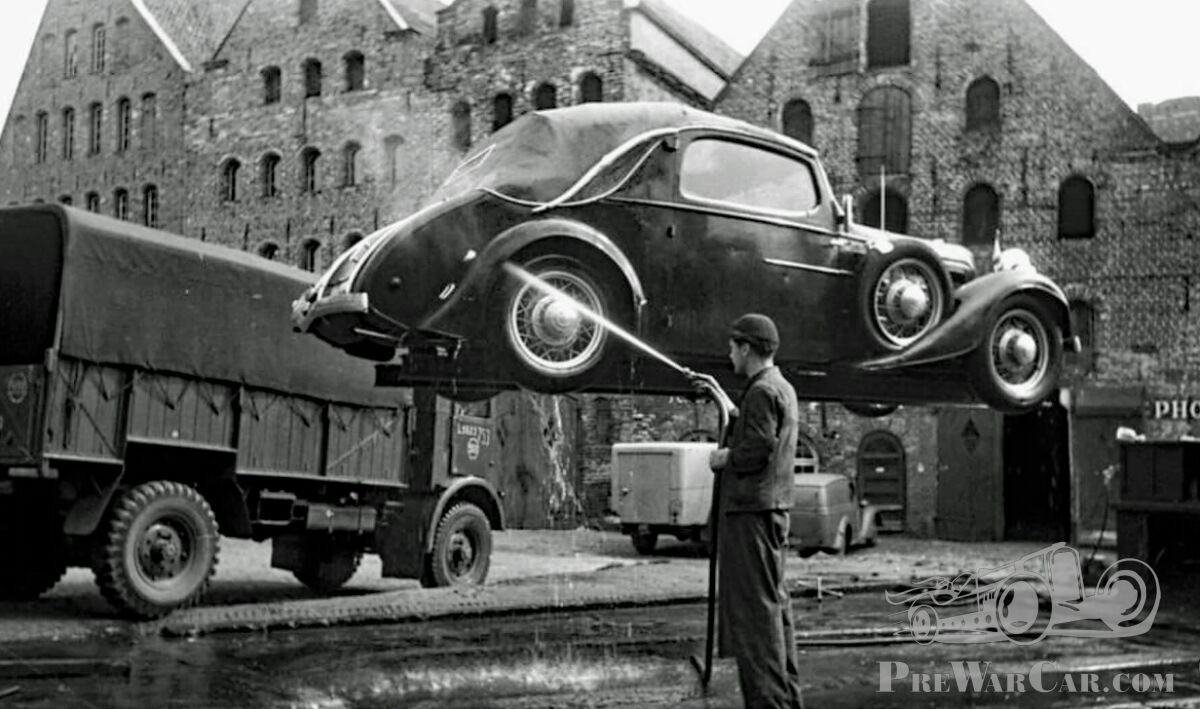

No, it’s not a trick! Look closely and you will see the car is not floating in the air, but is in fact on a lift with central pole, just hidden by the hose man standing in front of it. That’s pretty clever.
The photograph was taken in the town of Lübeck, in northern Germany, at an unknown date. We know that the buildings in the background are the town’s historic salt warehouses, which date back to the 16th to 18th centuries, when Lübeck was a major player in the salt trade. As a side note we’d also mention that the premises were used as the lair of Count Orlok much later, when the landmark horror picture Nosferatu was filmed there in 1922. Several of the ground-floor buildings became garages later. They are still there and can now be rented for events and concerts.
Anyway, when we car enthusiasts think of salt, the first thing that comes to mind is the grit used on the roads in winter. We all wince when we have to take our motors onto salty roads, so the picture seems quite appropriate—spray it off on that clever lift!
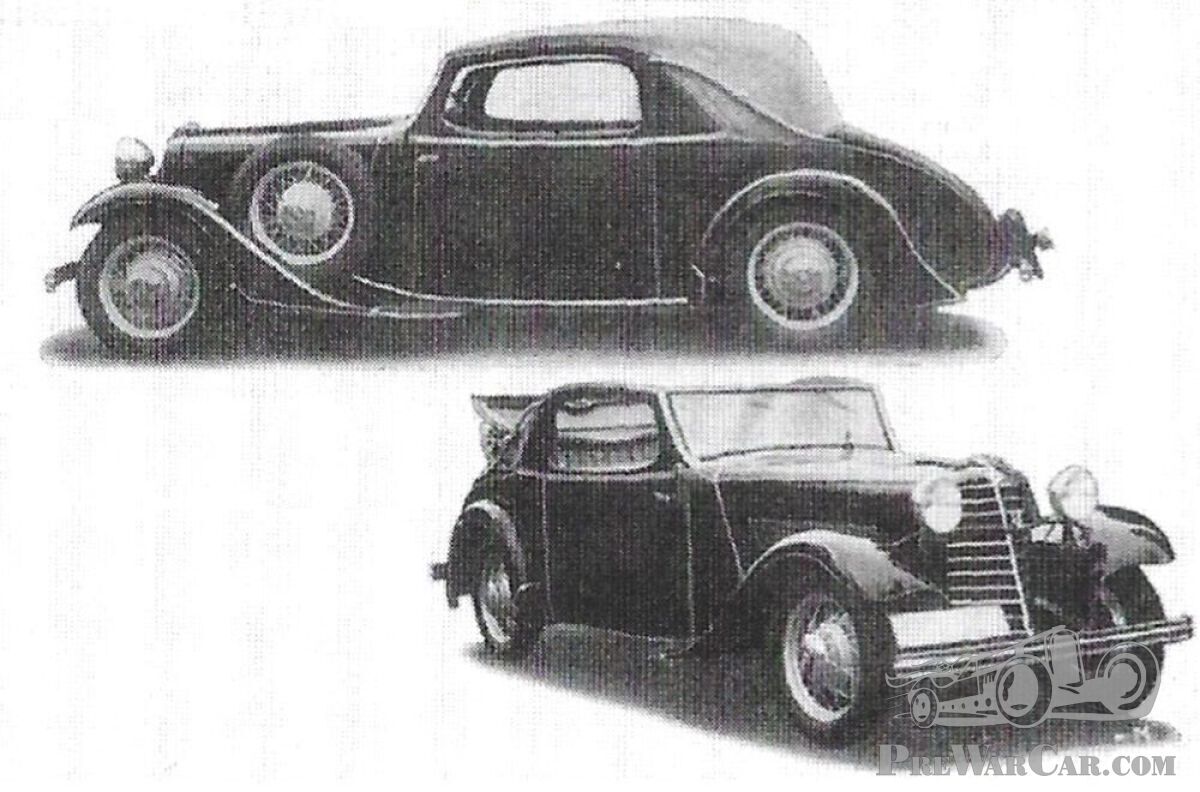
Now, on the subject of the car, there's little doubt that it's a product of German engineering, but what exactly?
Words: Jeroen Booij
Photograph: Scheerer Photo
Published:
Monday January 6th, 2025
Facebook
LinkedIn
Twitter
WhatsApp
Email
Copy
Comments
Gerd Klioba
08 January 2025, 08:26
The car in front of the salt warehouses in Lübeck is a 1932 Ford V8 Aero-Cabriolet bodied by Ludewig.
Read more
Tim Hewitt
06 January 2025, 23:31
I'm not sure what the car is, but the truck is definitely a British Army Austin K5 with a GS body. They made just over 12,000 of them between 1941 and 1945.
By the way, the spare wheel on the car won't do them much good; it looks flat to me.
Read more
By the way, the spare wheel on the car won't do them much good; it looks flat to me.
David Grimstead
06 January 2025, 22:02
I don’t know about the car but the “elephant-in-the-parkplatz” for truck enthusiasts looks like a British Second World War-era Austin K5 4x4 army lorry, known as a “screamer” due to its noisy transfer box, not to mention its dodgy piston rings.
A number of post-war armies got surplus ones free; notably this included a Norwegian Army unit of 4,400 men, which was moved from the Harz area to Schleswig-Holstein (with Lübeck at its edge) to secure some of the British occupation zone between September, 1948, and 1953—the Russian zone started a few miles east of Lübeck.
Information about the Norwegian unit says that “a number of administrative vehicles of German origin were also allocated”—could the wing-mounted standard that Dirk Eger mentions be a Norwegian flag on the C.O.’s personal staff car?
I must add that the Danish Army got some K5s, too, and their door-printed registration numbers start as here with “L.”
Looking at the style of the two commercial vans, this must be early 1950s rather than pre-war.
Read more
A number of post-war armies got surplus ones free; notably this included a Norwegian Army unit of 4,400 men, which was moved from the Harz area to Schleswig-Holstein (with Lübeck at its edge) to secure some of the British occupation zone between September, 1948, and 1953—the Russian zone started a few miles east of Lübeck.
Information about the Norwegian unit says that “a number of administrative vehicles of German origin were also allocated”—could the wing-mounted standard that Dirk Eger mentions be a Norwegian flag on the C.O.’s personal staff car?
I must add that the Danish Army got some K5s, too, and their door-printed registration numbers start as here with “L.”
Looking at the style of the two commercial vans, this must be early 1950s rather than pre-war.
Francisco Carrión
06 January 2025, 19:08
They're clearly Ford V8 bumpers and wheels. I think it is a German-bodied Ford V8, a very interesting one-off car.
Read more
Daniel Reuben
06 January 2025, 12:38
I vote for an Audi UW220. I think the hubcaps, the shape of the wings and the impressed beltline on the upper side of the bonnet which bends down at an angle at the very front all fit the Audi. I am having a hard time recognising the rear bodywork extending beyond the wings, the landau bars/top (is it just decorative—the fabric looks supported to be operational?) and also the horizontal trim piece on the door. Could this be special coachwork?
Read more