The global magazine and marketplace for classic car enthusiasts, by enthusiasts.


Filter
Make a choice:
- Cars
-
Make >>
- Bikes
-
Location >>
- Parts & more
-
Make of car >>
-
Manufacturer >>
-
Category >>
- Bicycles & more
-
Year >>
-
Countries


The mystery of the GATSO Kwik: An unknown roadster revealed

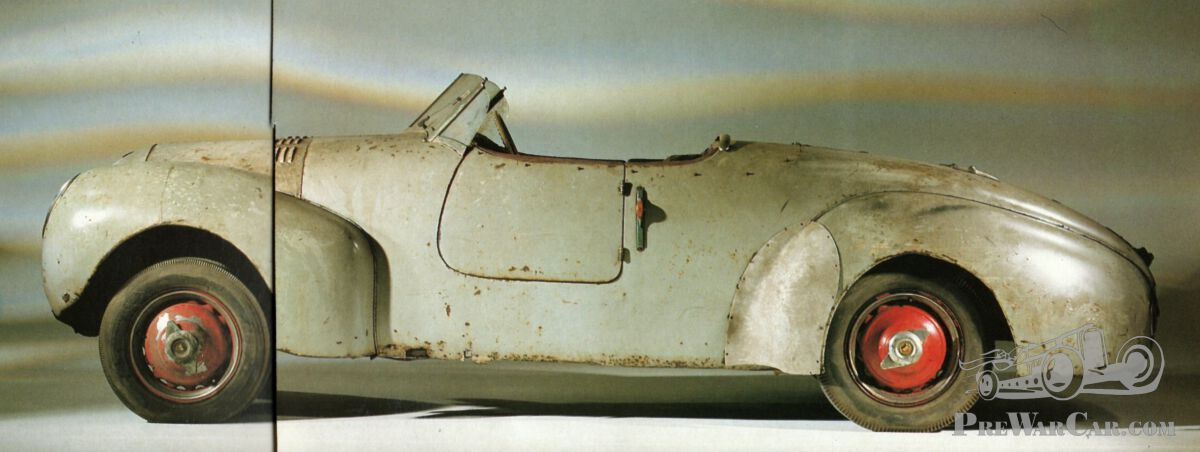


Recently, I came across an intriguing photo of a roadster under construction. What immediately caught my eye were the striking similarities to the GATSO Kwik from 1939. Specifically, the front wing and the door cutout closely resemble the legendary Kwik, an image of which was published in Autovisie, July, 1994. The photo of the Kwik clearly shows its construction, and it's hard not to wonder if this newly discovered roadster could have the same origins.
The GATSO Kwik has always been surrounded by mystery. The design was conceived in the late 1930s in Amsterdam, under the direction of renowned rally driver Maus Gatsonides. Gatsonides, known for his success in motor sports, envisioned a lightweight, fast roadster that would be both functional and stylish. The car was built by Schutter & Van Bakel, a prominent automotive company in the 1930s, known for its craftsmanship and innovation. The Kwik was praised for its forward-thinking design, with sleek, sporty looks and technical features that made it a precursor to the modern roadsters we know today.
What is so intriguing now is the question of whether the roadster in the photo could be a prototype of the famous Kwik. Given the similarities in the door cutout and the front fender, it’s possible that this is a continuation or another project by Schutter & Van Bakel, perhaps one that was never completed or never saw the light of day.
Who can shed more light on this? Are there any experts or individuals involved in the construction of the Kwik who can help solve this mystery? Or perhaps other photos or documents will surface to uncover the origin of this unique roadster. This could turn out to be a fascinating piece of Dutch automotive history that has yet to reveal all its secrets.
Text and photos: Herman van Oldeneel
Published:
Friday December 27th, 2024
Facebook
LinkedIn
Twitter
WhatsApp
Email
Copy
Comments
Herman van Oldeneel
05 April 2025, 10:04
Hans Veenenbos
28 December 2024, 09:08
For many years, during my student times at Delft University in the early 1970s, I used to go and visit the scrapyard of Henk Gentenaar and his dad in Voorburg, near the Hague, to buy parts for my ailing 2CV van. Of course, I ransacked the various buildings on the yard, but there was one which was always locked. One day, when I had obtained their confidence, the old Gentenaar opened up this shed and inside was Kwik! He told me that the Mercury-powered special had belonged to famous rally man Maus Gatsonides, who had offered them a brand new Volkswagen Beetle in exchange, but the Gentenaars wouldn't hear of it. Kwik was not for sale—full stop!
Another yard next-door that I visited had a terrifyingly large black Alsatian on a long chain guarding the yard. I entered and tried to convince myself that I had no fear, although he was already 'grinning' at me, showing his teeth. Then suddenly he got up, growling at me, and of course I started to run. He got me by the shoulder, but at the end of the long chain I managed to shake him off. I never went there again for parts. Oh, happy days, when life was simple.
Read more
Another yard next-door that I visited had a terrifyingly large black Alsatian on a long chain guarding the yard. I entered and tried to convince myself that I had no fear, although he was already 'grinning' at me, showing his teeth. Then suddenly he got up, growling at me, and of course I started to run. He got me by the shoulder, but at the end of the long chain I managed to shake him off. I never went there again for parts. Oh, happy days, when life was simple.
The same pictured and another one appeared in the Dutch magazine "Automobiel Klassiek" number 4, 1994, page 25. It is described as "Kwik in de spanten (bodyframe), Haarlem, 1939."