The global magazine and marketplace for classic car enthusiasts, by enthusiasts.


Filter
Make a choice:
- Cars
-
Make >>
- Bikes
-
Location >>
- Parts & more
-
Make of car >>
-
Manufacturer >>
-
Category >>
- Bicycles & more
-
Year >>
-
Countries


The International K-series: perfect for long journeys
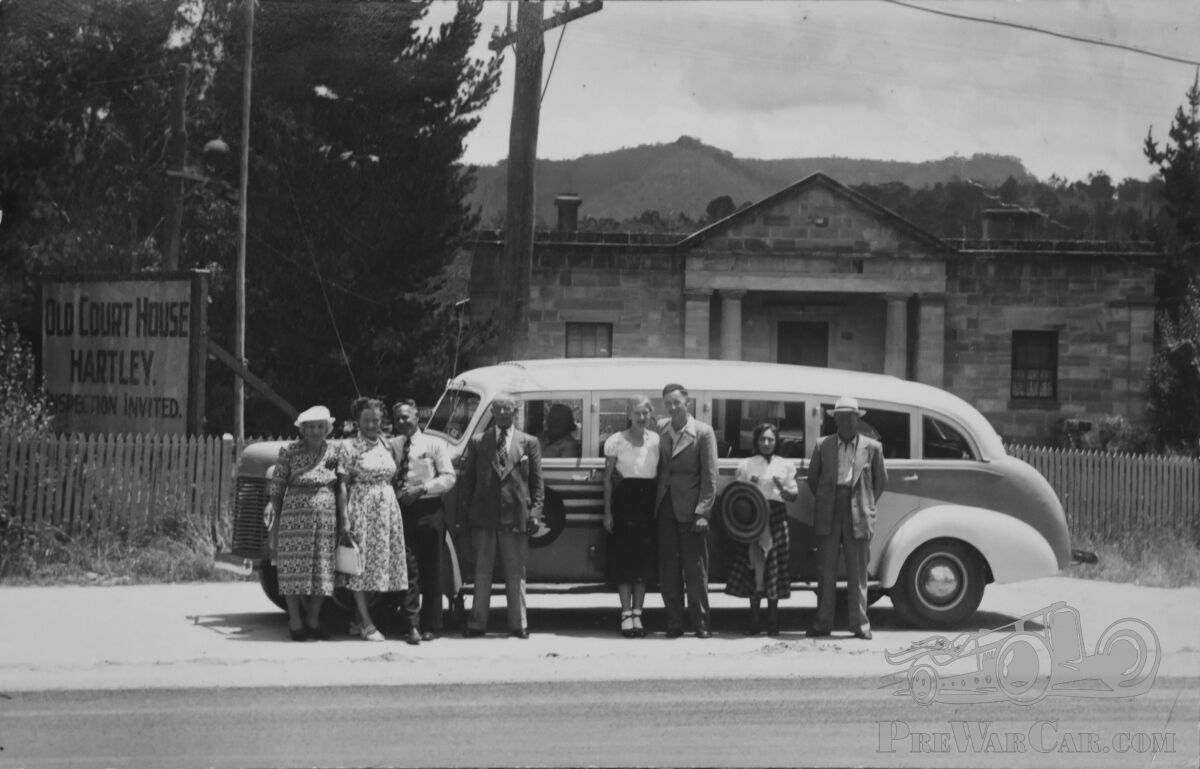

The architecture is at once familiar: a symmetrical, rectangular construction in the Neo-Classical style, with a simple front door flanked by corresponding windows, and some neat but minimal visual interest afforded by a plain pediment and some stout Doric columns. The description applies to several of the charming old country estate lodges which still pepper the British landscape, elegant souvenirs of the 1830s or thereabouts, but the eucalyptus-covered landscape behind doesn't belong to the British Isles, nor is the building a lodge.
There isn't any mystery to the location, since a large sign welcomes us to the Old Court House in Hartley, in New South Wales, Australia. The Courthouse was built in 1837 to a Mortimer Lewis design and for 50 years had to endure a constant stream of dubious visitors, but by the end of the 19th century it was falling out of use, along with the rest of the town, as the growth of the railways saw people travel straight past it without stopping. With the arrival of the motor car, however, it enjoyed a small but enduring revival, as its perfectly-preserved 19th-century architecture proved a diverting attraction for wayfarers. Happily, Hartley remains intact today as a designated historic site on the New South Wales Heritage Register.
The other great tourist attraction in the area is the Jenolan Caves, ancient limestone caves famed for their intricate calcite formations. In fact, the caves were in large part responsible for the revived interest in Hartley, since they cannot be accessed by road from Sydney without passing through the historic settlement. Sure enough, on the back of this photograph, we find the caption "Souvenir from our trip to Jenolan Caves."
The picture must date from the 1940s or early '50s, and though our tourists must have rejoiced at the old buildings and rock formations, we wonder if any appreciated what an unusual vehicle they were travelling in. If we were wondering at the identity of this stretched limousine, we would not find the answer in any encyclopædia of cars, because it was not built by a car-maker. Formed in 1902 from the merger of several different farm machinery companies, the International Harvester Corporation would become famous for its tractors, and from 1907 it started to make high-wheeler waggons, but its focus was always on commercial vehicles, and never cars. There would be an exception from 1953, when it started building the Travelall, a station wagon based on its small truck chassis, but until then the only non-commercial Internationals were some very early high-wheelers and woodies built on the small truck chassis, such as the K-series, by unaffiliated body-building companies. It is a K-series that we see here. The line was built by International from 1941 to 1949, so although this is almost certainly a post-war photo, the vehicle qualifies for inclusion.
Woodie wagons, in any case, were at least as van-like as they were car-like. Never before have we seen something like this, which has the appearance of an airport or hotel bus, but was probably operated by a tour company, rather like a 1940s version of a small char-à-banc. What has aroused our curiosity is the rear bodywork, which can only have been the work of an Australian coachbuilder. One would expect a vehicle like this to be stretched by separating the front and rear ends of the body and installing a midsection between the two, but since International never made sedan bodies, there can't have been a rear end to work with. That leaves us to wonder, did the constructor appropriate the rear end from some other, suitably-proportioned car, or did it fashion its own rear end from scratch? We're inclined to think the latter, as the rear panels look quite simplistic. It seems improbable that just one of these would have been built—there must have been several to justify the effort. The question then becomes did our tour company commission them, or did our body-builder produce several to market to different prospective customers?
Update — February 8th, 2025
I have chanced upon a photograph of a similar vehicle based on a 1942 Hudson Super Six in Don Butler's The History of Hudson. The caption notes that it was built by an unknown company (probably Knightstown) for the Shrader Driveaway Co. of South Bend, Indiana. However, the standard of finish on the Hudson's midsection, especially round the windows, is higher than that of the International.
Words: Zack Stiling
Photograph: Stiling Collection
Published:
Monday January 20th, 2025
Facebook
LinkedIn
Twitter
WhatsApp
Email
Copy
Comments
Magrath Derek
20 January 2025, 19:33
You are very wrong, Zack. The car is normal-sized. The people are dwarfs, possibly a touring troupe performing Snow White et al in the outback.
Read more