The global magazine and marketplace for classic car enthusiasts, by enthusiasts.


Filter
Make a choice:
- Cars
-
Make >>
-
Year >>
-
- Bikes
-
Location >>
- Parts & more
-
Make of car >>
-
Manufacturer >>
-
Category >>
- Bicycles & more
-
Year >>
-
Countries


Monday's midget mystery: the uncertain origins of the Hornet Special
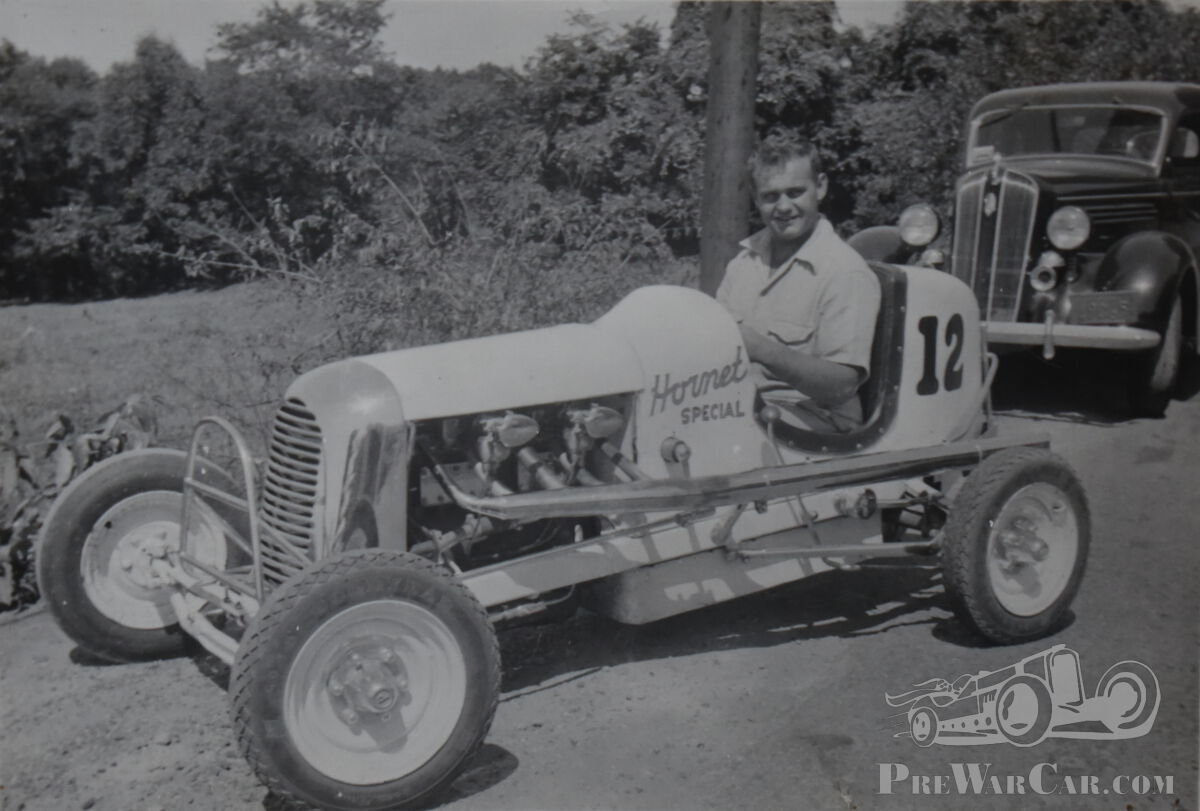

There are times when all the wonders of modern technology just can't help us. Try asking any search engine for information on the Hornet Special and see if you get any results that don't pertain to Wolseleys. Refine your search and ask about the Hornet Special midget racer and see if you get any results that don't pertain to Wolseley Hornets, with reference to their relation to MGs...
All that leaves us quite stumped with regard to this photograph. As all the PreWarCar.com staff are European by birth and residence, such topics as sprint cars and midget racing, which have little following outside of America and Australia, are no one's speciality. We must admit that we are not entirely sure of the difference between sprint cars and midgets. Obviously midgets are smaller, but where is the line drawn? Is the Hornet Special which is causing us so much confusion too big for a midget, or too small for a sprint car? We think we're correct in calling it a midget, as we would expect a sprint car at least to have normal-sized wheels, but we could be mistaken. The car behind is a 1936 Plymouth, giving us some indication of a date.
All the same, it is an interesting piece of history which will become more interesting as, with the help of our readers, certain facts are established. What we do know (or think we know) is that sprint cars had their origins in the late 1920s, with midgets becoming popular by the mid-1930s. Half-mile dirt tracks, some of them originally built for horse-racing, were to be found all over America in the years after the Great War, and they lent themselves quite naturally to motor racing. They were best-suited to cars with short wheelbases, and before purpose-built sprint cars appeared, it was common for racers to shorten Ford Model T chassis by six inches or so, to 88 inches, tune the engines and so become very competitive. While Ford engines were more or less de rigueur for a while, from 1933 Fred Offenhauser started to produce a d.o.h.c. 3.6-litre engine with four valves per cylinder which he had developed while working for Harry Miller, and which had some success in the late Miller racers. These engines became hugely popular with sprint racers, and continued to be competitive up to the 1960s.
As for midgets, the first race was held on June 4th, 1933, and very soon thereafter they became regular occurrences, typically on board tracks used for bicycle racing. Having originated in Los Angeles, the sport was adopted in Australia from 1934 and New Zealand from 1937. Like sprint cars, midgets were generally built from scratch, making identifications difficult beyond whatever name might have been painted on the side. Although some people became quite famous through midget racing, there were hundreds and hundreds of cars and drivers, and most were never especially significant. All the same, we wonder, does any historical record survive of our friend here and his Hornet Special?
Words: Zack Stiling
Photograph: Stiling Collection
Published:
Monday November 18th, 2024
Facebook
LinkedIn
Twitter
WhatsApp
Email
Copy
Comments
William Lee Kohler
24 November 2024, 14:02
I'm guessing the Hornet was a Hudson Hornet inline-six, partly based on the apparent intake/exhaust being on one side of a non-crossflow engine, as were Hudson's flathead six-cylinder engines, and partly based on the name itself. That's all the help I can offer.
Read more