The global magazine and marketplace for classic car enthusiasts, by enthusiasts.


Filter
Make a choice:
- Cars
-
Make >>
-
Year >>
-
- Bikes
- Parts & more
-
Make of car >>
-
Manufacturer >>
-
Category >>
- Bicycles & more
-
Year >>
-
Countries


Not just for gentlemen: the Beeston Ladies’ Model
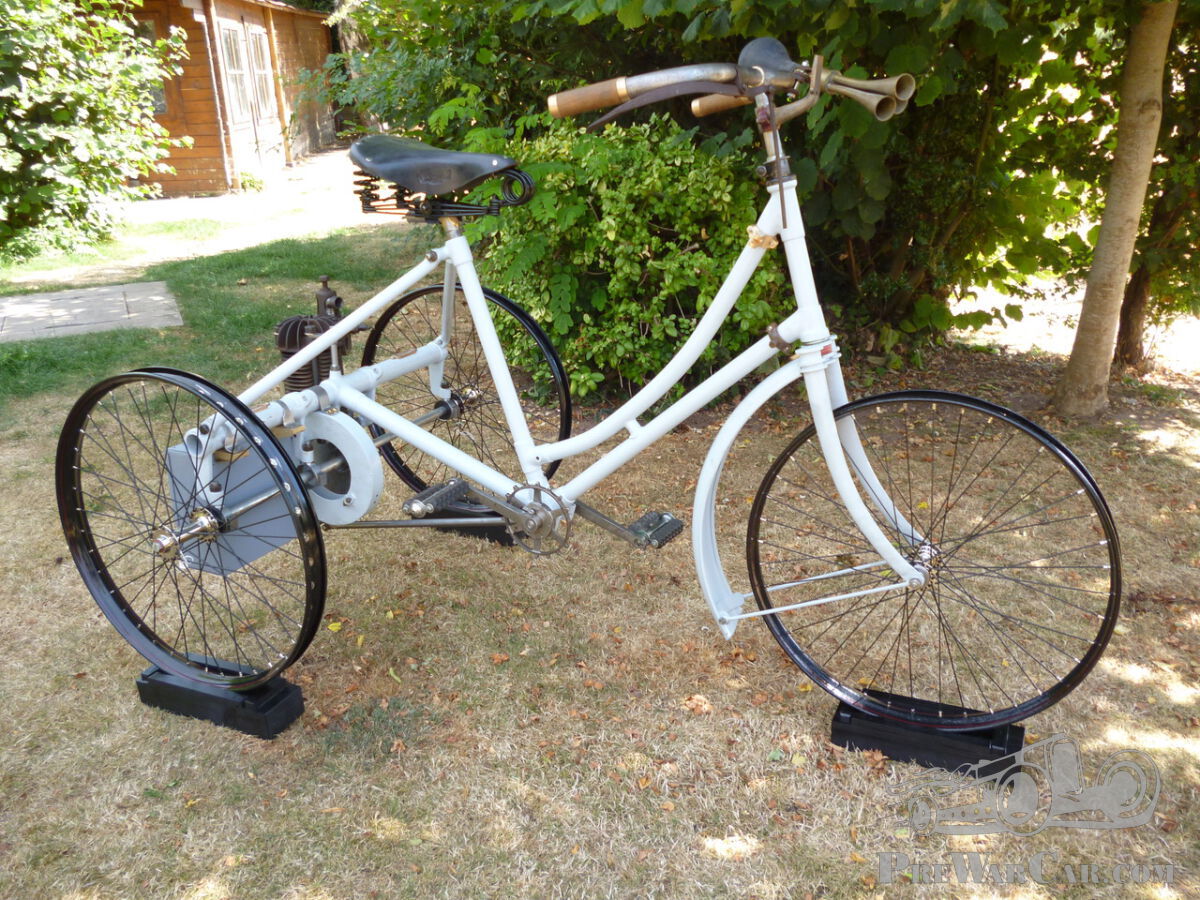


The motor tricycle has become remarkably popular over the past decade. The De Dion-Bouton Club organised special runs for tricycles, surprisingly high prices were sometimes achieved at auction, and we too featured them regularly. We thought we had become fairly familiar with the phenomenon. Then, earlier this week, a Beeston Ladies’ Model appeared on PreWarCar.com.
Indeed: a motor tricycle designed especially for ladies. It called for a little further investigation, because although the familiar tricycles appear to have been built almost exclusively for gentlemen, there is another, almost forgotten chapter in their history.
To understand that story, we must return to Britain’s flourishing cycle industry at the end of the nineteenth century. British manufacturers initially led the field, supplying continental European makers not only with complete bicycles, but also with chains, sprockets, saddles, front forks and technical expertise. Promising engineers such as C.R. Garrard and Thomas Pullinger found plenty of employment, while companies including Humber, Premier, Swift, Enfield and the Cycle Components Company enjoyed excellent business.
By the end of 1897, several of these companies had achieved their best-ever results, allowing their shareholders to sit back contentedly. Not for long, as it turned out.
Traditional export markets, including the United States, the Netherlands and other European countries, were increasingly beginning to manufacture their own bicycles. From 1898 onwards, British makers were confronted with an oversupply of cycles, falling retail prices and rapidly shrinking profit margins. They needed to find something new, preferably a product that would allow them to continue using their existing factories, machinery and skilled workforce. The answer was as logical as it was adventurous: the motor car.
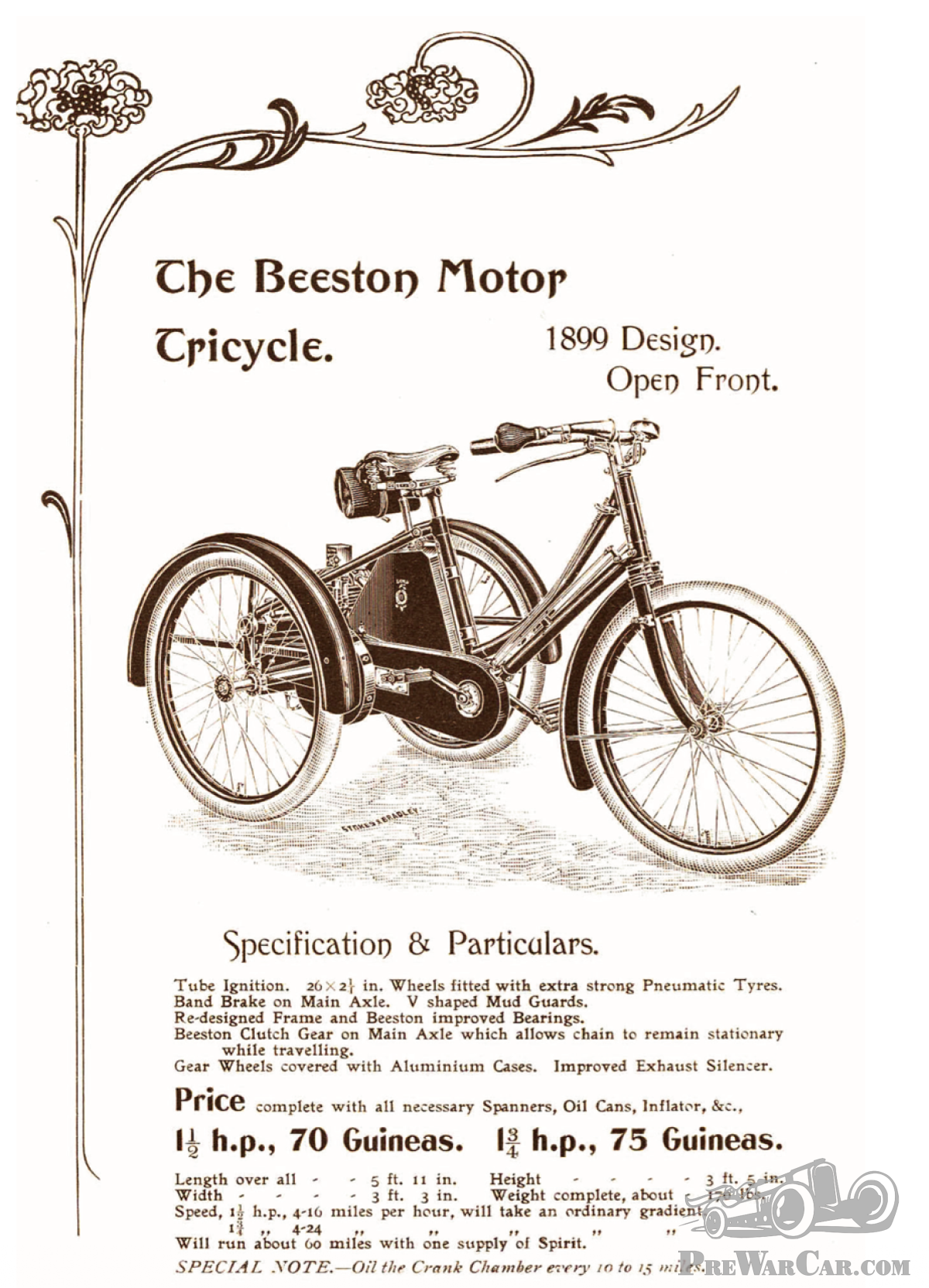
The New Beeston Cycle Company was among the first British firms to take the plunge. As early as 1896, the company experimented with motorised prototypes, followed by a motor tricycle. While the earliest French machines generally used electric ignition, Beeston initially opted for hot-tube ignition.
The first engines were clearly inspired by those of De Dion-Bouton, then the benchmark for the rapidly growing number of manufacturers producing lightweight motor vehicles. They were, however, built in England by Accles of Perry Barr, near Birmingham. Engines supplied by the Motor Manufacturing Company were also used later.
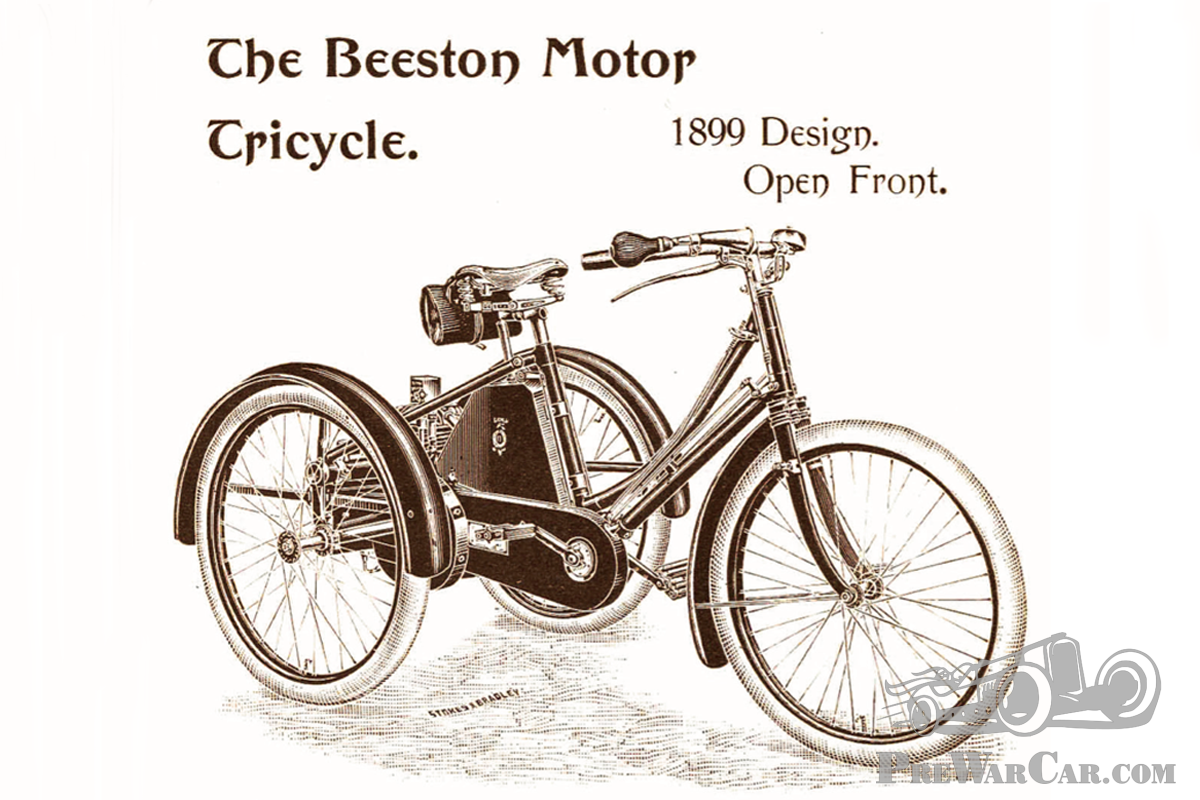
The catalogues of 1897 and 1898 featured only bicycles and tricycles with a top tube, intended for male riders. In the 1899 Beeston Cycles and Motors catalogue, however, a motor tricycle with an open frame suddenly appeared. Its design was based on the Ladies Model K Pedal Tricycle introduced that same year.
That it was more than merely a catalogue illustration is confirmed by a historic photograph held in the Motoring Picture Library at Beaulieu. It shows an elegantly dressed lady standing beside just such a Beeston motor tricycle, carrying a Glamorgan registration.
It is not difficult to understand why so few were built. At the end of the nineteenth century, a motor tricycle was already an expensive and highly progressive means of transport. A model designed specifically for ladies represented a niche within an already tiny market.
As far as is known, eight gentlemen’s Beeston motor tricycles survive worldwide. Only one example of the Ladies’ Model is known to exist – and that very machine is now being offered for sale.
It is an unfinished but largely complete restoration. According to the vendor, the work carried out so far is of an exceptionally high standard. Its new owner will therefore acquire something truly remarkable: one of the rarest survivors from the pioneering days of British motoring.
We have asked the vendor whether he would be willing to display the tricycle on our stand at the International Autojumble in Beaulieu, provided it has not been sold by then. So do come along to see this exceptional Beeston at close quarters and find out more.
Source: The Tricycle Book by Michael Edwards
Words: Laurens Klein
Published:
Wednesday August 26th, 2026
Facebook
LinkedIn
Twitter
WhatsApp
Email
Copy
Comments
Tony Press
27 August, 05:18
If I remember correctly my grandfather who had a Cycle and Motorcar business in Chard UK in the 1900s before coming to Australia used to talk about Beeston Humber?
Read more