The global magazine and marketplace for classic car enthusiasts, by enthusiasts.


Filter
Make a choice:
- Cars
-
Make >>
-
Year >>
-
- Bikes
-
Location >>
- Parts & more
-
Make of car >>
-
Manufacturer >>
-
Category >>
- Bicycles & more
-
Year >>
-
Countries


Off the rails: the bizarre phenomenon of the Trackless Train

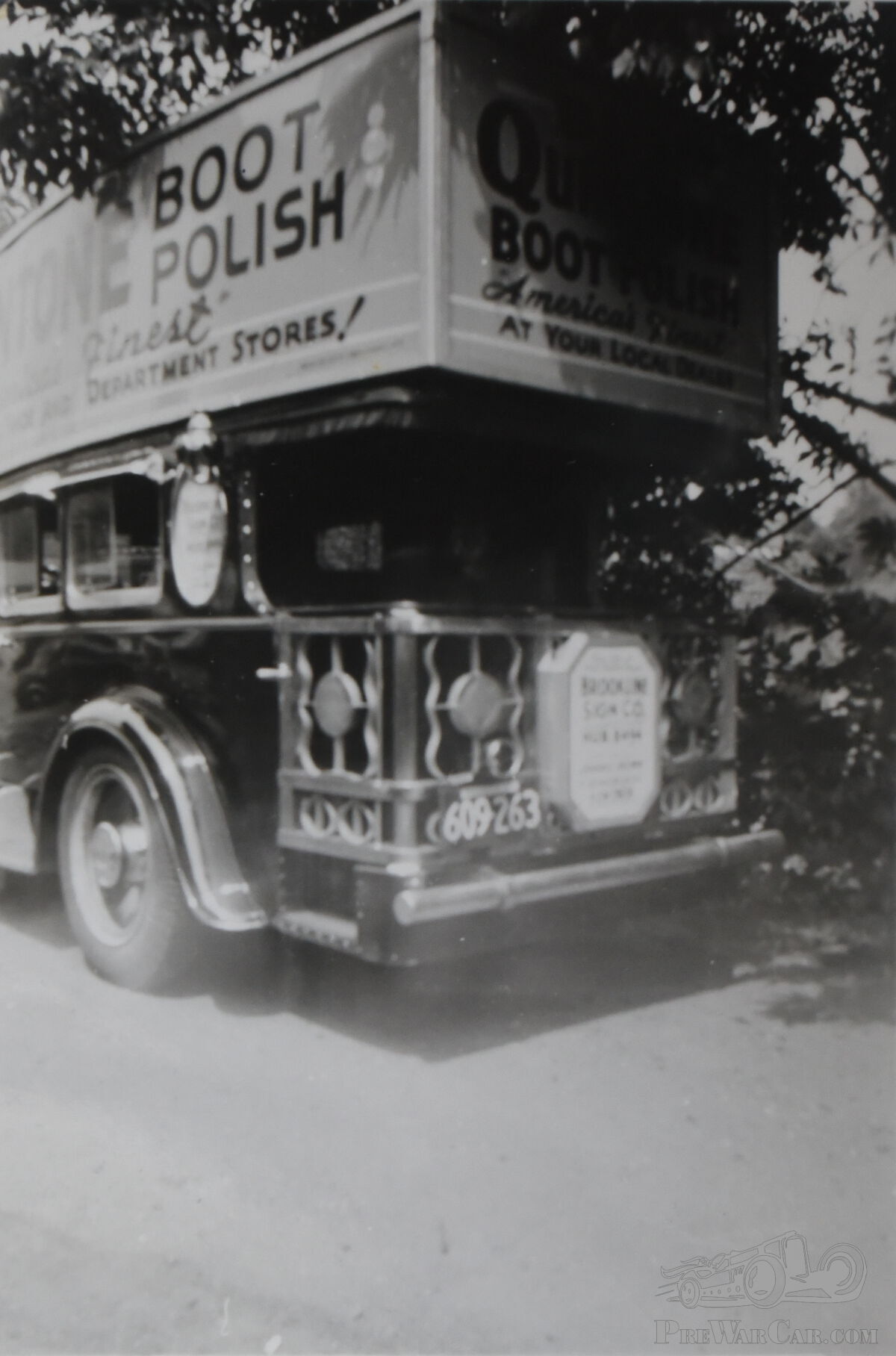


When these photographs came into our possession, we had to wonder why Quintone Boot Polish would be using a car dressed up as a locomotive to market its leather-rejuvenating products. The short answer, we found, is that it never commissioned such a vehicle—a series of these train cars were built for parade purposes, and Quintone simply took the opportunity to take out an advertisement on one. The story begins with Harry McGee, born in 1885 in Maplewood, Indiana. By 1910 he had moved to Indianapolis and in 1912 was engaged in the sale of Everitt and Stoddard-Dayton cars. In 1915, he attempted to prove the supremacy of cars by driving an eight-cylinder Cadillac in a race against an express train and winning, but he became obsessed thereafter with fashioning cars to look like trains, with ungodly results.
After a stint selling Dorts, McGee developed his own range of car paints under the Lyk-Glas brand, which went out of business in 1924, just months after he had spent $52,000 on the creation of his "Trackless Train," which he used to promote it. The beastly articulated creation, which used an unknown truck chassis and two Waukesha 70/80hp engines, was then leased to a series of high-profile companies and organisations, starting with the Indianapolis Chamber of Commerce. It even smoked, as Antique Automobile reported in 1976: "The method of expelling smoke through the funnel is to drop crude oil into the exhaust manifold and the smoke is conveyed by way of a small pipe to the smoke stack. In the stack are revolving blades which cause the smoke to be emitted in puffs instead of a steady stream. This operation is controlled from the driver's seat from which, too, the whistles, wireless apparatus and bell may also be worked."
Smokestack frightening
McGee himself drove a Dagmar, an expensive and good-looking, if uncommonly angular, car which he ruined by reshaping it with a faux boiler, smokestack and cow-catcher. After the Chamber of Commerce was done with his train, it was acquired by the newly-formed Metro-Goldwyn Motion Pictures, which sent it on a world tour, encompassing America, Canada, Europe, Britain, Australia, Mexico and the rest of the American continents. On its return in 1928, it was hired by International Beauty Tours, Inc., transporting its "beauty cargo" round the U.S.A. "They not only wear the latest gowns, lingerie and bathing suit creations, but they speak to the audience in their own native tongue," said the Charleston Gazette. The tour ended in March, 1929, when the manager of the troupe absconded with the funds and left the girls stranded...
McGee repossessed the train and its next guise was as the Trackless Sound Train, promoting Majestic radio sets, accompanied by a Cord L-29 also insultingly fitted with a cow-catcher. The train then changed hands several times until the autumn of 1933, when it returned to what had become Metro-Goldwyn-Mayer Pictures, which repainted it bright red and called it the Traveling Studio, to be used with its Hollywood Caravan which toured America. After several years with M.G.M., by 1937 the train had finally vanished completely.
Causing a Publix nuisance
In 1927, McGee formed the H. O. McGee Manufacturing Co.—"Manufacturers of Special Automotive Equipment"—which his advertisements claimed were "The World's First Trackless Trans-Continental Highway Trains." The trackless train moniker had been applied as early as 1903 to a Darracq which actually pulled a train of articulated cars through Paris, but McGee's boast may have been true if we assume that none of the preceding creations ever crossed continents. The plural, however, was less apt, for he had only built one train unless one also counts his hapless Dagmar. His headquarters were at 143, North Meridian Street, also known as the Indianapolis Board of Trade Building, but the factory location is unknown.
Sam Katz, chief executive of Paramount Pictures, and his head of advertising A. M. Botsford, had seen the Dagmar and decided that they needed more of the same in order to promote their new Publix cinema chain. Paramount duly commissioned McGee to produce a run of 15 Trackless Trains, this time using Graham-Paige Model 837 underpinnings. Each of the Publix Sound Trains was despatched to a different city, where its job was to collect actors and actresses and transport them to local premières, while huge speakers perforated citizens' ear drums with advertisements and interviews with the stars, who could parade themselves on the rear-mounted platform. Paramount used them until the early 1930s, after which they were sold and reused by various smaller companies. British magazine Motor Transport reported the total cost of the 15 cars was the equivalent of £90,000, and disagreed with this author when it wrote "Good taste and engineering ingenuity are at once apparent..."
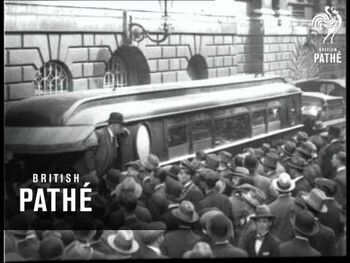
Impressively, four or five are known to have survived and one was exhibited at the Amelia Island Concours d'Elegance in 2009. We wonder if the example captured in these two little amateur snaps is among them? For interest, we have also included a Pathé film of the original Trackless Train from 1924 terrorising London while on its Metro-Goldwyn World Tour.
Words: Zack Stiling
Photographs: Stiling Collection
References: H. O. McGee Mfg. Co. by Mark Theobald (2012) on Coachbuilt.com
Published:
Friday January 10th, 2025
Facebook
LinkedIn
Twitter
WhatsApp
Email
Copy
Comments
Keith Kuehn
11 January 2025, 23:05
Years ago a local army veterans' group had one like it around here in St. Paul, Minnesota. After years of parades, etc., it was put up for sale after the organization's members had passed. I thought of buying it, but to what purpose? I know somewhere out there is that strange, weird locomotive on a truck chassis... As I recall, it was a World War One vets' group that served in France.
Read more
Mike Clark
10 January 2025, 22:54
Interestingly, the truly electrically-powered trolleybuses which survived in Bradford into the 1960s were known locally as Trackless. They were very like a double-decker bus but drew power from overhead cables just like a tram. Bet they wish they still had them now!
Read more