The global magazine and marketplace for classic car enthusiasts, by enthusiasts.


Filter
DeSoto for sale - DeSoto parts for sale
-

Desoto headlights for DeSoto
De Soto headlight glass for 1939 De Soto in as-new condition. Probably unused. 22cms high, 18cms wide (at widest point). -
Desoto dashboard & interior for DeSoto
One complete dashboard -cluster for a 1938 De Soto, wires and cable still connected. Temp. gauge, oil pressure gauge, amperage and fuel gauges, speedometer + odometer. -
Desoto engine-s (and parts) for DeSoto
6 cylinder engine of a circa 1929 De Soto. N° K7650. Valves and manifolds missing. Good block, ditto head and crankshaft/camshaft. Very suitable for spare parts or build up. -
Desoto grille for De Soto
Grille from a 1949 De Soto. Has some teeth missing and would benefit from re-chroming. Nice ornament to enhance your office with. -
Desoto documentation (manuals) for De Soto
Instruction Book for the 1929/30 De Soto - Six. Fourth edition, May 1929. 83 pages with many photos and technical drawings. Copied and bound. Price includes worldwide postage. -
Desoto pump for De Soto
Vacuum-pump as used in the 1928-30 De Sotos. Fittings on top missing. Good fuel-filter-glass and tank. Suitable for parts or restore. -
Desoto gasket (set) for De Soto
New-old-stock headgaskets (x2) for the 1928-30 6 cylinder De Sotos. Marked: Fitzgerald C° and 1019DC - made in USA. Price is for one and includes worldwide postage. (One gasket sold 31/3/15)


DeSoto
US, 1913 – 1916
DeSoto Motro Car Co, Auburn, Ind.
The DeSoto appears to have succeeded the Zimmerman. This was a large car with a 55hp, 6-cylinder engine, which was furnished with a compressed-air starter. The DeSoto model Six-55 five-seater touring car sold for $2185.
US, 1928 – 1960
Chrysler Motors Corp, Detroit, Mich.
The DeSoto was launched in 1928 as a 3.2-litre side valve six to compete with Oldsmobile, Pontiac and the cheaper Nashes. Styling and general design of the DeSoto were in line with the 1929 Chryslers, and at $885 for a DeSoto sedan 90.000 were sold in the first twelve months. A 3.4-litre straight-8 DeSoto on a 9ft 6in wheelbase was announced for 1930 as the world’s cheapest 8-cylinder car. However, DeSoto suffered badly in the Depression, and in 1932, when flexible rubber engine mountings and free wheels were made available, sales dropped to 26.000 DeSoto cars.
The DeSoto disappeared from the British market about this time, though certain ‘Chrysler’ models listed in England (the Mortlake, Croydon, and some of the Richmonds) were in fact DeSoto cars in all but name. A 6-cylinder version of Chrysler’s advanced unitary-construction Airflow, the SE-type with a 4-litre engine, was brought out in 1934, but was an unsuccessful as its bigger sister. Later DeSotos followed regular Chrysler lines closely though in later years there was a tendency for DeSoto to move into a higher price class than Dodge; by 1952 DeSotos started $300 higher than the companion make.
By 1939 the DeSoto cars for sale were being made with independent front suspension, hypoid back axles and column change. There was a choice at DeSoto of two 6-cylinder engines and three wheelbase lengths, the longest of these being reserved for seven-seater bodywork – DeSoto continued to offer a really roomy family car right up to 1954. A 4-speed semi-automatic Vacumatic transmission became an option in 1941, but DeSoto’s big post-war change of models did not take place until 1952, when the division followed Chrysler’s lead in adopting the oversquare ohv V8; the DeSoto version was of 4½-litre capcity and developed 16-bhp. With the advent of Chrysler’s ‘flight sweep’ styling in 1955, the side-valve sixes were dropped and the standard engine in a DeSoto was now a 4.8-litre eight, giving 185bhp in Firedome guise, and 200bhp in Fireflite form. Though this redesigning saved Chrysler sales generally, the slump in the medium-price class had an adverse effect on DeSoto and in 1959 the DeSoto division was merged with Plymouth. Last of the DeSotos were the 1961 models, unitary-construction cars with a choice of three engines: Plymouth’s 145bhp ohv ‘slant six’ as used in the Valiant, and V8s of 230 and 265bhp, the two former only in Canadian DeSotos. Production of DeSoto cars ceased in November 1960 after only a few had been delivered.
Source: Georgano, encyclopedia of motorcar; MCS
The information is written with the greatest of care. However, if you have any suggested amendments please contact us at office@prewarcar.com


Featured
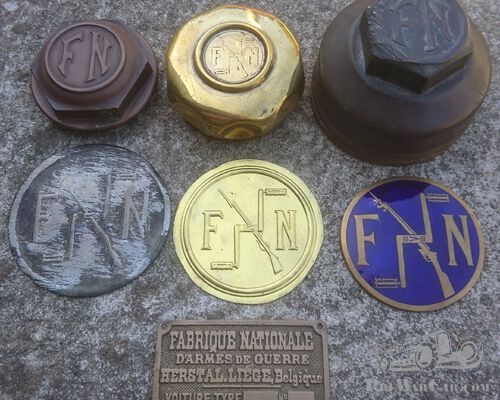
WANTED Fabrique Nationale (FN) car & motorcycle parts 1907 - 14
Interested in parts or info for 1907 - 1914 FN cars. Shown in the second photo are the brass steering column flange, aluminium 5 spoke steering wheel ..
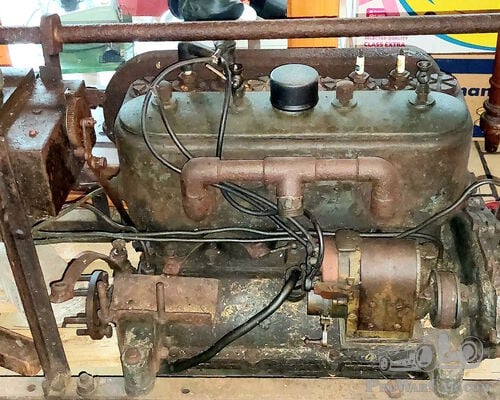
Cudell 4-Cylinder Engine ca. 1906
On offer is an extremely rare—and possibly now unique—4-cylinder engine manufactured by Cudell. We believe this to be the 16/20 hp, 2,554 cc four-c..

Wanted: 1923 Peugeot 163 BR Worm Drive Differential & Torque Tube
Hi, I'm looking to buy a worm drive differential and torque tube for a 1923 Peugeot 163 br also a windscreen frame, my car is a roadster cabriolet..