The global magazine and marketplace for classic car enthusiasts, by enthusiasts.


Filter
Make a choice:
- Cars
-
Make >>
- Bikes
-
Location >>
- Parts & more
-
Make of car >>
-
Manufacturer >>
-
Category >>
- Bicycles & more
-
Year >>
-
Countries


The American Bantam and the death-defying daredevils of the Pudding River


No, this is not a circus act. It’s not a record attempt either, and Evel Knievel was nowhere near the scene. This is just one of many fun rides over the Pudding River in Oregon as made by anyone wanting to pay 10 cents for it in 1932. Apparently, there were many folk wanting to do just that. These rides were performed that summer by local man C. W. West, who suspended his car on cables there to make a little money in that very original way.
One report mentioned the following: “The cables are 120 feet long and are anchored firmly to the ground on each side of the river, which is a popular spot
for swimmers. It is the swimmers who take most of the rides across the ‘bridge’, but C. W. West, the operator of the car, finds plenty of patrons who want to cross the river either for business reasons, or to enjoy the thrill of riding in an automobile traveling on a precarious highway... The expense of operating the car is slight, because there are no tires to wear out and 1500 crossings can be made on a gallon of gasoline.”
We found that the car, called a ‘baby automobile’ in the report, was an American Bantam sedan, which Mr. West managed to steer over two cables to get across. It was reported: "rubber rings have taken the place of the tires to give the necessary traction on the smooth steel ropes." Note that the third cable is there to steady the car on the top, with a clamp attached to the car’s roof. With a wheelbase of only 75 inches and a track of 40 inches, the Bantam was indeed a small car. Does anyone know exactly what it weighed? We doubt if the top cable would hold the car if the wheels ever decided to leave the bottom cables for whatever reason. Or is that just us speaking as 21st-century chickens? Speaking of which, swimming underneath it can’t have been for the faint-hearted either!
Words: Jeroen Booij
Published:
Thursday November 14th, 2024
Facebook
LinkedIn
Twitter
WhatsApp
Email
Copy
Comments
Peter
17 November 2024, 19:38
Irrespective of the make and model, not one of the bathers below is giving the car above a second glance, despite their perilous position!
Read more
Chrisso Rheault
17 November 2024, 14:09
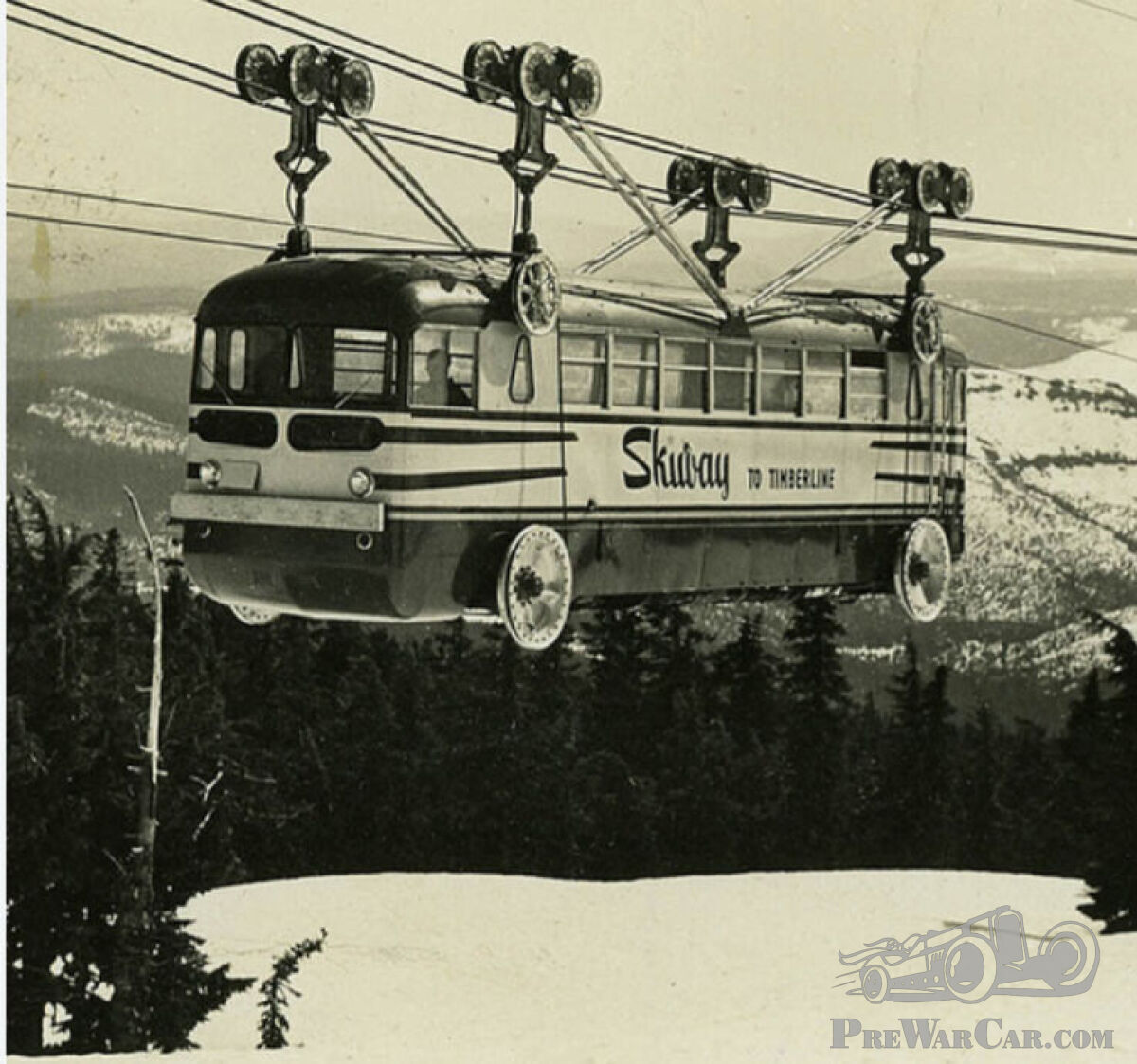
A few years later, a ski resort in the same area used a city bus on cables as the ski lift.
Read more
Steve Diggins
16 November 2024, 23:24
The American Austin was an Austin Seven produced under license from 1930 to 1935. It was not a sales success. In 1936 the name was changed to American Bantam. The car was also upgraded mechanically to the chassis and the engine. Mr. Austin no longer received his $10 royalty per copy. This new car arrived in 1937. The car pictured is an early thirties American Austin.
Read more
David Grimstead
15 November 2024, 16:40
In the “1932-1933 American Automotive Reference Manual for license registration, tax assessment, insurance classification, trade evaluation and general investigation”, 1930 to 1932 American Austin models were all listed as “Bantams” and were either 1- or 2-seater commercials or 2-seater roadsters, coupes or cabriolets on a 75-inch chassis until January 1932 when a longer “Sedan” is listed. It seems that some coupes were already known as sedans.
The Manual gave the ex-factory “shipping weights” in pounds:
New for 1930: Special Delivery Utility: 1130, Delivery car: no weight given, Roadster: 1100, Coupe: 1130, De Luxe Coupe: 1150.
Carried over to 1931: Panel Delivery: 1150, Roadster:1050, Standard Coupe 1130, Special Coupe 1130, Business Coupe 1130, Cabriolet 1210, De Luxe Coupe 1130.
Carried over to 1932: Panel Delivery: 1240, Runabout: 1020, Business Coupe: 1120, Standard Coupe: 1130, Cabriolet: 1210, De Luxe Coupe: 1140.
New in January 1932: 4-passenger/4-seater (Sedan) no weight given but wheelbase given as 85 inches. (These may never have been built as production was halted in spring 1932.)
Even the lightest enclosed passenger model was 1130lbs (10.1 cwt) or c.513kg – easily enough to sink several rubberised-fabric Li-Los. Mind you, according to a cable supplier’s data, a 5/16th inch/8mm iron wire rope with a 37.9kN (8520lb.ft) breaking strain would safely support up to 1700lbs. Best not try that at home with a crane and your vintage pride and joy...
Read more
The Manual gave the ex-factory “shipping weights” in pounds:
New for 1930: Special Delivery Utility: 1130, Delivery car: no weight given, Roadster: 1100, Coupe: 1130, De Luxe Coupe: 1150.
Carried over to 1931: Panel Delivery: 1150, Roadster:1050, Standard Coupe 1130, Special Coupe 1130, Business Coupe 1130, Cabriolet 1210, De Luxe Coupe 1130.
Carried over to 1932: Panel Delivery: 1240, Runabout: 1020, Business Coupe: 1120, Standard Coupe: 1130, Cabriolet: 1210, De Luxe Coupe: 1140.
New in January 1932: 4-passenger/4-seater (Sedan) no weight given but wheelbase given as 85 inches. (These may never have been built as production was halted in spring 1932.)
Even the lightest enclosed passenger model was 1130lbs (10.1 cwt) or c.513kg – easily enough to sink several rubberised-fabric Li-Los. Mind you, according to a cable supplier’s data, a 5/16th inch/8mm iron wire rope with a 37.9kN (8520lb.ft) breaking strain would safely support up to 1700lbs. Best not try that at home with a crane and your vintage pride and joy...
David Liepelt
15 November 2024, 06:25
The car is actually an American Austin. The American Bantam came in 1937 and had significantly different fenders and a rounded radiator grill.
Read more
Tony Press
14 November 2024, 01:52
The Bantam version of the Austin Seven was quite heavy compared to the British Ruby saloon—possibly 15 cwt. This sort of stunt didn't save the Bantam Company, even after it won the design competition for the car which went on to become the Jeep. The design was then given to Willys, with a lot of government support which was not offered to Bantam. The design was also given to Ford.
Read more