The global magazine and marketplace for classic car enthusiasts, by enthusiasts.


Filter
Make a choice:
- Cars
-
Make >>
-
Year >>
-
- Bikes
-
Location >>
- Parts & more
-
Make of car >>
-
Manufacturer >>
-
Category >>
- Bicycles & more
-
Year >>
-
Countries


The Austro Daimler 'Sascha': Porsche's first racer?
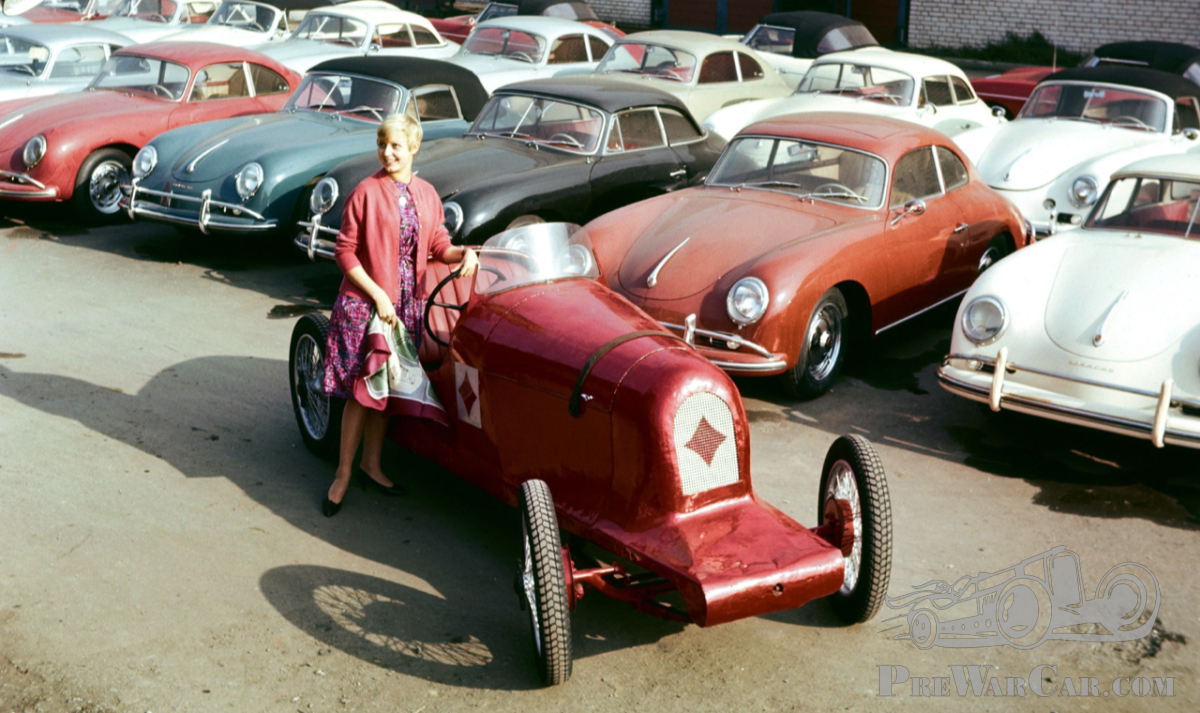

We see here rather a lot of post-war Porsches for a website dedicated to pre-war cars. Don't be distracted, though; it’s the centrepiece which is the star here, an Austro Daimler ADS-R racer dating back to 1922 and with strong links to later Porsche sports cars, with it being an early design of Herr Doktor Ferdinand Porsche. He was the man who built it prior to starting car manufacture under his own name; in fact, he worked as a chief designer for Austro Daimler at the time. We’re not quite sure whether they initially liked his idea for a lightweight racer, though. Porsche named the car Sascha after his friend Alexander Joseph Graf Kolowrat-Krakowsky, better known as Sascha. Count Sascha is said to have greatly encouraged him to build a small sports car, and he also personally financed the project.
Does that make it the first Porsche sports car? We'll leave that for the experts to debate, but it seems a nifty design in all its Spartanness. With an 1,100 c.c. four-cylinder engine with an aluminium block and bevel-driven overhead camshafts, it pumped out some 50 b.h.p., making it seriously competitive in its day. It seems Austro Daimler realised that, as it was not confined to being just a one-off. For the 1922 Targa Florio, no fewer than four Sascha racers were built, with three of them entered in the race. They came first and second in class. Legend has it that the cars were originally white in colour but painted red for the train journey to Italy to ensure that they wouldn’t stand out too much and get stolen. To make them easier to identify from a distance, playing card symbols were painted on the sides of each of them: hearts, diamonds, clubs and spades.
Do any of them besides this one survive? We’re not sure. This picture dates from the early 1960s when the Porsche Museum already existed and the Austro Daimler racer was already part of the inventory. It is photographed here outside the manufacturing hall next to brand-new 356s. The car is still part of the museum collection today, but a few years ago it was restored and repainted in white, oddly now wearing the spades symbol rather then the diamonds seen here
Words: Jeroen Booij
Picture: Porsche Museum
Published:
Friday February 28th, 2025
Facebook
LinkedIn
Twitter
WhatsApp
Email
Copy
Comments
Thomas Billicsich
03 March 2025, 20:26
An original Sascha was taking part at Porsche Landpartie in 2024.
Read more
Hergen Deuter
03 March 2025, 19:07
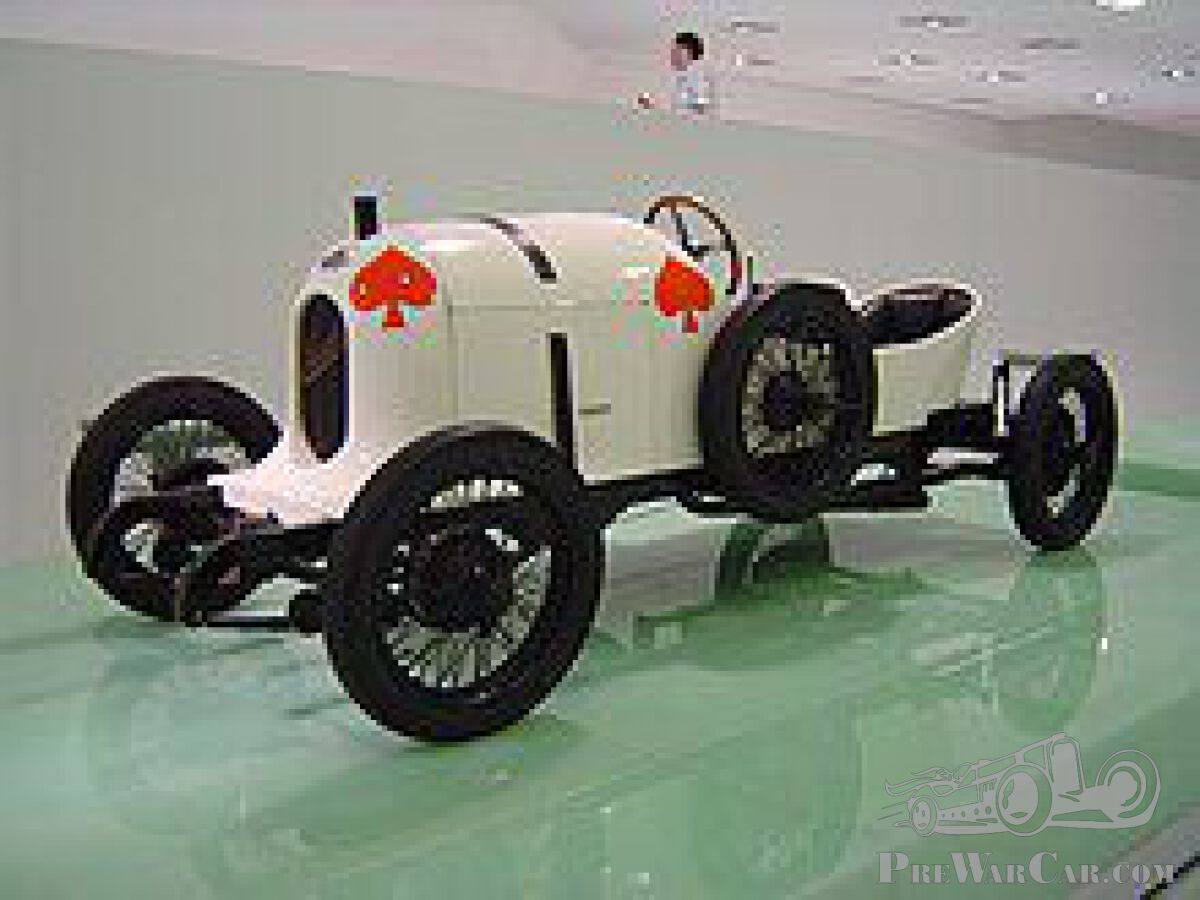
On porschesport.com we learn that this Sascha came to Porsche in poor condition and painted red in the 1950s, was first refurbished and repainted white by apprentices in 1975 and was completely restored for the 100th anniversary (photograph from Wikipedia). Another one (coloured red) apparently still exists in Hamburg.
Read more
Erler Thomas
03 March 2025, 10:08
Thank you Alistair, you made my day. I might have to take my coment of it being a replica back. I think comparing the front axle on the Porsche museum piece and the auction picture, you can clearly see the crude brake drum and the brake shaft in the centre. It would be interesting to know what happened to the "Sascha" from the auction. It would be great if Porsche could decide on a restoration of that article.
Regards from Tyrol.
Read more
Regards from Tyrol.


Alistair Hacking
02 March 2025, 21:52
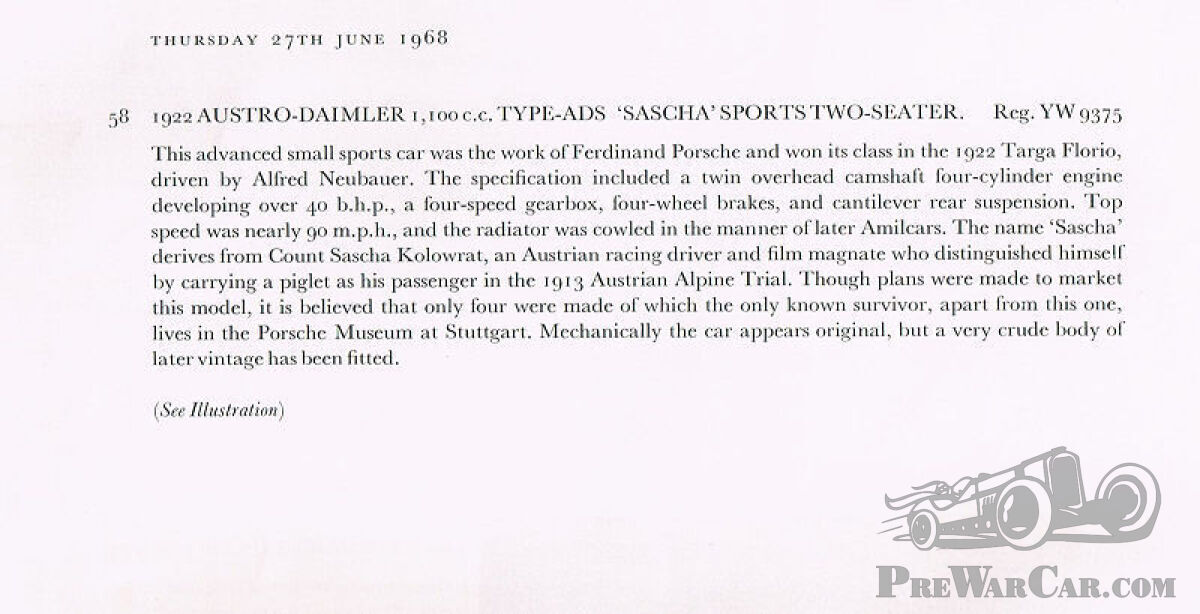
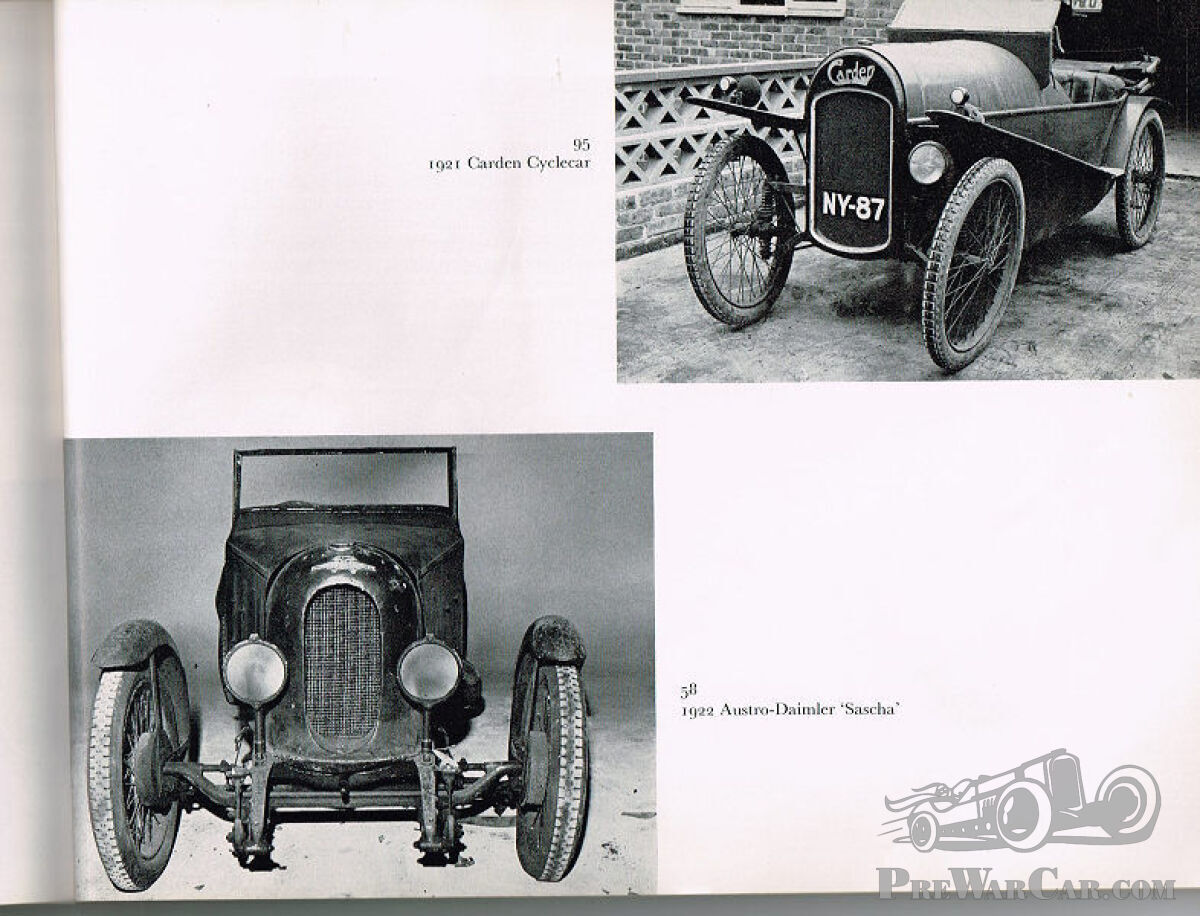
There was a Sascha sold by Sotheby's in the A. W. F. Smith sale at Cross-in-Hand, Sussex, England, in June, 1968. Surprisingly I managed to find the catalogue!
Read more
Alistair Hacking
03 March 2025, 11:25
The Sotheby's catalogue quotes the British registration as YW 9375. YW is a London mark issued between May and July, 1928, so it is likely the Sascha arrived in Britain at that time.
Read more
Lawrence S.
02 March 2025, 18:03
Strange that nobody mentioned that Alfred Neubauer (Mercedes's post-war team manager) drove a Sascha in the 1922 Targa Florio.
Read more
Hergen Deuter
01 March 2025, 20:03
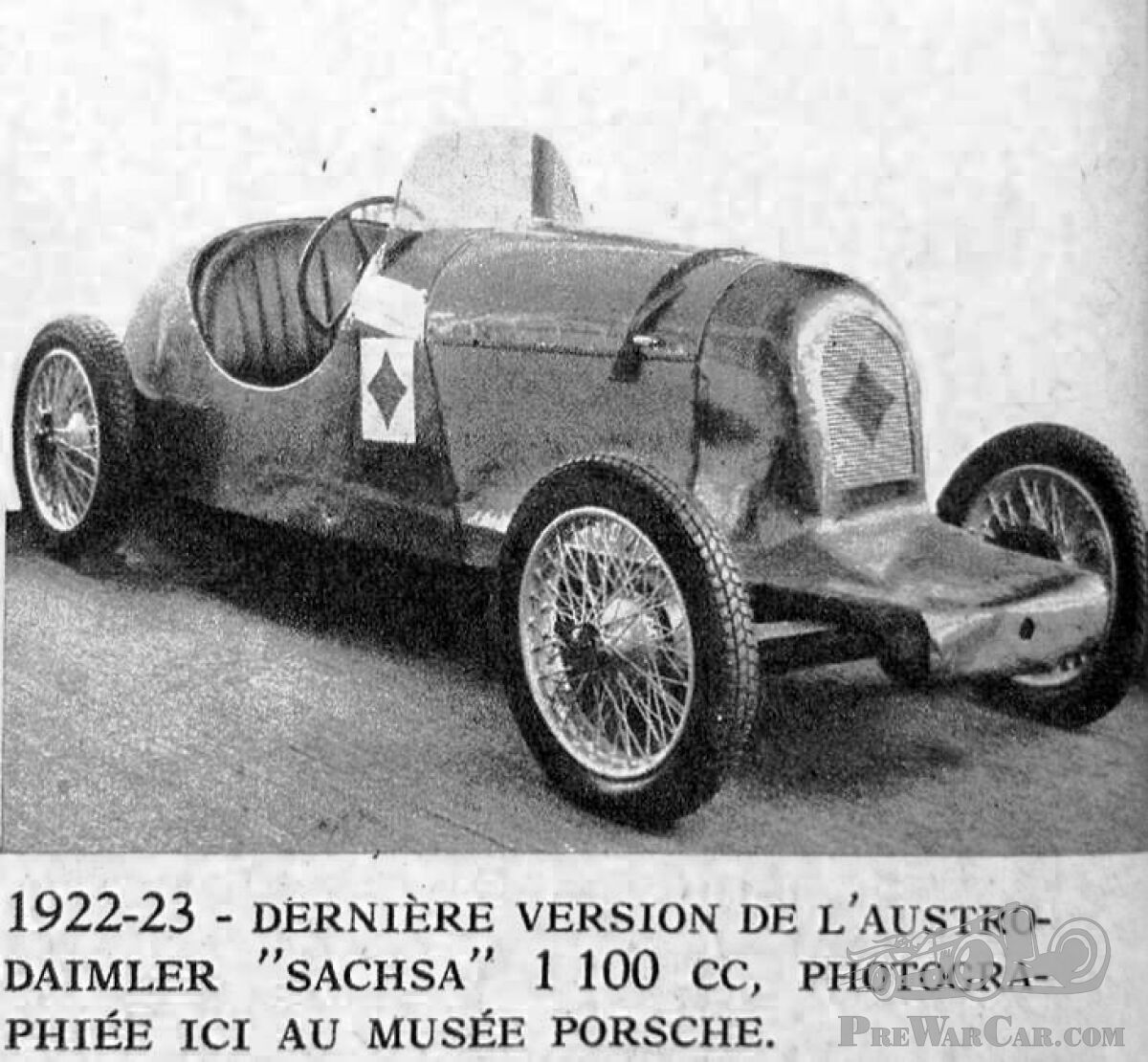
According to this press photo, probably from the 1960s, it surprisingly seems to be one of the original vehicles. It was possibly repaired with simple means after front damage and must have been on display in this condition in the Porsche Museum at the time.
Read more
Stanislav Kirilets
01 March 2025, 01:51
What is it? The automobile? Sorry, there is still one month until April 1st :-)
Read more
Stig Larsson
28 February 2025, 21:02
This is not a genuine "Sascha." Take a look in the book "Sublime Creations: Professor Ferdinand Porsche" by Karl Ludvigsen, pages 94-105, and you could see that it at least the body is a badly-made lookalike. Ferdinand Porsche's first sports car was the Prince Henry model of 1910-11, which can be seen in the same book on pages 40-59. The real car can be seen at the Austro-Daimler Museum in Mattsee.
Read more

Bart
28 February 2025, 12:51
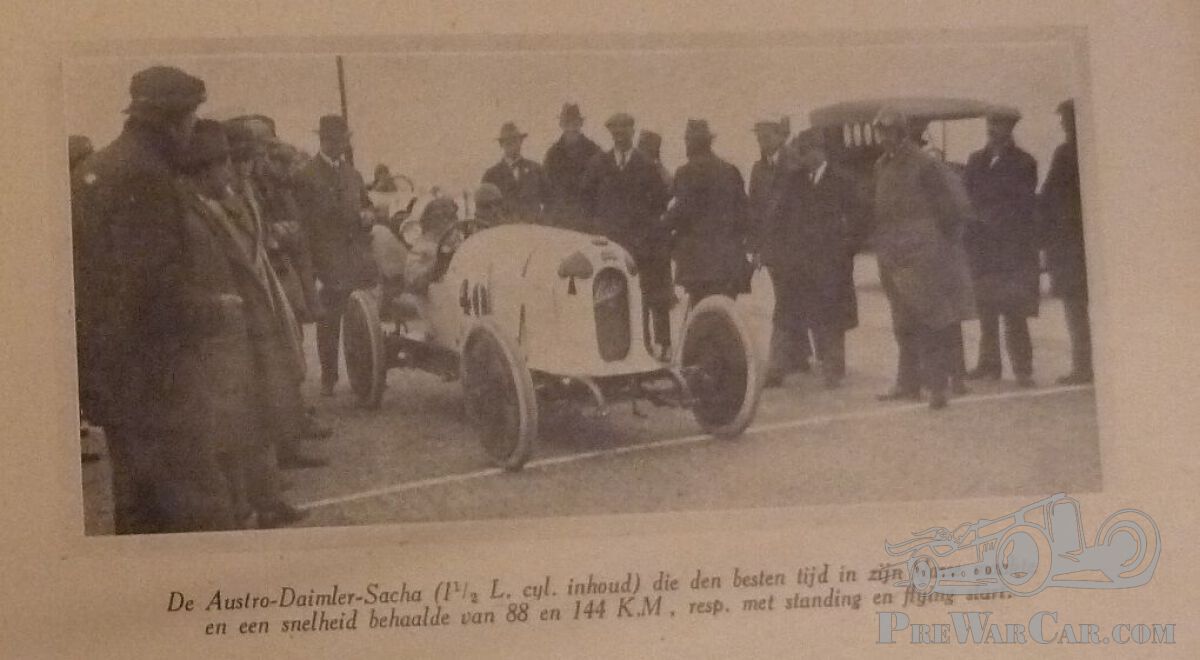
The red one looks a different car to me. Attached is a picture of when it was white and racing at the Scheveningen Boulevard in 1922.
Read more
Michael Schlenger
28 February 2025, 12:39
Another remark: The 1,100 c.c. version mentioned in the article had a maximum output of 35 h.p., which was already quite an achievement in 1921. In 1922, a 1,500 c.c. version was introduced which produced 50 h.p. A good source in this regard is the book by Martin Pfundner, "Austro-Daimler & Steyr," 2007.
Read more
Michael Schlenger
28 February 2025, 12:14
Looks almost like a carousel car to me. The absence of a coolant filler neck says it all...
Read more
Hergen Deuter
28 February 2025, 11:25
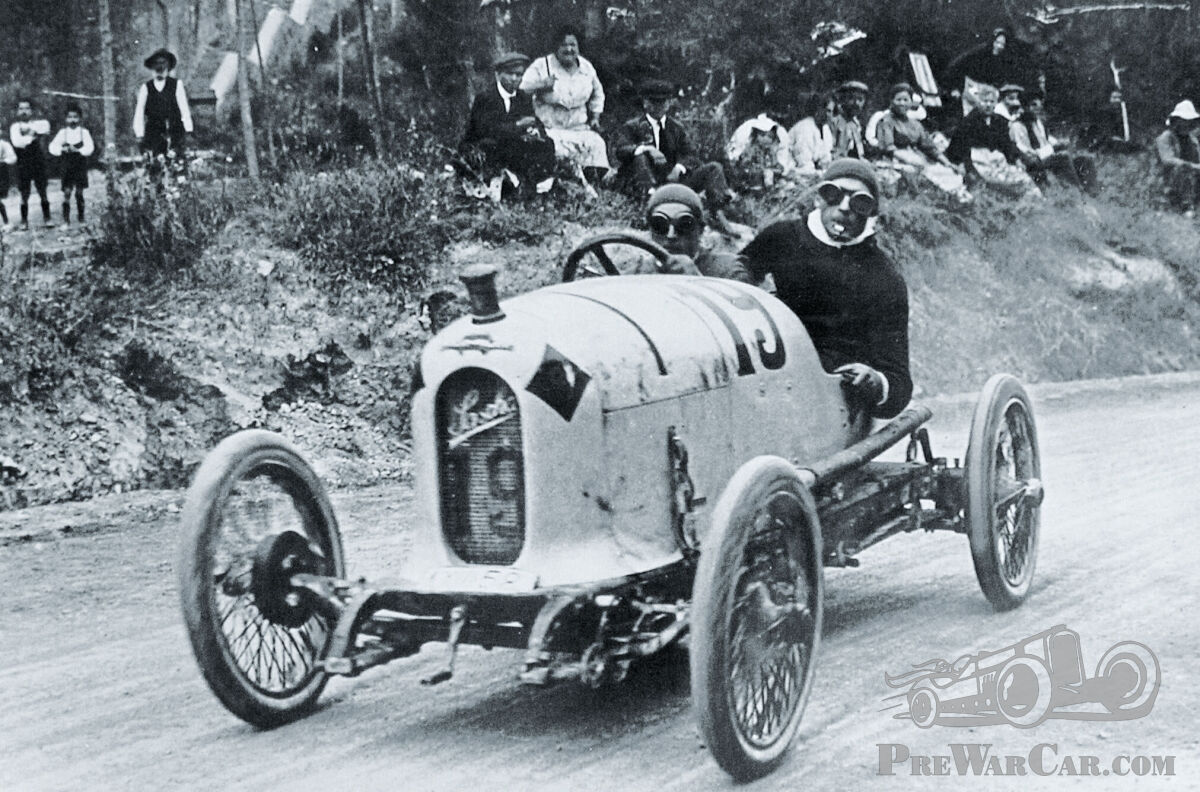
Apparently a mock-up was built for some reason. Here is a contemporary photo.
Read more
Christoph Röhrs
28 February 2025, 08:55
What irritates me a bit is the way the racer is steered. It looks like it has a turntable steering, which was absolutely unusual in automotive engineering from the very beginning. But it looks a little too big for a children's toy.
Read more
“Of course we have decided to leave the modern carburetter on it. It's easier for us to handle.”
In my opinion, this is not what the restoration of such an historic car means.