The global magazine and marketplace for classic car enthusiasts, by enthusiasts.


Filter
Make a choice:
- Cars
-
Make >>
-
Year >>
-
- Bikes
-
Location >>
- Parts & more
-
Make of car >>
-
Manufacturer >>
-
Category >>
- Bicycles & more
-
Year >>
-
Countries


The Compound Motorcar
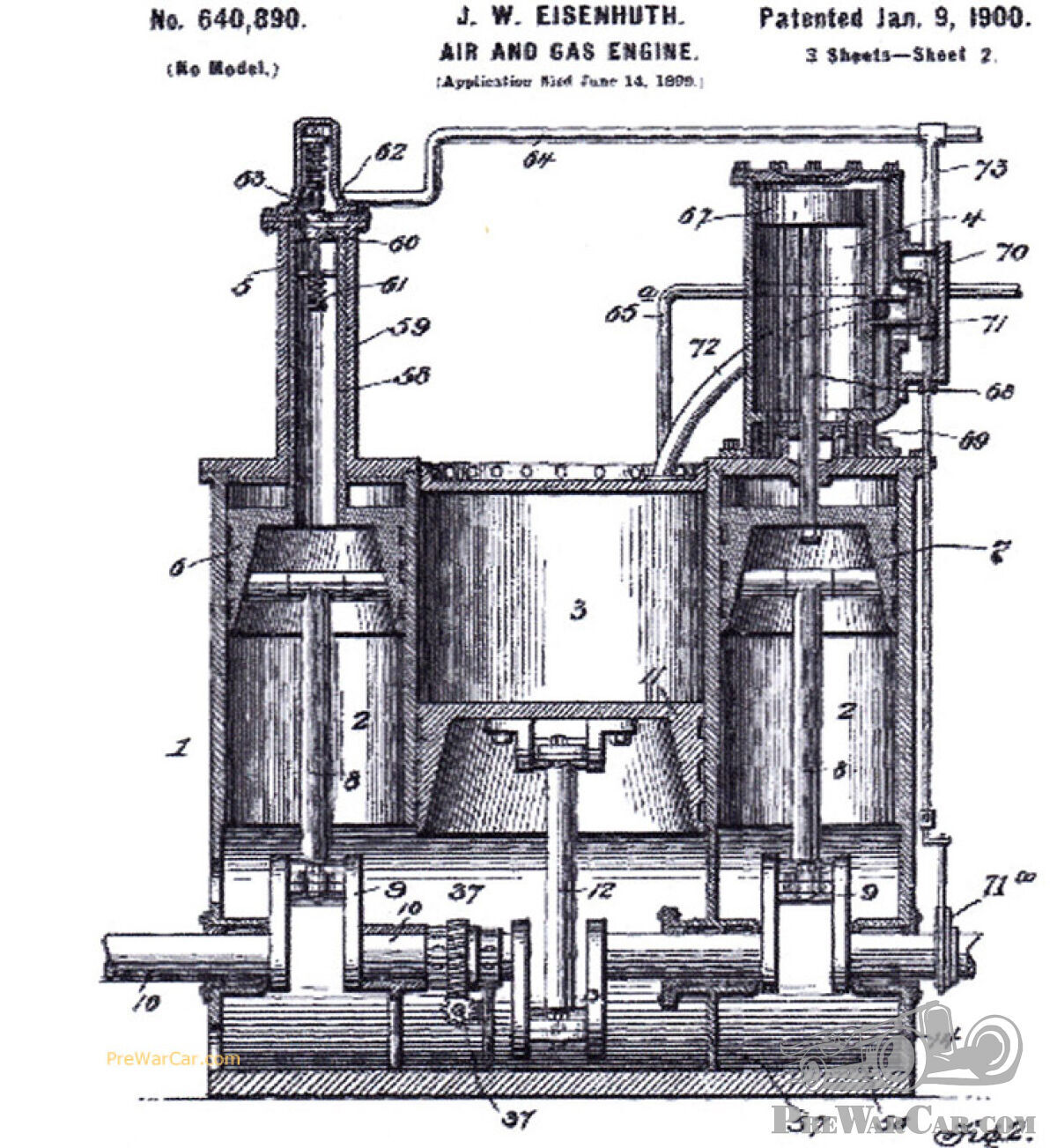

It is amazing the number of different designs and construction ideas that formulated in the inventive brains of the early engine designers, the ideas seemed endless. One of the more completely different and innovative must have been the 3 cylinder motor designed by D.Fox Graham in 1903.
John W. Eisenhuth an engine builder had designed a motorcar as early as 1896 which he built in Newark, New Jersey but he decide to move east, where all the action was happening, moving to the Greater New York to continue his experiments. He then moved to Middletown, Connecticut and purchased the Keating Wheel and Automobile Company. In 1903 he also established the Elsenhuth Horseless Vehicle Company. He met D. Fox Graham who had invented the Graham-Fox compound engine and the two companys merged, forming the Graham- Fox Motorcar Company and produced a new car that they called “the Compound”.
In 1903 a prototype design was shown at Madison Square Garden where it was called the Graham-Fox, but when the first production model was produced in late 1903 the name had changed to “The Compound". Their 1904 model was a 7 seater touring car, with a 3 cylinder engine vertically mounted at the front of the car. It produced 35 hp weighed 3100lbs. it cost $6,000 to $7,000 depending on the body style and extras.
This is a pre-publication from Historic Wheels, a free 9 page emailed magazine and originally published on June 27, 2015. Written and published by transportation historian Ivan D, Taylor in New Zealand. As its name suggests it covers everything that is on wheelsand is historic no matter be it propelled by humans, animals, steam, electricity, petrol or any other means.
Published:
Tuesday September 5th, 2023
Facebook
LinkedIn
Twitter
WhatsApp
Email
Copy
Comments
Greg Prior
05 September 2023, 01:33
Thank you for the nice article. The Graham-Fox was named for David Graham and Frank Fox. One minor point is that of the middle name: David Ferguson Graham was my great-great-uncle. I have a number of photos and blueprints from the Graham-Fox and Compound cars including a shot of the G-F engine. The factory still stands as of today in Middletown.
Read more
Unknown
28 June 2015, 15:13
I'd like to add some comment to this story. I was somewhat confused by the information given by several sources (including the Standard Catalog by Beverley Rae Kimes), that the Compound car was shown at the Madison Square Garden show of 1903, while an experimental vehicle would have been tested some months earlier, which would have been during the fall of 1902. Looking at all info I could find, my guess is that this has all happened a year later. What follows here is the time-line according to actual magazine info.
In November 1902, The Motor World gives a complete description of the Graham-Fox engine and in December the same magazine states that a company has been formed to produce engine and cars. In the March 1903 issue The Motor World states, that the Graham-Fox Company is firmly settled and that it has the intention of producing severals models including a 100hp racing car! In June the Cycle & Automobile Trade Journal shows a line-drawing of the first model to be ready, a 35hp model. Apparently the first Graham-Fox is ready during the fall of that year for a test drive, but not yet the 35hp engine. The following description is derived from The Automobile Review of November: “The [16 hp] engine used on this occasion was hardly powerful enough for this car, […] where in reality this type weight of car demanded a 35 hp engine”. Clearly this was the experimental car, mentioned in several sources. In January 1904 this vehicle was shown with the name of Compound at the Madison Square Garden Show by the Eisenhuth Horseless Vehicle Co.. In Motor Age the following description is given: “This company shows the compound gasoline car which was developed and brought out by the Graham-Fox Motor Co.” Eventually this car proved to be far too expensive indeed and during 1904 a smaller model was developed, being the model 3 on the 1905 advertisement, which would remain the basic model during the remaining existence of the EHVC.
Read more
In November 1902, The Motor World gives a complete description of the Graham-Fox engine and in December the same magazine states that a company has been formed to produce engine and cars. In the March 1903 issue The Motor World states, that the Graham-Fox Company is firmly settled and that it has the intention of producing severals models including a 100hp racing car! In June the Cycle & Automobile Trade Journal shows a line-drawing of the first model to be ready, a 35hp model. Apparently the first Graham-Fox is ready during the fall of that year for a test drive, but not yet the 35hp engine. The following description is derived from The Automobile Review of November: “The [16 hp] engine used on this occasion was hardly powerful enough for this car, […] where in reality this type weight of car demanded a 35 hp engine”. Clearly this was the experimental car, mentioned in several sources. In January 1904 this vehicle was shown with the name of Compound at the Madison Square Garden Show by the Eisenhuth Horseless Vehicle Co.. In Motor Age the following description is given: “This company shows the compound gasoline car which was developed and brought out by the Graham-Fox Motor Co.” Eventually this car proved to be far too expensive indeed and during 1904 a smaller model was developed, being the model 3 on the 1905 advertisement, which would remain the basic model during the remaining existence of the EHVC.
Unknown
28 June 2015, 10:18
perhaps to explain better, the Ford Mustang had a V8 engine, . . . but here is a Midland Railway steam engine from the same era; https://chasewaterstuff.wordpress.com/2013/01/14/steam-locomotives-of-a-more-leisurely-era-1902-4-4-0-compounds-midland-railway/
Read more
Unknown
28 June 2015, 06:18
how clever these engineers were, no computers and nothing to copy. take the first cadillac's NO carbureters twin spark plugs how on earth did they get there. without all these engineers efforts we would not have cars today.
Read more
Unknown
28 June 2015, 03:16
I had wondered whether the car was an EHV as in the advert, not a Compound. Certainly, compound railway and mill steam engines were generally known by the name of their designer rather than the type of engine, which throws the answer to last week's quiz into doubt, doesn't it ?
Read more