The global magazine and marketplace for classic car enthusiasts, by enthusiasts.


Filter
Make a choice:
- Cars
-
Make >>
-
Year >>
-
- Bikes
-
Location >>
- Parts & more
-
Make of car >>
-
Manufacturer >>
-
Category >>
- Bicycles & more
-
Year >>
-
Countries


The Edwardian and Vintage motorists of Cornwall




For our international readers not familiar with Cornwall, it occupies the extreme south-westerly corner of England, bordered on two sides by the English Channel and the Atlantic Ocean. It is predominantly known for its rugged sea cliffs and windswept moorland, quaint fishing villages and the ruins of Tintagel Castle, the legendary birthplace of King Arthur. Because of its remoteness, parts of it remain refreshingly untouched by modernity, but, as these photos show, Cornish folk were quick to embrace the arrival of the motor-car.
Day trips by charabanc
For our lead photo, we had to use the marvellous shot of the Delaunay-Belleville 30hp, registered in November 1919. While Delaunay-Belleville is typically associated with some of the most luxurious automobiles of the Edwardian era, this one seems to have been bodied as a small charabanc. Operated by the Penryn & Falmouth Motor Co. and photographed on an outing to Truro in the 1920s in front of a gloriously ornate Victorian draper's shop, we can't help but marvel at its passenger capacity. How many people are in or on it? Fifteen or so? The vehicle behind looks to be another charabanc, on a more natural Tilling-Stevens motor-bus chassis.
The second photograph shows a 1913 Studebaker 20/25hp model, owned by Col. Faulkner Brown of Tremough, Penryn, but in the service here of Hicks of Truro, and a vital service it's performing. The scene is Truro railway station, and the Studebaker is collecting wounded soldiers from the Great War to take them to the local infirmary.
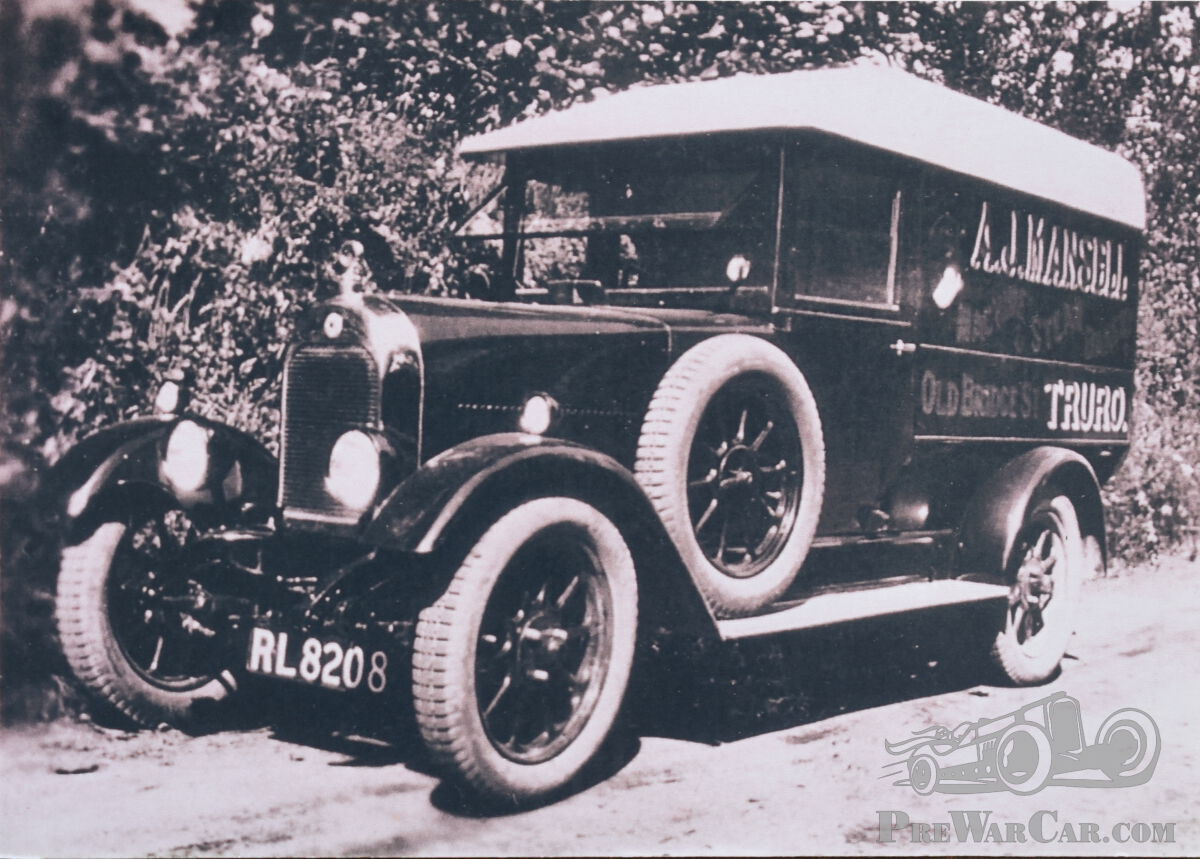
The van is easily identified as a c.1928-30 Morris one-ton van. Alfred James Mansell (1865-1949) ran his 'Machine & Steam Bakery' in Truro from the 1890s to c.1932, and from 1910 was based at 15 Old Bridge Street.
A mystery car to finish
We thought we'd save the mystery car for last. Someone has gone to the effort of writing that the driver is a fellow called Edgcombe and the passenger one Geoffrey Coon, and that the car itself is a 1912 Darracq. It appears to have some connection with a garage in Liskeard, either Botterell's or Taylor's. However, unless we're very much mistaken, the car is not a Darracq at all, which begs the question: what is it?
Over to you...
Words: Zack Stiling
Published:
Monday December 5th, 2022
Facebook
LinkedIn
Twitter
WhatsApp
Email
Copy
Comments
Roger Armstrong
11 December 2022, 16:29
I think that this is a Darracq of c.1910, a large, powerful car. I note that others think the same.
Read more
Steve Diggins
09 December 2022, 01:33
I am sure the Studebaker, which was a fine car of the day, is a Canadian-built example.
Read more
Clive Hamilton-Gould
05 December 2022, 15:54
Looks like a Darracq having owned a 14/16 of 1909. This had louvers in the bonnet sides and this also looks like the solid undertray which formed part of the chassis up to the back of the gearbox.
Read more