The global magazine and marketplace for classic car enthusiasts, by enthusiasts.


Filter
Make a choice:
- Cars
-
Make >>
-
Year >>
-
- Bikes
-
Location >>
- Parts & more
-
Make of car >>
-
Manufacturer >>
-
Category >>
- Bicycles & more
-
Year >>
-
Countries


The evolution of the De Dion Bouton voiturette


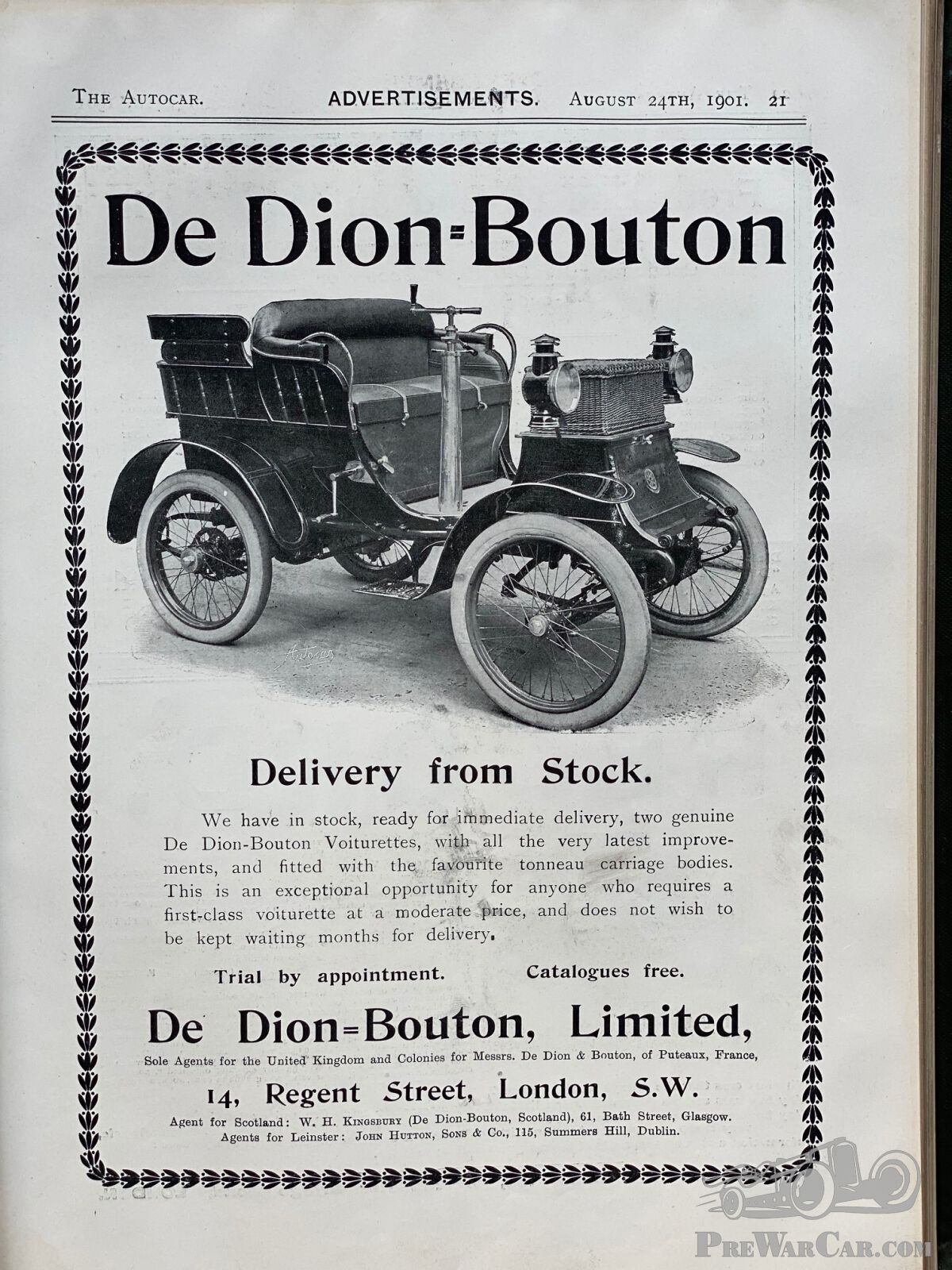



By the middle of 1901, less than two years since the finalisation of development for the rear-engined De Dion Bouton voiturettes, plans were well advanced in Puteaux for the launch of a front-engined De Dion Bouton motor car at the end of the year with some significant changes to the technical layout and design. The Type G voiturette (image 1), launched in December, 1900 and revised early the following year, had sold well but there was a need to maintain momentum in the face of increased competition, much of it from manufacturers to whom De Dion Bouton had supplied 3½hp and 4½hp engines in the preceding years.
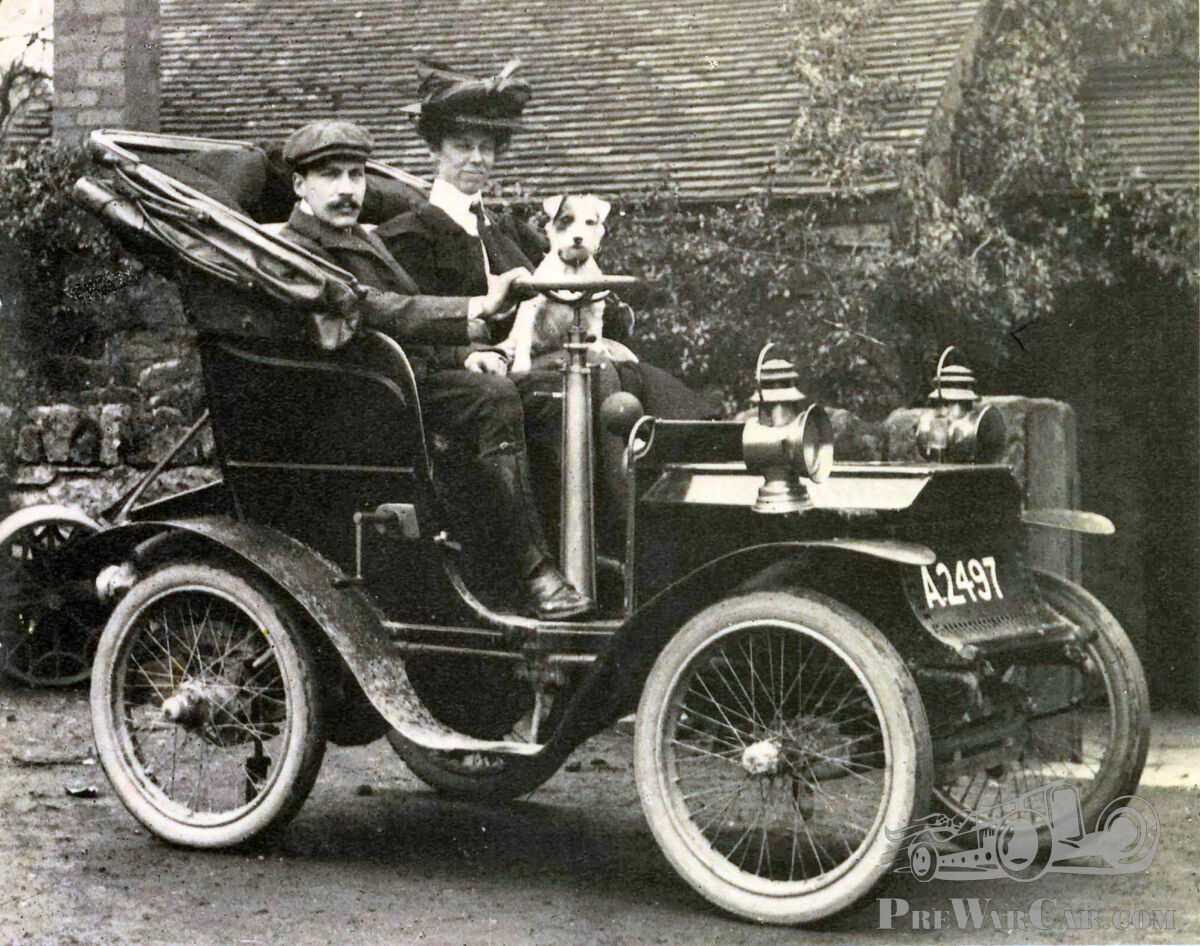
It was readily apparent at the time of the launch of the voiturette in 1899 that the usable space on the chassis frame was relatively limited and it did not take long before different approaches were made to optimise the level of functionality. For many motoring commentators the wisdom of having two rear-facing passengers oblivious to the road and obstacles ahead was questionable, especially as the driver’s view was severely restricted, increasing the jeopardy in which the passengers might find themselves. This matter was tackled by repositioning the front seat so that the passengers faced forward, which was a straightforward adjustment, but they needed somewhere to place their feet. This layout required the installation of a footboard, which sometimes was designed to fold up if not required. For a passenger at the front of any vehicle travelling at 25 mph, especially in poor weather, the discomfort would have been considerable, which prompted the creation of a rigid horizontal platform fronted by a vertical shaped board to deflect the wind.
No doubt this would have been appreciated by the occupants, but it came at the expense of legroom for the driver (image 2). The alternative approach was to leave the front of the vehicle untouched and reposition the passengers in a separate compartment to the rear of the driver. At a stroke this solution improved the visibility for the driver, offered some small amount of luggage space within or on top of the front plinth, and it transformed the safety of the passengers. On the other hand, both front-seat occupants and the rear passengers had restricted legroom; for the nearside rear passenger there was the additional problem of sitting directly above the engine, and with the larger size of the 6hp unit from the end of 1901, it protruded through the floorboards, creating a potential hazard (image 3).
There was another consideration for motorists, and that was fashion and the need to be seen on the road in a vehicle that reflected current trends. The voiturette had been a great success and the readily accessible layout of the engine and transmission at the rear was perfectly logical but the latest models from many competitor manufacturers had bonnets at the front and generally were equipped with steering wheels. The transformation from a standard voiturette design to front-bonneted motor car was relatively simple, requiring a vertical board in front of the steering binnacle, hinged to which was a shaped metal bonnet that sat on top of the wooden plinth. The rear of the vehicle was unchanged but to non-motoring members of the public this dummy bonnet convincingly presented the vehicle as a current model (image 4).
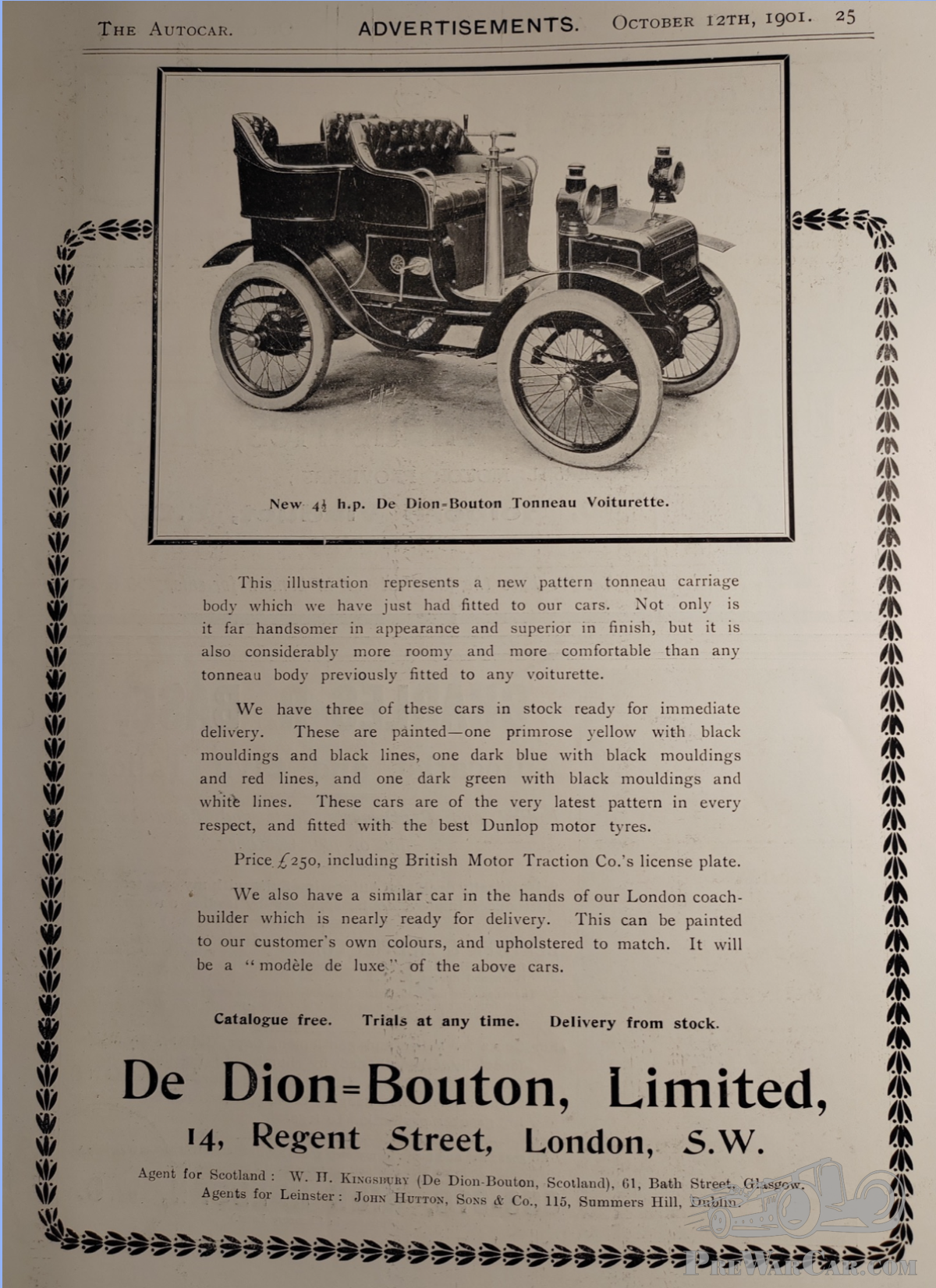
Some owners favoured the complete makeover approach with enclosed coachwork, substantial bonnet with prominent upright radiator and raked steering column, finished off with windscreen and external quadrant handbrakes. The visible effect was of a sporty two-seater, but the actual performance on the road may have been rather different (image 5). In the autumn of 1901, the London-based De Dion Bouton company responded to demands of the marketplace by advertising a four-seater motor car based on the standard voiturette chassis and equipped with a well-designed bonnet that was rather more in keeping with the overall proportions of the body than some of the other examples that had recently appeared from some small-scale workshops. The result was a dummy bonnet that was slightly smaller in scale than the previous front-positioned wooden plinth, which created more legroom for the driver and front passenger. For the rear-seat passengers, the chassis space was still restricted but the upper part of the coachwork extended over the rear
mudguards in a design that increased the seating area and became typical for rear-entrance tonneaus for the next five years (image 6).
Vehicles with these "new pattern tonneau carriage bodies" were advertised in the English motoring press in September and October, 1901, but did not appear in the French motoring magazines. With a price tag of £250, this was an expensive vehicle when compared with the standard 3½hp version, which had been sold for 200 guineas (£210) the previous summer.
Just a few weeks later, De Dion Bouton in Paris launched their first front-engined, 6hp motor car, the Type J, which bore a striking resemblance to the tonneau voiturette (image 7).
More details can be found on the veteran De Dion Bouton motor cars in De Dion Bouton: The Veteran Years, 1899-1904 by Michael Edwards, published June, 2024, and available from Surrenden Press and during PreWar Days at the PreWarCar.com stand.
Published:
Thursday December 5th, 2024
Facebook
LinkedIn
Twitter
WhatsApp
Email
Copy