The global magazine and marketplace for classic car enthusiasts, by enthusiasts.


Filter
Make a choice:
- Cars
-
Make >>
-
Year >>
-
- Bikes
-
Location >>
- Parts & more
-
Make of car >>
-
Manufacturer >>
-
Category >>
- Bicycles & more
-
Year >>
-
Countries


The truth about La Nef cars and errors in museums

Photo by Alexander Dmitriev

Photo by Vasily Shishka


In Moscow there is a museum that houses an interesting three-wheeled vehicle. The museum sign alongside it says that this is the Belgian De la Croix and that only four examples are still in existence in the world today. This vehicle does not have a nameplate. The historian Vasili Shishka decided to make a study of the information on the La Nef brand held by museums in Europe. He discovered that there were many inaccuracies and came to his own conclusion about this mysterious car brand.
The automobile bible 'Encyclopedia Georgano' says that the Belgian firm Delecroix produced a car in 1897 with an engine at the back, and in 1898 with an engine at the front, but with chain drive. At that time production ceased. This car therefore cannot be a Belgian Delecroix because it has a belt drive.
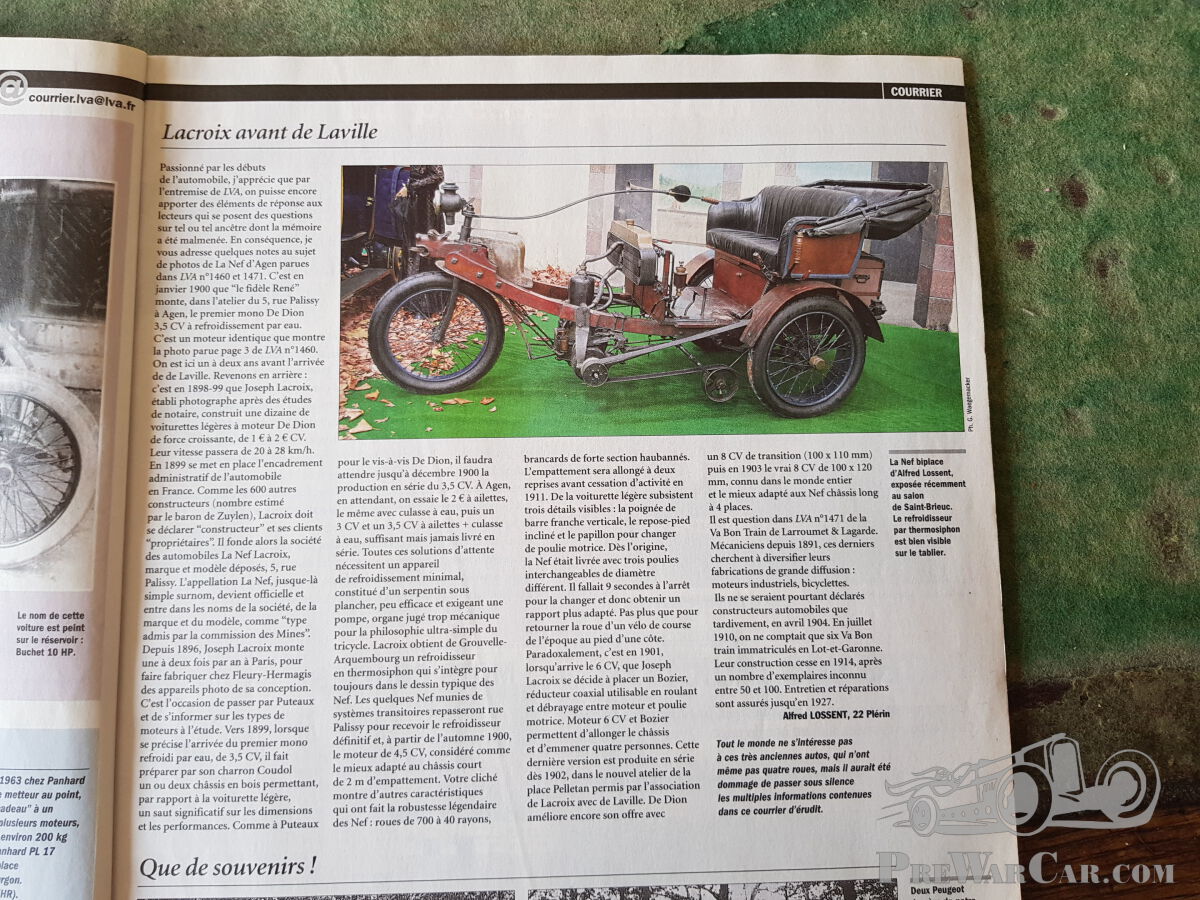
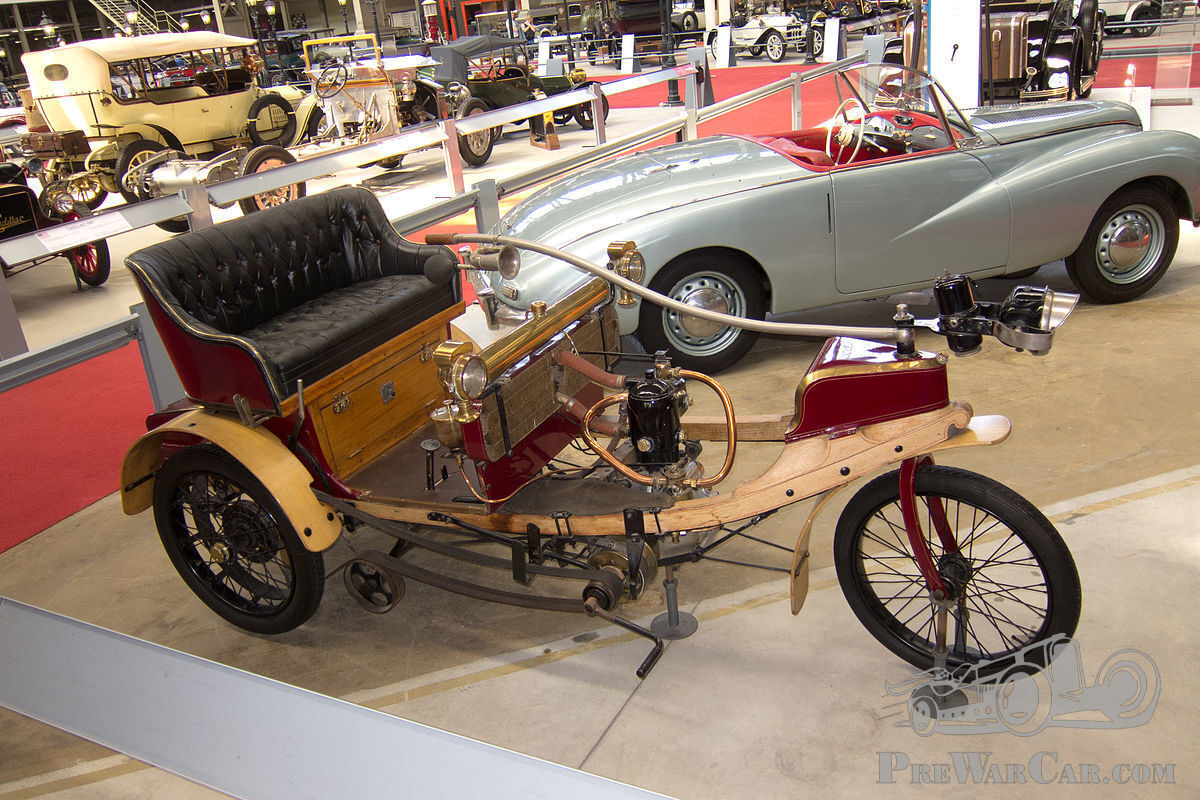
The word "la Croix", written on the plaque at the museum, is reminiscent of the famous car La Nef by Lacroix & DeLaville. Most specialists and lovers of early automobile history will know this car. Its curved wooden frame and cow-tail steering attract much attention at exhibitions and in museums, with many examples still in existence. At the Oldtimer Gallery 2008, this car was presented as a Lacroix & DeLaville. Of course, there are far more than four of these cars. Plus, in the 1960s, several examples were made with original De Dion Bouton 8 hp engines. But that's another story.
I would like to draw attention to the year 1898, when the car has a water-cooled engine. De Dion Bouton started producing water-cooled engines in 1899. I often hear the argument that the car was made in that year, and that it was later modernised — a more powerful engine was fitted. I accept this is correct.
Books by René Ville and later by Michael Edwards, give us an insight into the early production of De Dion Bouton engines. The Encyclopaedia Georgano came before these wonderful books.
Georgano writes that the prototype used a 2.25 hp engine. In 1898, however, only the 1.75 hp air-cooled engine was made. I have searched open patent databases but unfortunately have not been able to find out what the Lacroix prototype looked like. Maybe it had a bamboo frame and one seat? It seems possible. After all, you can't imagine that a 1.75 hp engine powered the four-seater in this photo. Perhaps if three passengers were pushing instead of riding along...
The Dion Bouton engine, rated at 2.25 hp, appeared in June 1899. I am afraid the extra 0.5 hp will not have made much difference, but we are talking about a prototype. In June 1899 De Dion Bouton also began producing a water-cooled 3.5 hp engine for the De Dion Bouton Type D. This car also had a vis-à-vis four-seater body and an acceptably powerful 3.5 hp engine. Perhaps someone can tell us if they know of at least one Lacroix & DeLaville with a 3.5 hp or 4.5 hp engine that has survived to this day. Or will all engines have been replaced?
Which engine does the car from the Moscow Museum have? If we compare it with the picture of the De Dion Bouton engines of 3.5 hp and 4.5 hp, we can see that these engines have an exhaust port pointing forward, while the La Nef engine has a side exhaust. Therefore this engine was not made before 1901. Next, take the book Michael Edwards wrote, The Dion Bouton. An Illustrated Guide to Type & Specification 1899-1904. Judging from this information, it appears to be a Type K2 8 hp engine, production of which began in 1902. Could it have been built in later?
Now take a look at the radiator of the car in the museum. These looked different in 1898. For example, compare the radiator of a modern 1900 Panhard-Levassor car with the radiator of a La Nef — the latter clearly looks younger. Perhaps they changed it later too?
If you want to sell a car, you advertise in car and other magazines and take part in car exhibitions. When I wrote my book Cars of France in the 19th Century, I studied almost all car and technical magazines published in France, England and the USA, as well as many books of the period. I have already collected several thousand magazine pages for a new book entitled Automobiles of France 1901-1902 but so far I have not seen this car anywhere. Wouldn't journalists have written about this unusual car?
Talking about journalists, what do modern French journalists write about this car? My French friend sent screenshots of an article from the Gasoline Magazine website dated 27 November 2010. The journalist is driving a 1901 Lacroix & DeLaville with a De Dion Bouton 8 hp engine. And guess what? They changed the engine later, of course!
Also in this article, it is said that the first prototype was built in 1896 with a De Dion Bouton engine. For reference, the De Dion Bouton engine had a power of 0.75 hp in 1896, while a De Dion Bouton tricycle with an engine of this size had pedals for a very good reason!
The journalist also says that DeLaville joined the firm in 1902. But this same journalist drives a Lacroix & DeLaville car from 1901. So should the company have been called Lacroix in 1901? Has anyone seen a nameplate with just Lacroix on it?
In other words:
1. All Lacroix & DeLaville La Nef cars made before 1902 had their engines replaced by more powerful ones.
2. On all Lacroix & DeLaville La Nef cars made before 1902 the radiators were replaced by more modern ones.
3. On all Lacroix & DeLaville La Nef cars manufactured before 1902, the Lacroix plate was unscrewed and replaced by the Lacroix & DeLaville plate.
4. None of the cars were mentioned in the press, at least not until 1903.
Or could it be that they only started to appear later on?
After writing this article, Serge Rinero, my French friend and tireless researcher of the history of tricycles from Agen, sent me a photo from the Agen city archives and everything falls into place! Here is a fragment.
The car of 1898-1899 was very different, namely a voiturette. The prototype La Nef was made from the end of 1899 to 1901. Production started in 1902. The same document says that DeLaville made his appearance in 1902. So the engines and the radiators were not changed, nor were the plates turned.
Here is another example from the Louwman museum in the Netherlands, dated 1898. This is a serious car museum. Does the plate on this car say that the engine and radiator were installed later?
Maybe I am wrong? I will be glad to hear reasoned counter-arguments.
The author thanks Serge Rinero, Alexander Dmitriev, Michael Edwards, Laurent Zoller for their help in preparing this article.
If you want to know more about early French cars, support the Free Electronic Encyclopedia French Cars 1901-1902 project.
Words Vasily Shishka.
Published:
Wednesday February 9th, 2022
Facebook
LinkedIn
Twitter
WhatsApp
Email
Copy
Comments
Vasily Shishka
21 February 2022, 18:52
Thank you very much for this comment! I didn't know about this article. This confirms that no one has changed engines.
Read more

Les Six Troenes
10 February 2022, 15:12
an other Lacroix de Laville , in the car museum I worked ( earlier 90's)
my own picture is not as good as the picture from the museum brochure...
Read more
my own picture is not as good as the picture from the museum brochure...
LARS LEGAARD
09 February 2022, 09:18
As a young engineer working at some USSR projects, I visited the "Polytechnic Museum" in Moscow.
Here they exhibited a car which was stated as a gift from russian workers to Lenin
Actually the car was a GAZ phaeton ( Ford model A ), and produced from 1934.
Mr Lenin died allready in 1924 - so museum beware !
Read more
Here they exhibited a car which was stated as a gift from russian workers to Lenin
Actually the car was a GAZ phaeton ( Ford model A ), and produced from 1934.
Mr Lenin died allready in 1924 - so museum beware !
It remains remarkable that so many La Nefs still exist today. I once read somewhere (but I can't remember where) that in the 1960s someone had a stock of original De Dion-Bouton mono engines and placed them in replicas of the La Nef three-wheeler that he had made. I have no idea if this is true but it is a fact that rebuilding a La Nef is not the most complicated job considering the rather simple construction of the car.