The global magazine and marketplace for classic car enthusiasts, by enthusiasts.


Filter
Make a choice:
- Cars
-
Make >>
-
Year >>
-
- Bikes
-
Location >>
- Parts & more
-
Make of car >>
-
Manufacturer >>
-
Category >>
- Bicycles & more
-
Year >>
-
Countries


A Bugatti at the beach: the perfect sightseeing holiday


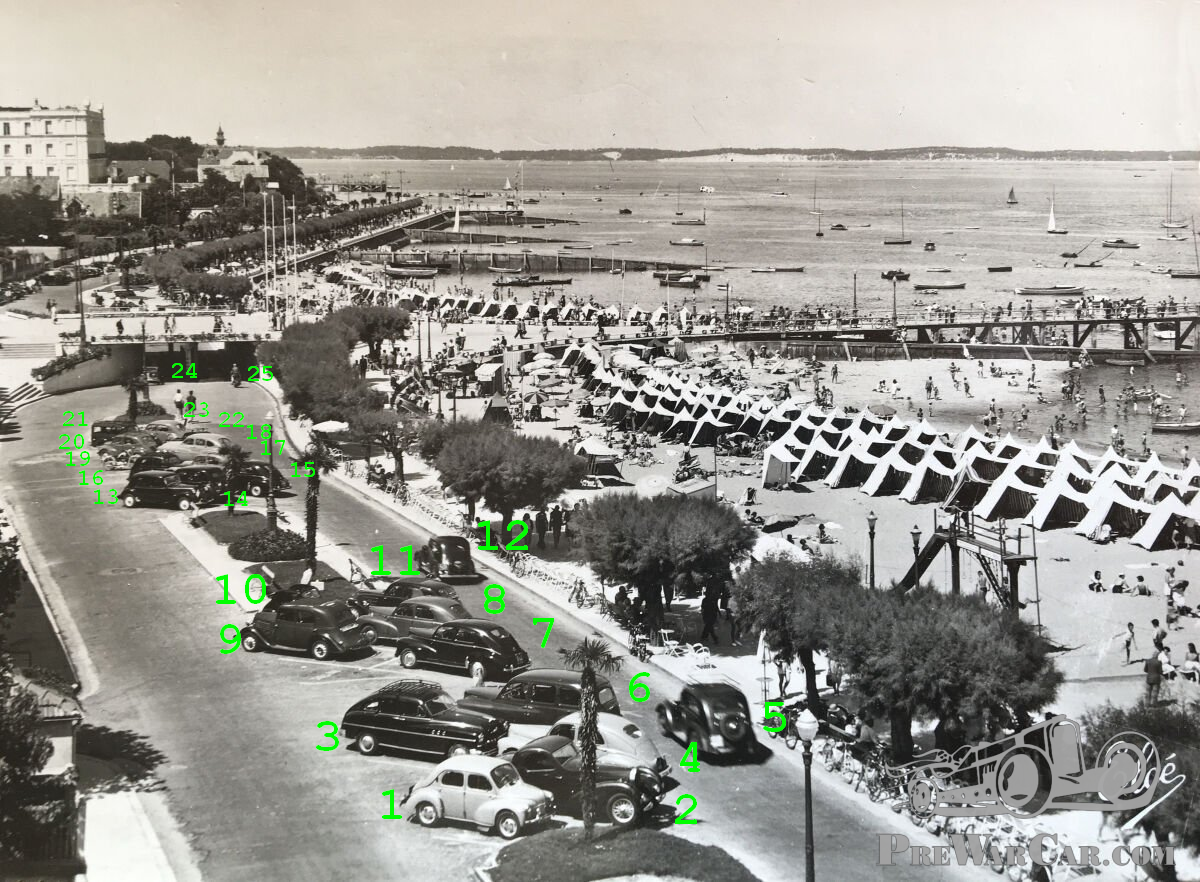
Many people go on holiday to see important historic or cultural sights, visiting places such as Rome, Athens, Cairo and many more of the world's great cities. Others prefer just to relax by the sea, underneath a hot sun, and let their cares float away. That's probably the reason why hundreds of people here have descended upon Arcachon in Gironde, France, a resort town on the Atlantic coast.
Little did those holidaymakers know, when they set off to top up their tans and dip their toes in the sea, that they would also be treated to a sight to rival the wonder of the Sphinx and the beauty of the Sistine Chapel. Is not the Bugatti Type 57 Atalante one of the most beautiful exercises in design ever to take shape, and who would have expected to find one inconspicuously parked on a busy coastal thoroughfare in the late 1950s, nestled between a Renault 4CV and Peugeot 203, with a dumpy Ford Vedette behind it for good measure? Mind you, if we were to go to Arcachon today, just the sight of a cheerful little 4CV among all the sad-dreary modern cars would make our day.
We'd like to know exactly which Atalante this is, because there's a very good chance that it's still in existence. With no number plate visible, though, that's beyond our abilities, but maybe one of our readers knows something?
Of course, anyone who wants to do some Bugatti sightseeing, and also enjoy the history and beauty which other parts of France have to offer, would be well advised to pay a visit to the Cité de l'Automobile in Mulhouse, better known as the Schlumpf Collection after the brothers who initiated it. Bugatti was the marque dearest to their hearts and they acquired their first, a Type 35B, shortly before the German invasion of France in 1940. The collection remained a secret until 1976, and by the 1980s was on the way to becoming publicly owned. Today, the collection has 400 cars on display at any one time, including the world's largest collection of Bugattis, among them two of the original six Type 41 Royales. Just the history of the museum alone, irrespective of the cars in it, is extraordinary enough, being set against a backdrop of industrial turbulence and union action.
Of course, that's only a fraction of what there is to see in Mulhouse. The city also house a 16th-century town hall and numerous other museums including the Cité du Train and the Musée des Beaux-Arts. What's more it's conveniently located just 16 miles from the Basel-Mulhouse-Freiberg airport, so access is easy at any time. Have you booked your flight yet?
Words: Zack Stiling
Published:
Thursday July 11th, 2024
Facebook
LinkedIn
Twitter
WhatsApp
Email
Copy
Comments
Alexander Stolpmann
16 July 2024, 15:31
A postscript from me:
Car No. 16 is most likely a Renault Juvaquatre.
It looks rather big compared to the Citroën Traction Avant and Peugeot 203, but I think the Juvaquatre is a match.
And a correction for car No. 21: in principle correct, but the name Dauphinoise was not used until 1956, when the Renault Dauphine engine was installed. Before that, it was known as the Renault Break Juvaquatre.
The picture is from 1950 earliest (Renault Colorale was introduced in that year), possibly 1951 or 1952. All cars from the 1930s were replaced in the following years by cars like Simca Aronde or Vedette, Peugeot 403, Panhard Dyna Z, Renault Dauphine or Frégate and Citroën 2CV or DS, to name the most common cars of that time.
Read more
Car No. 16 is most likely a Renault Juvaquatre.
It looks rather big compared to the Citroën Traction Avant and Peugeot 203, but I think the Juvaquatre is a match.
And a correction for car No. 21: in principle correct, but the name Dauphinoise was not used until 1956, when the Renault Dauphine engine was installed. Before that, it was known as the Renault Break Juvaquatre.
The picture is from 1950 earliest (Renault Colorale was introduced in that year), possibly 1951 or 1952. All cars from the 1930s were replaced in the following years by cars like Simca Aronde or Vedette, Peugeot 403, Panhard Dyna Z, Renault Dauphine or Frégate and Citroën 2CV or DS, to name the most common cars of that time.
Alexander Stolpmann
16 July 2024, 22:49
A second postsript:
The tunnel under the "Place Thiers", now a pedestrian way to the pier, connects the "Boulevard Veyrier Montagnères" to the "Boulevard Marcel Gounouilhou" on the far side. It was opend in 1951, which narrows down the date of the photograph.
Before the tunnel was built, the street was known as the "Boulevard Promenade", which itself was constructed in 1914.
Many postcards from all decades can be found showing this part of the "Ville d'Été", the summer town. But only this one shows a Bugatti.
Read more
The tunnel under the "Place Thiers", now a pedestrian way to the pier, connects the "Boulevard Veyrier Montagnères" to the "Boulevard Marcel Gounouilhou" on the far side. It was opend in 1951, which narrows down the date of the photograph.
Before the tunnel was built, the street was known as the "Boulevard Promenade", which itself was constructed in 1914.
Many postcards from all decades can be found showing this part of the "Ville d'Été", the summer town. But only this one shows a Bugatti.

Jack Braam Ruben
11 July 2024, 10:22
The "Atalante" in the parking is for sure a later version as the wipers do not come from the roof like this (one of two FCs still existing).
Read more
All the other vehicles in the picture are interesting too. If I observe correctly, all but one are French. Here is my list with the numbers on the edited image. Perhaps you can fill in the blanks.
1 Renault 4CV
2 Bugatti Atalante
3 Ford Vedette
4 Peugeot 203 berline (very early, no bumper horns)
5 Simca 8
6 Renault Colorale
7 Peugeot 203 berline
8 Peugeot 203 berline
9 Renault Monaquatre (ca. 1935)
10 Simca 5
11 Peugeot 302 Berline
12 [possibly] Matford Alsace (early, 1934/35)
13 Citroën Traction Avant (probably 11CV Légère)
14 Citroën Traction Avant (probably 11CV Légère)
15 Peugeot 203 berline
16 ??
17 Peugeot 203 berline
18 ?? [US car ... close to Chrysler New Yorker or Dodge Coronet]
19 ?? [motorcycle ... possibly Peugeot or René Gillet]
20 Renault 4CV
21 Renault Dauphinoise
22 ?? [black roof]
23 Renault 4CV
24 ??
25 ?? [motorcycle]