The global magazine and marketplace for classic car enthusiasts, by enthusiasts.


Filter
Make a choice:
- Cars
-
Make >>
- Bikes
-
Location >>
- Parts & more
-
Make of car >>
-
Manufacturer >>
-
Category >>
- Bicycles & more
-
Year >>
-
Countries


What is it? Quiz #470
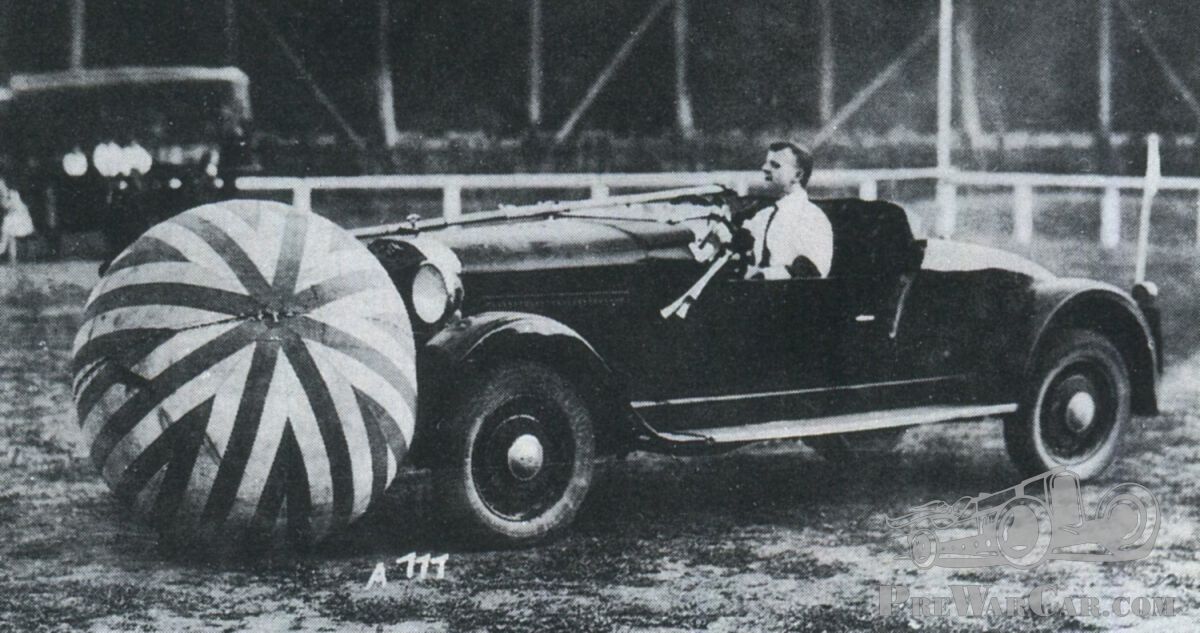

The Football World Cup is around the corner and so is the season, in which we push our cars out of the sheds for a first ride, enjoying the warm spring sun. But how to combine these two hobbies? The solution of this problem was solved in the 1930s, when one of the most successful German racing drivers, Karl "Charlie" Kappler invented "Autoball".
After Kappler partially retired in the early 1930s, he still wanted to participate in automotive endurance events. For some reason, trying to score goals with cars sounded like the perfect solution to his problem. The first match was played on the pitch of the FC Frankonia soccer team in Karlsruhe, Germany in 1933. No official rules were recorded, but matches were played in teams of two or four.
The cars were "future classics" such as the Wanderer W10 and the Mercedes-Benz Type 290. Of course, a standard soccer ball was not suitable for such a game, so Kappler worked with Continental to create a special ball that had a diameter of four feet.
In the very first match, Kappler faced off against Opel dealer and gentleman racer Willy Engesser. The tires on Kappler's Mercedes were better suited for the terrain, and he was able to take home the victory. The local press was delighted with the first match, and Kappler would go on to stage three more years until his full retirement in 1935. With the sport's creator and main champion gone, autoball quickly died off. Since then it has disappeared but it has been resurrected several times.
But it is Saturday, and on Saturdays, we don´t only want to teach history lessons but want to delight you with a quiz. On the photograph, you can see a 1929 Autoball-car. It´s neither a Wanderer, nor a Mercedes, but it is a German car and it is named after its founder and chief designer. Like the Autoball game, the factory also closed its doors in 1935. I think these hints are sufficient, aren´t they?
Words and photograph by Hubertus Hansmann.
Published:
Saturday May 19th, 2018
Facebook
LinkedIn
Twitter
WhatsApp
Email
Copy
Comments
RECORD
21 May 2018, 11:22
I think the car could be a Röhr typ R 9/50 HP which was producted at about 1.000 cars.
Read more
Gerd Klioba
20 May 2018, 20:26
The Autoball-car is a Röhr 8 Typ R, built from 1928 to 1930. This bodywork by Autenrieth was called Sport-Roadster. It was the first German car with swing axles. Together with a low platform frame it made the Röhr 8 handle very well because of its low center of gravity. Röhr marketed this inline eight-cylinder car as the "safest car in the world". After quite some sales successes in the beginning, the 1929 economical crisis struck Röhr as well, so that Gustav Röhr had to leave the company, after it went into liquidation and was taken over by Swiss investors.
Read more
Fried Stol
20 May 2018, 16:47
Hans Gustav Röhr a former fighter pilot in WW1, started as an apprentice at the Priamus Automobielwerke where he created an advanced prototype economy car with a 4 cyl engine and individual front suspension weighing only 346kg, but the company went bankrupt in 1921. He then rented a workshop at Bolle and Fiedler to improve his design. By now the prototype had front wheel drive and a 6 cyl engine. After taken over Falcon Automobielwerke and changing the name into Rohr Auto AG, he came up with the Rohr 8 cyl in 1927, which is the car in the picture.
Read more
fritz hegemann
19 May 2018, 22:20
Dear prewarcar-team,
find here the solution, written in a distance of around 50 miles to the town Ober-Ramstadt:
Röhr 8 R Roadster, built in 1929 by Röhr Auto AG. Röhr Auto was founded in 1926 by Hans Gustav Röhr in Ober-Ramstadt, Odenwald, Germany. The 8 R was until the Great Depression an economic success (about 1,000 cars) and technically very demanding: Very good road holding by independently suspended front-wheels and pendulum swing axle rear. 8-cylinder OHV inline engine with 2.3 L, 9/50 hp, simple Solex carburettor, 4-speed gearbox, 100 km/h. Available as a sedan, 2- and 4-seater convertible and roadster.
Röhr had to declare bankruptcy in 1930, the factory taken over by investors had to close in 1935.
Ik wens U prettige Pinksterdagen!
Fritz Hegemann
Read more
find here the solution, written in a distance of around 50 miles to the town Ober-Ramstadt:
Röhr 8 R Roadster, built in 1929 by Röhr Auto AG. Röhr Auto was founded in 1926 by Hans Gustav Röhr in Ober-Ramstadt, Odenwald, Germany. The 8 R was until the Great Depression an economic success (about 1,000 cars) and technically very demanding: Very good road holding by independently suspended front-wheels and pendulum swing axle rear. 8-cylinder OHV inline engine with 2.3 L, 9/50 hp, simple Solex carburettor, 4-speed gearbox, 100 km/h. Available as a sedan, 2- and 4-seater convertible and roadster.
Röhr had to declare bankruptcy in 1930, the factory taken over by investors had to close in 1935.
Ik wens U prettige Pinksterdagen!
Fritz Hegemann
Michael Schlenger
19 May 2018, 14:53
Röhr 8 Typ R Roadster (1928-30) with 50 hp straight-eight. Driver is the son of Georg Autenrieth whose company manufactured the body and paid the wages for the workers of the Röhr Auto AG when it got into trouble in 1930. The designer of the car, Hans-Gustav Röhr (1895-1937), built a plane as a teenager and served as a pilot in WW1. Later he and his friend Joseph Dauben developed a car with superior roadholding due to low level of gravity and independent front and rear suspension. After his company had gone bust Röhr designed the front-drive Adler Trumpf Junior.
Read more