The global magazine and marketplace for classic car enthusiasts, by enthusiasts.


The Market; all pre-war cars for sale
Overview of related ads to ad 1921 Ansaldo type 4C rolling chassis
-

1928 Avions Voisin Type C28 Recreation | Selections from the Mullin Collection Auction | Gooding & Company | April 26, 2024
This evocation of a Voisin Type C28 was created as a movie prop for use in the filming of Sahara, a 2005 movie starring Matthew McConaughey and Penélope Cruz. Based on a novel by best-selling author Clive Cussler, the film was a continuation of his Dirk Pitt action stories. Cussler was a noted car enthusiast and it is believed that his .. -
1930 Citroen C4 Limousine | Selections from the Mullin Collection Auction | Gooding & Company | April 26, 2024
Debuted at the 1928 Paris Motor Show, the four-cylinder Citroën AC4 and six-cylinder AC6 were methodically improved evolutions of the French automaker’s prior B12, B14, and B15 model lines. A slight redesignation came by 1929, with the AC (André Citroën) model prefix simplified to C4 and C6. Featuring handsome styling clearly inspired by Ford’s .. -
1928 Citroen B14 Coupe | Selections from the Mullin Collection Auction | Gooding & Company | April 26, 2024
Featuring an all-new and lighter-weight chassis and all-steel bodywork, the B14 continued to improve Citroën’s characteristically advanced and effective engineering principles with a smoother-running engine and new four-wheel brakes. Initially powered by a 1,539 cc four-cylinder powerplant, subsequently upsized to 1,628 cc, the B14 was offered i.. -
1928 Tracta D2 9CV Faux Cabriolet | Selections from the Mullin Collection Auction | Gooding & Company | April 26, 2024
A boutique manufacturer, Tracta was founded by Jean Albert Grégoire in 1926, and its initial models were geared towards competition – even winning its class at the 24 Hours of Le Mans in 1927. Grégoire developed the “Tracta joint,” which allowed the front wheels of a car to be driven while still steering, a predecessor of the CV joints that are .. -
1927 De Dion-Bouton Type TKS Torpédo | Selections from the Mullin Collection Auction | Gooding & Company | April 26, 2024
Jules-Albert de Dion set out to manufacture steam cars late in the 19th century in the town of Puteaux, a suburb of Paris. He partnered with Georges Bouton and Charles Trépardoux to form De Dion-Bouton in 1883. Together the trio revolutionized the automotive industry with new technologies such as a modern rear axle design, V-8 engine, and rack a.. -
1930 Darmont Morgan Sport Aero Roadster | Selections from the Mullin Collection Auction | Gooding & Company | April 26, 2024
As early as 1913, the jaunty three-wheeled Morgan had become very popular in France; spurred by a local hero winning a Cyclecar Grand Prix race in one such Morgan at Amiens that year. Following WWI, another victory in a Morgan by a Frenchman, this time at the Circuit de l’Eure, increased their popularity with fans of the sport yet again. Afforda.. -
1924 Turcat-Méry Type UG Limousine | Selections from the Mullin Collection Auction | Gooding & Company | April 26, 2024
While likely unknown to all but the most ardent enthusiasts and collectors of vintage and classic French motorcars, Turcat-Méry delivered outstanding engineering and scored numerous racing achievements during its active years spanning 1899 to 1928. Actually, the firm’s origins date more correctly to 1895, when Marseille resident Alphonse Méry pu.. -
1925 Citroen B12 Estate Wagon | Selections from the Mullin Collection Auction | Gooding & Company | April 26, 2024
As the successor to the B10, the Citroën B12 debuted at the October 1925 Paris Motor Show and was available for sale through January 1927. Both the B12 and its predecessor utilized innovative and industry-leading tout acier (all-steel) bodywork standard. The 1,452 cc four-cylinder engine was also shared with the B10, yielding a 10 hp (or 10 CV) .. -
1929 Panhard Et Levassor Type X63 Berline | Selections from the Mullin Collection Auction | Gooding & Company | April 26, 2024
Founded in 1887 by Réne Panhard and Émile Levassor, Panhard et Levassor began producing automobiles under the license of Daimler Motoren Gesellschaft for the French automotive market. Throughout the 1890s, the company developed technological advancements in partnership with DMG, including a radiator mounted at the front of the chassis as well as.. -
1925 Ford-Montier Model T Speedster | Selections from the Mullin Collection Auction | Gooding & Company | April 26, 2024
Charles Montier was a Parisian Ford agent with a keen racing interest. The son of a blacksmith and a skilled engineer, Montier modified Ford Model Ts – and later Model As – for sporting and competition use. He even co-drove one of his own designs at the first running of the 24 Hours of Le Mans and finished in 14th place. While little is..


Featured
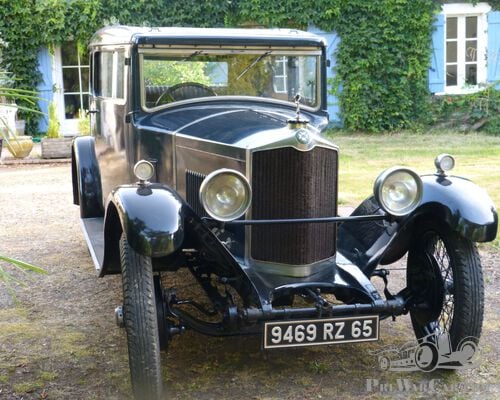
2-door 15.7hp six cylinder saloon
The car is a 6-cylinder 2-door saloon described as the "Sportsman's coach built coupé". Only three of this model are known to have survived. I have..
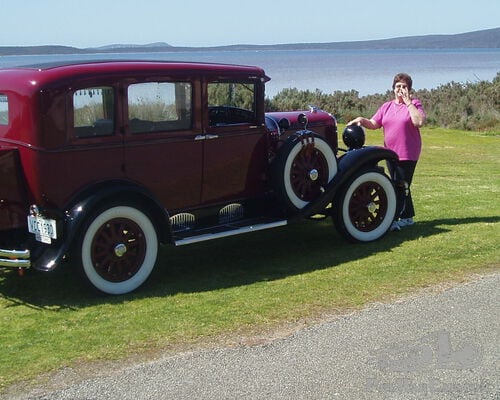
1930 Chrysler 66 Six-Wheel Equipped Royal Sedan
An exceptionally well restored and highly awarded Chrysler 66 Royal Sedan, with only two owners in nearly 97 years.The present owner ..
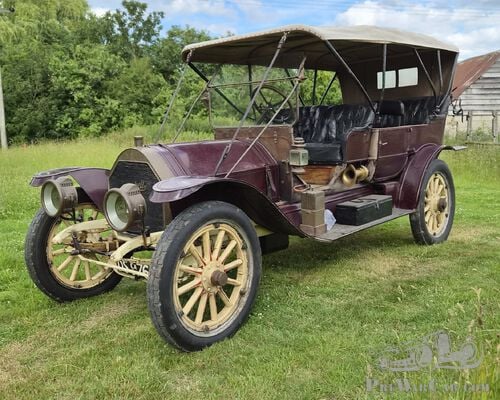
1910 Mitchell Model S - 50HP Six Cylinder
Based in Racine, Wisconsin and being the largest wagon manufacturer in the USA, Mitchell-Lewis produced their first motor car in 1903. Sales grew ..