The global magazine and marketplace for classic car enthusiasts, by enthusiasts.


Filter
Classic Donnet/ Donnet-Zédel, Stanley for sale - Donnet/ Donnet-Zédel, Stanley cars for sale
-

Stanley Steamer 1919 touring
Very original . Runs good and has new boiler , with pressure test.Use it from day one. Has Danish registration document .Price : please ask ! -
Stanley steamcar Mountainwagon 820
1915 Stanley Mountain Wagon steamcar Stanley steam cars were made from 1897 to 1927. The "Mountain Wagons" were developed to take guests 35 miles uphill from the train station in Loveland, Colorado into the heart of the Colorado Rockies to the Stanley Hotel. This was a climb with gradients that few cars with combustion engines coul..


Donnet / Donnet-Zédel
France, 1924 – 1934
SA des Automobiles Donnet, Nanterre, Seine; Neuilly, Seine, Pontarlier, Doubs.
After Zédel and Vinot et Deguingand ceased production, Donnet, a new company constituted from them in 1924, offered two new cars called Donnet-Zédel. A light car was made, the 7CV Donnet-Zedel Type G, which had a side-valve 4-cylinder engine of 1100cc and (unusual for so small a vehicle) a 4-speed gearbox. It was a solidly-built machine, and a Donnet-Zedel sports model was listed. There was, in addition, a medium-sized four of about 2¼-litres. From 1926, the Donnet-Zedel firm came to concentrate upon a 2½-litre six, also with side valves, which proved a popular car. Another, smaller six with 1.3-litres (later 1.8-litre) Sainturat-designed engine was also offered by Donnet-Zedel. In the 1932 range however, was a new small Donnet-Zedel car in the shape of a 750cc 2-stroke. This, a violet design, had been sold as the Dequingand until 1930. A fwd 2-litre 6-cylinder Donnet-Zedel, shown at the 1931 Paris Salon came to nothing. With the demise of Donnet, Simca took over the Donnet-Zedel factory.
Source: Georgano, encyclopedia of motorcar; TRN
The information is written with the greatest of care. However, if you have any suggested amendments please contact us at office@prewarcar.com
Stanley
US, 1897 – 1927
(1) Stanley Dry Plate Co, Newton, Mass., 1897 – 1899
(2) Stanley Manufacturing Co, Lawrence, Mass., 1899 – 1901
(3) Stanley Motor Carriage Co, Newton, Mass., 1901 – 1924
(4) Steam Vehicle Corporation of America, Newton, Mass., 1924 – 1927
The Stanley twins, F.E. and F.O., were partners in a photographic dry plate business in Newton, where they produced their first light steam Stanley car in 1897. This Stanley car proved a great success, over 200 Stanley cars being sold in the first year of production. In 1898 a Stanley car was timed over a mile at Charles River Park at 27.40mph. Among the customers of the Stanley cars were A.L. Barber and J.B. Walker, who purchased the manufacturing rights of the Stanley car, and produced it as the Locomobile and Mobile respectively. In 1899 some Stanley cars were advertised by the Locomobile Co of America under the name Stanley-Locomobile. The Stanley cars proceeded to evolve an entirely new design, which appeared in 1902 with a simple non-condensing engine, driving directly on the rear axle. The boiler was mounted at the front of these Stanley cars, frames were of wood, and steering was by tiller. Locomobile went over to Petrol cars at the end of 1903, but the Stanley cars prospered, listing an 8hp Stanley car at $750, and selling their Stanley cars to police and fire departments. More powerful versions Stanley cars rated at 10 and 20hp were available by 1904, and by 1906 the Stanley car had assumed its characteristic appearance, with coffin-like bonnet concealing the boiler, and wheel steering. The Stanley car could out-accelerate petrol cars, and that year Frank Marriott was timed at 127.66mph on Daytona Beach with the streamlined Woggle-Bug. Marriott tried again the following year, but a spectacular crash at about 150mph destroyed the car. Stanley cars 1908 Gentleman’s Speedy Roadster was capable of 60mph, and would run over 50 miles on a filling of water. 1913 Stanley cars were electrically-lighted, and 1915 brought the introduction of steel framed and V-shaped frontal condensers on the Stanley cars on a 10ft 10in wheelbase chassis which lent itself to seven-seater coachwork. However, the advent of Cadillac’s electric self-starter in 1912 had signaled the end of the steamer , with its need for a long warm-up from dead cold. The 1920 Model 735 Stanley car resembled a conventional petrol car in outward appearance with a flat radiator of typically American aspect, but the boiler of the Stanley car was still under the bonnet, and the double-acting 2-cylinder engine still drove direct on the back axle. Acceleration was well above par for the standards of the day, and the Stanley car would cruise at 45mph, with more available. But at around the $2.600 mark sales were low (about 600 Stanley cars per annum), and the Stanley cars had retired from the company during World War 1. The Stanley car firm was reorganized in 1925, and the last Stanley cars had hydraulic front-wheel brakes and balloon tyres.
US, 1907 – 1910
(1) Stanley Automobile Manufacturing Co, Mooreland, Ind., 1907
(2) Troy Automobile & Buggy Co, Troy, Ohio, 1908 – 1910
This Stanley car was a five-seater touring car weighing 1.550lb. The Stanley car was powered by a 2-cylinder, water-cooled engine of 3.6-litres. A friction transmission was used, with a single-chain to drive the rear axle.
Source: Georgano, encyclopedia of motorcar; MCS, GMN
The information is written with the greatest of care. However, if you have any suggested amendments please contact us at office@prewarcar.com


Featured
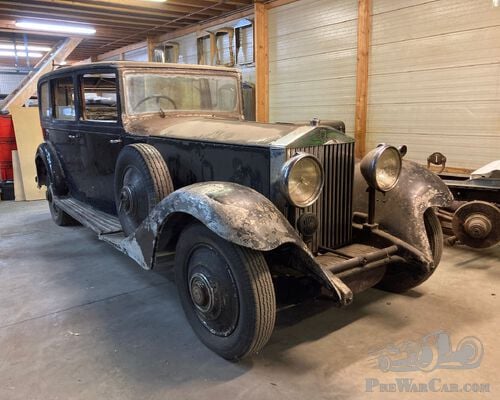
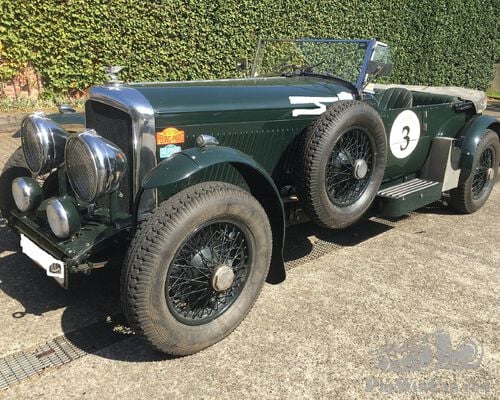
Bentley Derby Special Open Rally Car
This Bentley Derby, manufactured in 1935, has been rebuilt into a short and long-distance rally car. Full rebuilt engine in 2021, Since 2021 low mi..
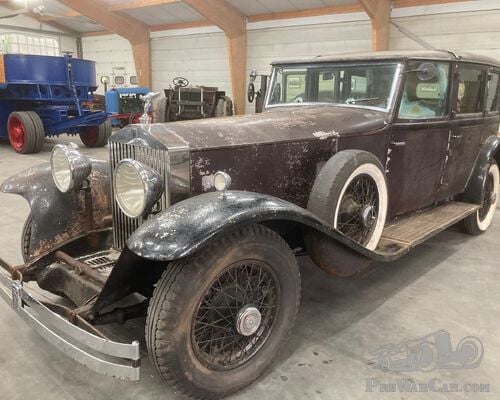
Rolls-Royce
Rolls-Royce Phantom ll chassisnummer 287 AJS. bouwjaar 1932, Links gestuurd, Brewster Keswick Sedance Towncar