The global magazine and marketplace for classic car enthusiasts, by enthusiasts.


Filter
Make a choice:
- Cars
-
Make >>
-
Year >>
-
- Bikes
-
Location >>
- Parts & more
-
Make of car >>
-
Manufacturer >>
-
Category >>
- Bicycles & more
-
Year >>
-
Countries


George Nicholas’s luxurious home away from home
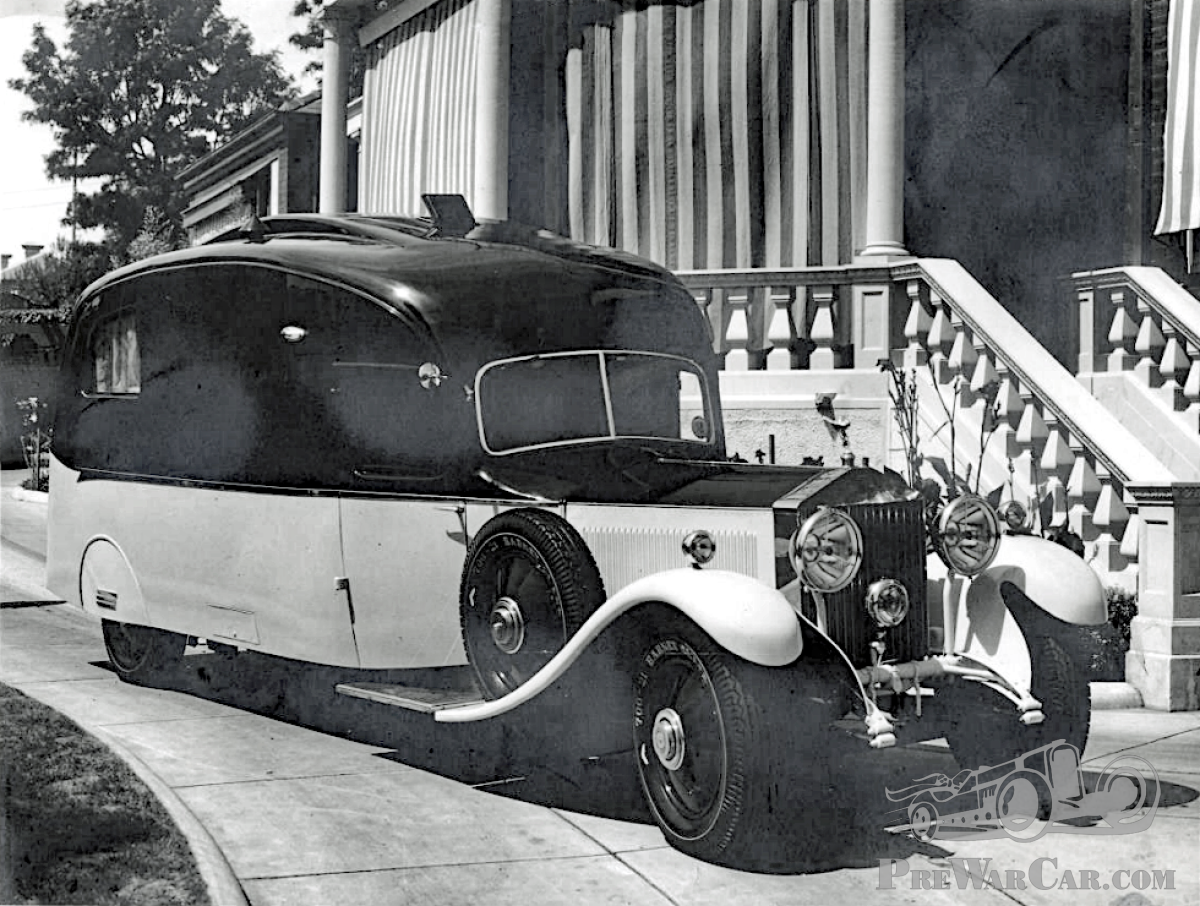

This photograph shows a truly luxurious motor caravan. And the great thing is that, thanks to the National Library of Australia and historical consultant David Neely, we know a great deal more about it. They found a detailed description of the vehicle in the Australian newspaper The Argus of 8 February 1938, under the headline ‘Luxury caravan delivered – Rolls-Royce chassis’. For once, let us simply reproduce what it said:
“Caravanning will have its peace and quietness for Mr G. R. Nicholas, of Toorak, who took delivery yesterday of one of these miniature homes built on the chassis of a 40/50 horse-power Rolls-Royce.
Beautifully finished in ivory and black, the caravan has accommodation for four persons and an enclosed front compartment with combined seat and sleeping berth for the chauffeur. It was built by the Romany Road Caravan Co. Pty. Ltd. of South Melbourne and weighs three and a half tons. The overall length of the caravan is 21 ft 10 in, the height from the ground is 8 ft 5 in, and the interior height about 6 ft. Special attention has been paid to the detail of the interior and external appearance of this luxury travelling home.
From a distance it looks like a huge limousine, with the lower portion of the body in ivory, the upper half in black and a gently sloping rear. Large rectangular windows with rounded corners are fitted to the sides and rear, the petrol-filler cap and door handles are recessed into the coachwork, and the rear wheels are covered by ivory-coloured shields finished with three narrow strips of chrome.
The walls of the caravan are insulated against sound and heat and, although nothing which could make a journey more comfortable has been excluded, there is ample room to walk about the interior. Cushioned seats and a folding table are at the rear, and when not in use they may be converted into a double bed 6 ft 3 in in length. On one side are an enclosed sink and petrol stove, an ice chest, a bread cupboard, drawers and cupboards; on the other is a full-length wardrobe with a mirror and more drawers.
Built into the front panel are a wireless, an electric light with a rounded glass shade and an electric fan, which receive their current from two six-volt batteries. Other shaded lights on the side walls illuminate the interior. Water is pumped from a large tank beneath the sink. Hidden away on one side of the caravan is a long box for carrying fishing tackle and golf clubs. The interior of the caravan is finished in cream and jade green, with tapestry curtains to match. The handles of the doors and cupboards are black and chrome.”
Not bad for touring the countryside, although it must be said that Burnham Beeches, the house in the background, does not look like a bad place to stay either! Neely added that the chassis actually came from a lengthened 1929 Phantom I, originally fitted with Hooper landaulette coachwork and sold new to Nicholas. George Nicholas was the first person to manufacture aspirin in Australia, registering it in 1917 as ‘Aspro’ rather than using the German name ‘Aspirin’. It would make him a fortune.
Words: Jeroen Booij
Picture: The Sir Henry Royce Foundation
Published:
Friday October 2nd, 2026
Facebook
LinkedIn
Twitter
WhatsApp
Email
Copy
Comments
Graeme Simpson
02 October, 08:44
I believe that the car was bought by the late james Kelso after the war. I'm unsure whether the caravan body was still intact, though memory suggests that it had been volunteered for use as an ambulance during that war. James had intended to build an appropriate body on the bare chassis, but I don't know whether he ever did so
Read more