The global magazine and marketplace for classic car enthusiasts, by enthusiasts.


Filter
Make a choice:
- Cars
-
Make >>
-
Year >>
-
- Bikes
-
Location >>
- Parts & more
-
Make of car >>
-
Manufacturer >>
-
Category >>
- Bicycles & more
-
Year >>
-
Countries


Lone driver with low, coffin-shaped projectile
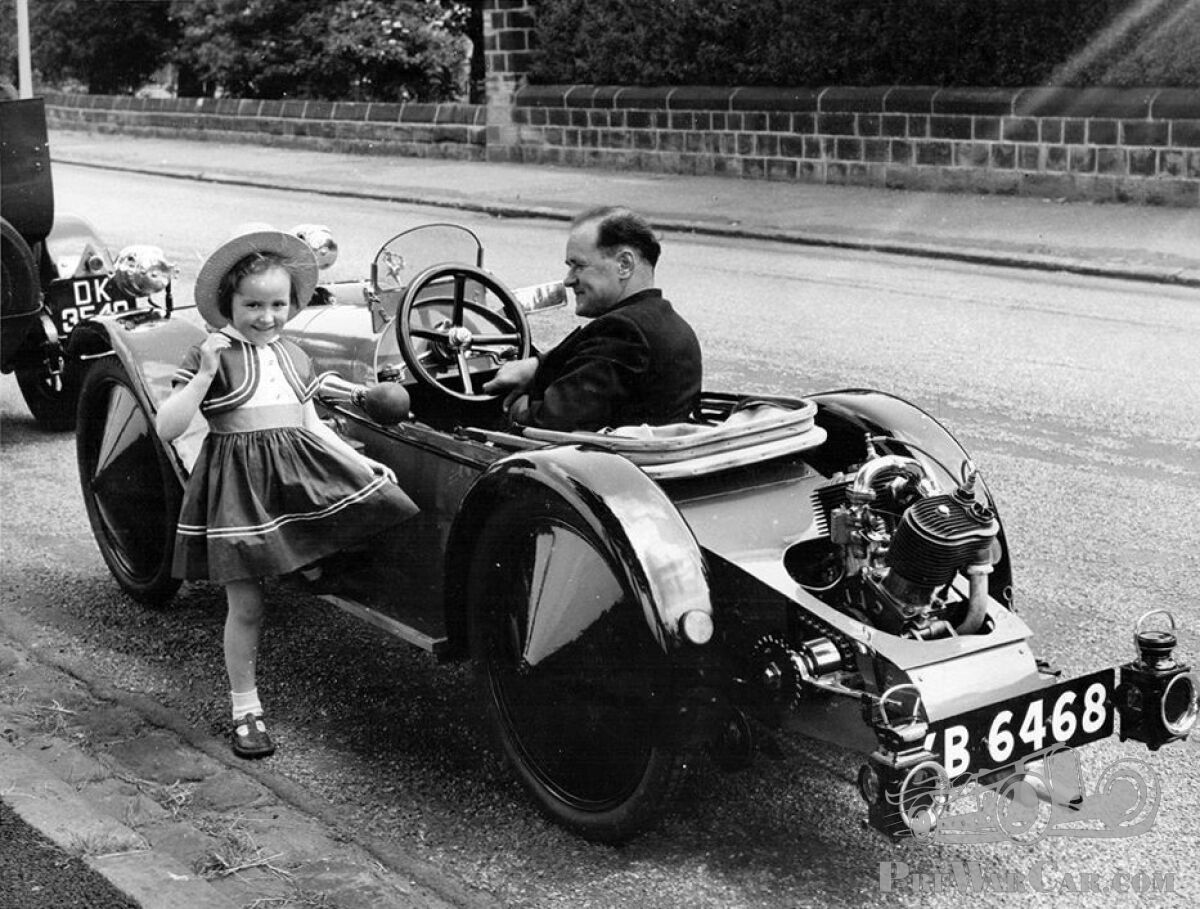

Ahh, don’t these two look proud and happy? And they're dressed their best, too, with that vehicle looking equally smart. Is it brand-new, perhaps? At least the shiny manifold, the exhaust and even the chain mechanism would suggest that it hasn’t run much.
AV Monocar and..... Bi-car
It’s a British-built AV Monocar with the model name of course referring to its single-seater configuration. It's a pity the girl can’t go for a ride, but AV of Teddington, Middlesex, was to come up with a solution to that. A 1919 advertisement mentions: “We are booking orders in strict rotation for early delivery of the two-seater models.” This was to become the AV Bi-car, with the vehicle's width now increased from 30 to 36 inches and seating in a tandem position. The third model that followed was the Runabout and came with two seats positioned more conventionally next to each other. Still just 42 inches wide, passengers certainly couldn't be too large. This girl would fit, but what about her mother?
The Motor Cycle magazine test drove the original Monocar and described it as “A low, coffin-shaped projectile, moderately attractive in dense fog.” Our correspondent Tim Gunn drove one years ago and wrote about the experience: “Like me, the owners must have felt like a WWI fighter pilot. However, I’m sure if you look back through old copies of The Cyclecar magazine, it is full of stories of crashed AVs and lucky escapes with the owners wiping sweat from their brows.”
Words: Jeroen Booij
Published:
Friday November 11th, 2022
Facebook
LinkedIn
Twitter
WhatsApp
Email
Copy
Comments
mr Peter Russell
19 November 2022, 09:52
Mark
18 November 2022, 22:54
By coincidence The Automobile this month have an article on the owner of the AV`s sister car registered XB 6469
Read more
Jeroen Booij
18 November 2022, 13:27
Thank you for filling in much of the detail David and Robin! Now, wouldn't it be nice to hear from the car's current owner..?
Read more

Robin Batchelor
17 November 2022, 12:23
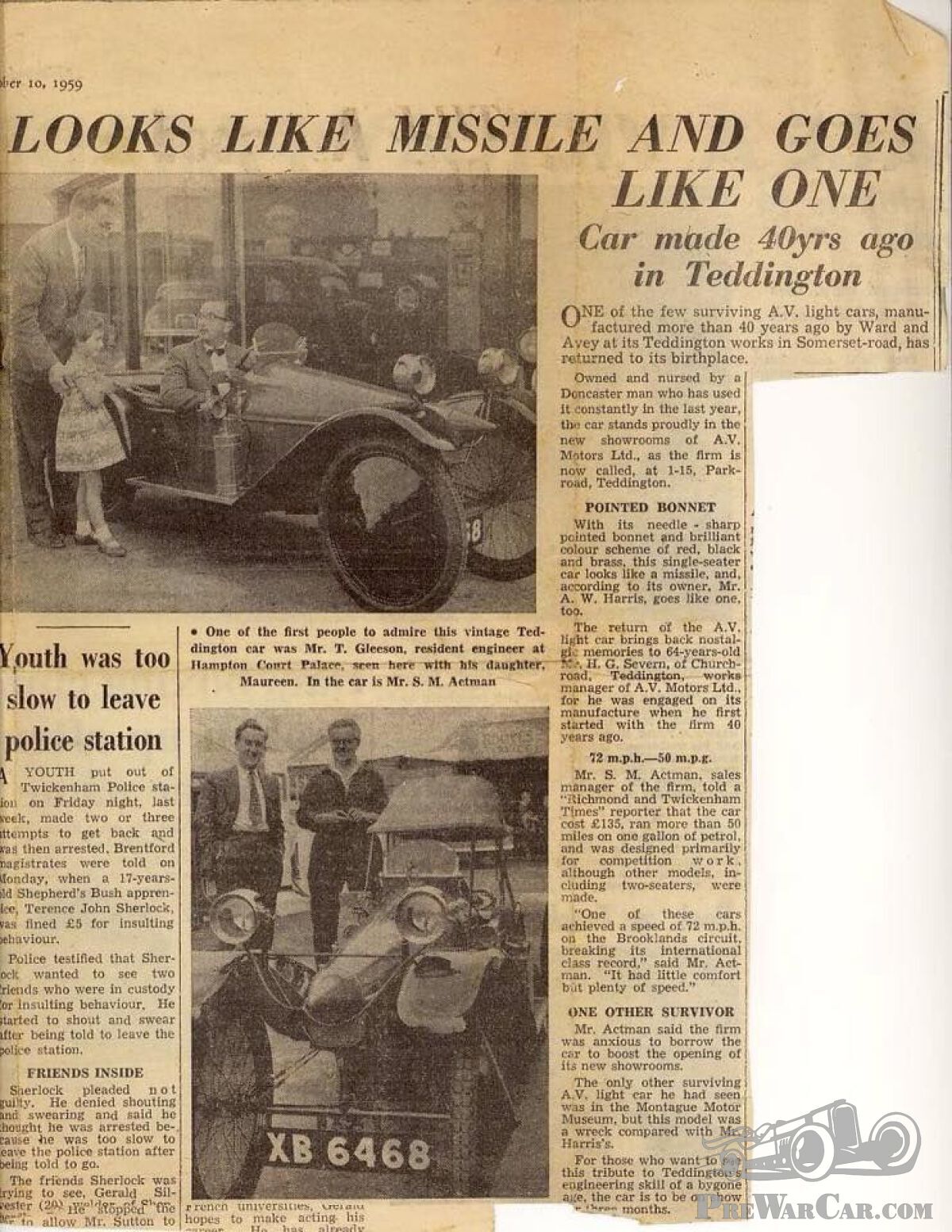
From The Surry Comet October 10 1959......
"... It stands in the Park Road, windows of A. V. Motors, only a few yards from where it was built at a time when many large garages made their own cars.
The car, an A.V. Monocar, was made by Ward and Avey, the firm which is now known as A. V. Motors. Between 1919 and 1923, when mass production put the small manufacturer out of business, the firm built more than 200 of its single-seat Monocars and two- seater Bicars.
Until recently the present direc- tors of the firm, who include Mrs. E. G. Avey, wife of one of the firm's founders, and her son, Mr. R. W. Avey, did not know that any A.V. cars were still in existence.
But an advertisement in motoring magazine brought replies from two owners--Lord Montague of Beaulieu, who has an AV in his motoring museum, and Mr. A. W. Harris, a Don- caster businessman.
The firm's sales manager, Mr. Sam Actman, went to Beaulieu, but found the car there to be in poor condition and awaiting renovation.
The Doncaster owner sent a photograph of his car, showing it to be in spotless condition, and he agreed to drive it down to Tedding ton, where it will be on show for three months.
During the journey it was followed by an immaculate Sapphire, in which Mr. Harris returned to Doncaster. Anxiously awaiting its arrival was another director of the company, Mr. H. G. Severn, who was a foreman-fitter with the firm at the time the car was built and almost certainly helped to assemble this particular one.
He was also a competition driver for the firm and once drove the AV. Monocar on the Brooklands track at over 75 m.p.h. "
Read more
"... It stands in the Park Road, windows of A. V. Motors, only a few yards from where it was built at a time when many large garages made their own cars.
The car, an A.V. Monocar, was made by Ward and Avey, the firm which is now known as A. V. Motors. Between 1919 and 1923, when mass production put the small manufacturer out of business, the firm built more than 200 of its single-seat Monocars and two- seater Bicars.
Until recently the present direc- tors of the firm, who include Mrs. E. G. Avey, wife of one of the firm's founders, and her son, Mr. R. W. Avey, did not know that any A.V. cars were still in existence.
But an advertisement in motoring magazine brought replies from two owners--Lord Montague of Beaulieu, who has an AV in his motoring museum, and Mr. A. W. Harris, a Don- caster businessman.
The firm's sales manager, Mr. Sam Actman, went to Beaulieu, but found the car there to be in poor condition and awaiting renovation.
The Doncaster owner sent a photograph of his car, showing it to be in spotless condition, and he agreed to drive it down to Tedding ton, where it will be on show for three months.
During the journey it was followed by an immaculate Sapphire, in which Mr. Harris returned to Doncaster. Anxiously awaiting its arrival was another director of the company, Mr. H. G. Severn, who was a foreman-fitter with the firm at the time the car was built and almost certainly helped to assemble this particular one.
He was also a competition driver for the firm and once drove the AV. Monocar on the Brooklands track at over 75 m.p.h. "
Robin Batchelor
17 November 2022, 12:06
More on AV Monocar XB 6468 from The Richmond and Twickenham Times newspaper dated October1959.
" One of these cars achieved a speed of 72 m.p.h. on the Brooklands circuit breaking its International class record. It had little comfort but plenty of speed."
Read more
" One of these cars achieved a speed of 72 m.p.h. on the Brooklands circuit breaking its International class record. It had little comfort but plenty of speed."
Robin Batchelor
17 November 2022, 11:55
In the mid 1970s I taught a friend to fly hot air balloons and his wife Georgie used to follow us with a trailer to take us back to the launch site. Evidently Georgie came from a good motoring family because that is her, in 1960, standing beside a friend of her father in his AV Monocar XB6468.
Adrian says..."Georgina's father had a passion for vintage cars and was an active member of Cannon Hall Vintage & Veteran Club at Cawthorne near Barnsley. This is a press photo from their Concourse Rally around 1960."
The picture below is from Motor Sport magazine.
Read more
Adrian says..."Georgina's father had a passion for vintage cars and was an active member of Cannon Hall Vintage & Veteran Club at Cawthorne near Barnsley. This is a press photo from their Concourse Rally around 1960."
The picture below is from Motor Sport magazine.
Mike Clark
15 November 2022, 15:07
The AV is still registered with the DVLA although not taxed or SORNED. The latest V5C logbook was issued in 1984 so it is probably still around in some collection.
Mike
Read more
Mike
David Grimstead
14 November 2022, 13:21
This B&W picture is probably late 1950s or early 1960s, as a 1920 A.V. Monocar registered XB 646?, with the same head and tail lamps, owned by a dark-haired but slightly bald-pated Mr. Harris (perhaps this man?) was photographed in shiny concours condition at the Gringley Traction Engine and Vintage Car Rally in July 1964 where it won top prize in the Vintage Car Class: “First, Mr. Arthur Harris of West Stockwith for his AV Monocar Cycle Car, 1920, 7.2-h.p., which was previously owned by the late A. G. Rose of Gainsborough. It has wire-bobbin steering, swivelling front axle and rear-mounted engine.”
The 1913, £59 10s. Carden Mono-car was the direct ancestor of the A.V., which was reportedly the first “new monocar” (and “new duocar” in two-seater form) to appear post-WWI. This is how the new A.V. range was reported in April 1919: “It is a quite smart and distinctive machine, selling at about £l20, with its twin J.A.P. engine of 5-h.p. neatly tucked away in the tail, long pointed bonnet or nose, dome wings, and disc wheels. The driver's seat strongly resembles the cockpit of an aeroplane, and is as nicely fitted up as anything of the kind could be. A second A.V. model has two seats and two speeds, with a water-cooled engine. Motor-cycle enthusiasts will welcome the A.V. in its present form as a vehicle which has been improved greatly in design and finish.”
Yet, during 1919-20, “the £100 Carden Monocar… built down to a price… without making a mess of the job” and the “racy little A.V. Monocar… likely to enjoy popularity among sporting types” were both reported on sale at the same time. A “Carden Monocar, A.V. type, 7-h.p. J.A.P.” was also sold then. There was an identical sounding rear-engined “5-6-h.p. J.A.P. Aviette… with a long, pointed body forward” reportedly on sale in 1919 and a 9-h.p. 2-seater version of that was also sold. An odd car name “Aviette”, as it had been a pre-war term used to describe cheap, even man-powered, attempts at making low-cost single-seat aircraft but it does suggest they were A.V.’s Anyone know?
The English descriptive terms “Monocar” and “Duocar” appeared c.1910-11 and seem to reflect acknowledgement by side-slipping motorcyclists of the comparative safety of French one- and two-seater tandem cyclecars, e.g., the Bedelia, “a four-wheeled car on motor-bicycle lines”. Motoring writers then often referred to monocars as being the latest form of motorcycle, hence the single rear wheel, single seat Morgan runabout was also considered to be one - the very narrow track on a cyclecar similarly avoided the cost of a differential. The 1909 racing Lagonda was also called a monocar.
The A.C.U. banned such from its competitions initially, then agreed with the R.A.C. that monocars, duocars, light 3- or 4-wheelers and motorised quadricycles were all just cyclecars, after all they were all akin to earlier light voiturettes, so not worthy of the name motor car. Nevertheless, at the September 1920 Brooklands junior car club meeting, a Monocar Handicap Race was run and all nine entries were A.V.’s; the winner was W. F. Davenport who cranked his up to 49.5 mph.
A.V.’s did travel abroad; Capt. Walton of the 4th Gurkhas had his for sale in Bakloh, India in 1921. There were heaps of A.V. and Carden Monocars for sale initially new, then second-hand, all over the UK right through the 1920s.
As the Sunday Mirror foresaw it in 1919: “A road enthusiast assures me that monocars at £40 apiece will be the popular vehicle of the future. We shall all, he says, run about seated in torpedoes, as it were, with an engine and a suitcase astern. The railways will be left to the wealthy, because they alone will be able to pay the fares.” Mostly wrong of course, the sensible public made better choices, like the 1922 Austin 7, so there were no new monocars on sale in the UK by 1928 but that bit about rail fares, well maybe not...
Read more
The 1913, £59 10s. Carden Mono-car was the direct ancestor of the A.V., which was reportedly the first “new monocar” (and “new duocar” in two-seater form) to appear post-WWI. This is how the new A.V. range was reported in April 1919: “It is a quite smart and distinctive machine, selling at about £l20, with its twin J.A.P. engine of 5-h.p. neatly tucked away in the tail, long pointed bonnet or nose, dome wings, and disc wheels. The driver's seat strongly resembles the cockpit of an aeroplane, and is as nicely fitted up as anything of the kind could be. A second A.V. model has two seats and two speeds, with a water-cooled engine. Motor-cycle enthusiasts will welcome the A.V. in its present form as a vehicle which has been improved greatly in design and finish.”
Yet, during 1919-20, “the £100 Carden Monocar… built down to a price… without making a mess of the job” and the “racy little A.V. Monocar… likely to enjoy popularity among sporting types” were both reported on sale at the same time. A “Carden Monocar, A.V. type, 7-h.p. J.A.P.” was also sold then. There was an identical sounding rear-engined “5-6-h.p. J.A.P. Aviette… with a long, pointed body forward” reportedly on sale in 1919 and a 9-h.p. 2-seater version of that was also sold. An odd car name “Aviette”, as it had been a pre-war term used to describe cheap, even man-powered, attempts at making low-cost single-seat aircraft but it does suggest they were A.V.’s Anyone know?
The English descriptive terms “Monocar” and “Duocar” appeared c.1910-11 and seem to reflect acknowledgement by side-slipping motorcyclists of the comparative safety of French one- and two-seater tandem cyclecars, e.g., the Bedelia, “a four-wheeled car on motor-bicycle lines”. Motoring writers then often referred to monocars as being the latest form of motorcycle, hence the single rear wheel, single seat Morgan runabout was also considered to be one - the very narrow track on a cyclecar similarly avoided the cost of a differential. The 1909 racing Lagonda was also called a monocar.
The A.C.U. banned such from its competitions initially, then agreed with the R.A.C. that monocars, duocars, light 3- or 4-wheelers and motorised quadricycles were all just cyclecars, after all they were all akin to earlier light voiturettes, so not worthy of the name motor car. Nevertheless, at the September 1920 Brooklands junior car club meeting, a Monocar Handicap Race was run and all nine entries were A.V.’s; the winner was W. F. Davenport who cranked his up to 49.5 mph.
A.V.’s did travel abroad; Capt. Walton of the 4th Gurkhas had his for sale in Bakloh, India in 1921. There were heaps of A.V. and Carden Monocars for sale initially new, then second-hand, all over the UK right through the 1920s.
As the Sunday Mirror foresaw it in 1919: “A road enthusiast assures me that monocars at £40 apiece will be the popular vehicle of the future. We shall all, he says, run about seated in torpedoes, as it were, with an engine and a suitcase astern. The railways will be left to the wealthy, because they alone will be able to pay the fares.” Mostly wrong of course, the sensible public made better choices, like the 1922 Austin 7, so there were no new monocars on sale in the UK by 1928 but that bit about rail fares, well maybe not...
Keith K. Kuehn
11 November 2022, 18:21
are there any out there yet? And, as far as crashes, most are probably due to over exhuberant driving!
Read more
Fred Veenschoten
11 November 2022, 13:41
The Morgan 3 wheeler was only 34" wide with side by side seating.
Read more
Mike Clark
11 November 2022, 10:46
An interesting picture for me as the car in front of the Monocar is a 1926 Bullnose Morris Oxford reg DK 3548, which I bought as my first car for £30 in 1954. The Bullnose still exists, four or five owners later. The picture must be recent rather than period.
Mike
Read more
Mike
Mike Hill
11 November 2022, 10:30
Both vehicles bear Lancashire registrations, KB Liverpool and DK Rochdale.
Mike.
Read more
Mike.
WB meets a Mr Harry Severn, who had been with AV since the start in 1919, and the photo shows very neat weather equipment.