The global magazine and marketplace for classic car enthusiasts, by enthusiasts.


Filter
Make a choice:
- Cars
-
Make >>
-
Year >>
-
- Bikes
-
Location >>
- Parts & more
-
Make of car >>
-
Manufacturer >>
-
Category >>
- Bicycles & more
-
Year >>
-
Countries


The supreme Leach that didn’t last
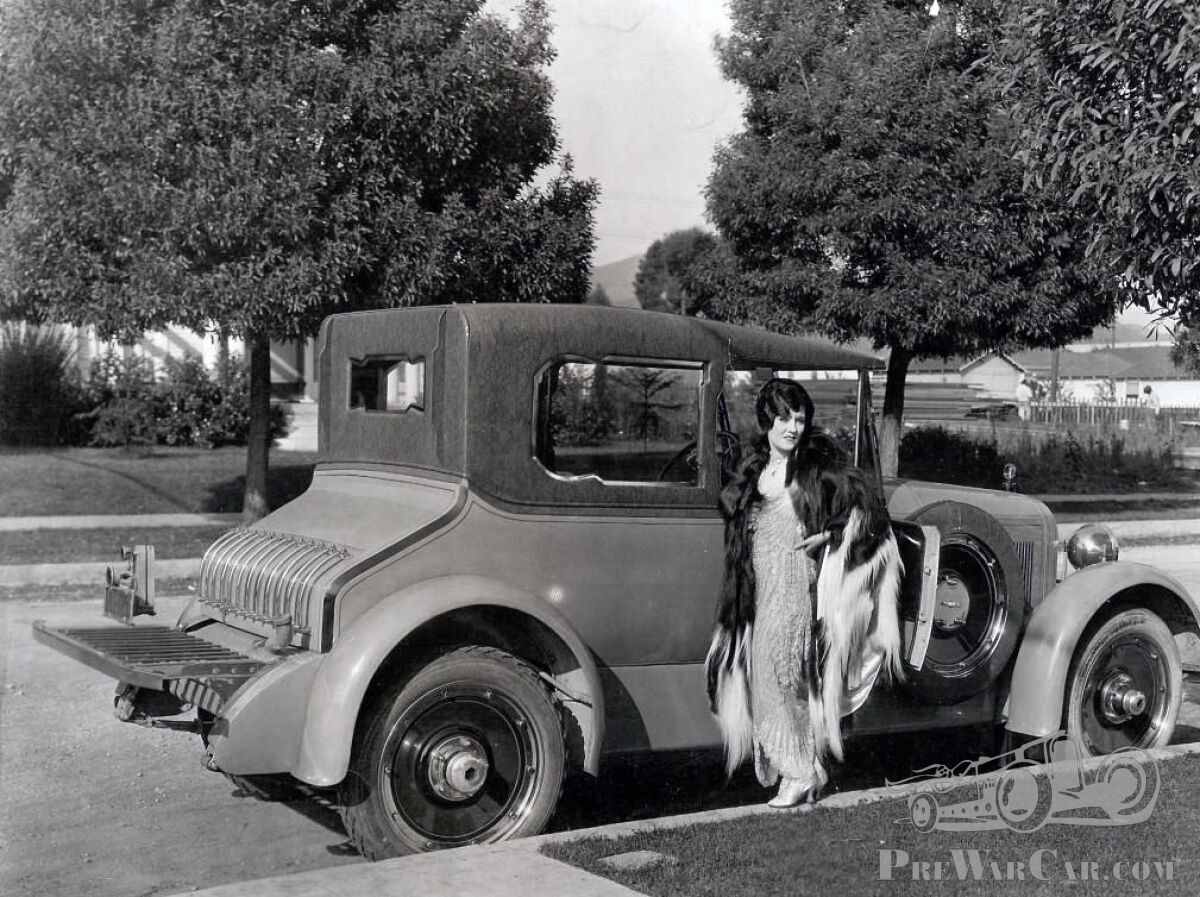

This car here is a Leach. Had we ever heard of Leach before? We hadn’t. Should we have? We probably should since today’s Friday Lady certainly wasn’t just any lady. That’s Hollywood star Gloria Swanson posing with the car, made in Los Angeles and targeted at the rich and famous there. Another picture of a Leach car shows Western star Tom Mix posing with it. We soon learned that: "The stylish Leach car was the brainchild of Martin Andrew Leach, who went into the auto restyling and customizing business for the elite Hollywood crowd." Not a marque to be missed?
Martin Andrew Leach
Leach cars were expensive and luxurious coachbuilds, but the amount of work involved was not to be underrated, or so we understood. The design and engineering that went into these cars was well beyond the repaint and reupholstery kind of thing. We couldn’t find out what chassis were used. Could they have made a chassis of their own design? We did find that the Leach Power-Plus Six model used the 100hp Continental inline six-cylinder engine and a tilt and telescoping steering column. They came with golf bags and a removable steering wheel for anti-theft reasons as standard. "Individual aluminium steps, illuminated automatically, take the place of a running board," wrote one report. Another feature was "a trouble lamp with 17 feet of cord mounted on the well-arranged dash".
In 1920 the company praised its own product as "the Most Complete Motor Car Built Today — and the greatest intrinsic value for the price". By that time the factory employed some 300 people. But still the $6,500 price that had to be paid for all this automotive extravagance proved to be a step too far, even in Hollywood. By 1923 the company was in dire straits and in January 1924 it had to close its doors. Some 250 cars are believed to have been built but survivors are about as scarce as silent movie stars are today.
Words Jeroen Booij. Picture from the archive.
Published:
Friday May 20th, 2022
Facebook
LinkedIn
Twitter
WhatsApp
Email
Copy

A contemporary report says the 134-inch wheelbase chassis-frame of the new larger, more powerful 1922 cars was supplied by Parrish and Bingham of Cleveland. It also had a Rayfield carburettor, a Delco ignition, dynamo and starter system, a Detlaff clutch, Gemmer steering and Timken axles (4.25:1 differential) on Camria semi-elliptic springs (60.5-inch at the rear).
However, following Leach’s refinancing of the business in 1921, when a Miller ex-WWI engine plant was incorporated as Harry A. Miller joined the Board, fatally for the company’s reputation and finances its previous Continental engine was replaced with a new, under-developed Miller-design, with a Leach-built three-speed gearbox.
There were five standard 1922 models, all selling for $6500: “Sport, Touring, Chummy Roadster, Seven-Passenger and Coupe.” Included in that price were “a Waltham clock, Motometer, Disteel wheels, trunk rack and guard rods, Cuno cigar lighter, golf bag holder, bumpers front and rear, and traffic signals front and rear.”
The Miller engine was a four-bearing crank, vertical bevel-drive overhead-cam six-cylinder with a 3.75-inch bore and 5.25-inch stroke. It was claimed to develop 100-h.p. at 3000 revs but seemingly not for long, as these engines failed catastrophically requiring recall and replacement, likely with the previous model’s reliable but mundane Leach-badged Continentals. This costly period of unreliability was partly the undoing of the company, which ended car manufacture a year later.
Gloria Swanson adorning Leach’s “glorious swansong”; how apt.