The global magazine and marketplace for classic car enthusiasts, by enthusiasts.


Filter
Classic Skoda, DeSoto for sale - Skoda, DeSoto cars for sale
Change your filters to get results, or show all
Sorry, there are no results with your filters Cars
.
Skoda
CS, 1923 to date
(1) Akc. Spol. Drive Skodovy zavody, Plzen (Pilsen); Mlada Boleslav, 1923 – 1945
(2) Skoda np, Mlaa Boleslav, 1945 to date
Skoda was one of the most important industrial concerns of the Austro-Hungarian empire. After World War 1 it was included in the territory of the new Czechoslovak republic. The Skoda company branched out into car production, building Hispano-Suizas under licence. The first of these Skoda cars appeared in about 1923. The engine of the Skoda car was the 37.2hp 6-cylinder 6.6-litre, while the bodies were of Skoda’s own design. Production of Skoda cars was in the Skoda car works at Pilsen. In 1925 Skoda cars took over the Laurin & Klement works at Mlada Boleslav, and production of private cars under the Skoda car name began in this factory. The first Skoda cars were based on earlier Laurin-Klement designs. For the next few years the range of Skoda cars included various 4-, 6- and 8-cylinder models Skoda cars of conventional design. More advanced ideas were introduced with the Skoda 420 model in 1933. The engine of the Skoda car was a 995cc unit developing 20bhp, the chassis was on Tatra lines with a centre tubular layout and rear swing half-axles. The 420 Skoda car ushered in the 1930s range of Skoda cars with which Skoda became famous. The Skoda 420 developed into the Skoda Popular and the same technical features were to be found in the 4-cylinder Skoda Rapid (1.380cc and 22bhp) and the 6-cylinder Skoda Superb(2.480cc and 50bhp). Model 932 was an experimental Skoda car with rear engine. The Skoda Popular also appeared with a streamlined coupé body and this Skoda carwas quite successful in a number of sporting events, including the Monte Carlo Rally. All Skoda car models gradually increased capacity and output, and changed from side to overhead valves. The range of Skoda cars was supplemented by the 1.8-litre Skoda Favorit and the Skoda Monte Carlo with a Popular chassis and Rapid engine. In 1939 the Skoda car range consisted of four types, the most important Skoda car being the 1100 OHV (1.089cc and 32bhp) and the 6-cylinder, 3.140cc 85bhp model.
After World War 2, the Skoda 1100 OHV and 1200 OHV – based on pre-war designs –appeared, and these Skoda cars were developed into the well-known 40 or 50bhp Skoda Octavia with a capacity of 1.089cc, the Skoda Octavia Super (1.221cc and 45bhp) and the Skoda Felicia, a two-seater Octavia version with a 50bhp engine. The Skoda Octavia/ Felicia range was discontinued, with the exception of the station wagon Skoda cars, after the introduction of the Skoda 1000MB (MB for Mlada Boleslav) in 1964, a rear-engined 988cc 40bhp Skoda car. The Skoda Octavia wagons were discontinued in 1969, and a year later came a new version of the 1000MB Skoda car, the Skoda S110 with 1.107cc engine and disc front brakes. Even faster was the S110R coupé Skoda carof 1971. The 1972 Skoda car range embraced variations on the basic rear-engined theme with 48bhp, 53bhp and 62bhp power units. Disc front brakes were standard on Skoda car.
Skoda cars are now built as part of the Volkswagen AG group.
Source: Georgano, encyclopedia of motorcar; HON
The information is written with the greatest of care. However, if you have any suggested amendments please contact us at office@prewarcar.com
DeSoto
US, 1913 – 1916
DeSoto Motro Car Co, Auburn, Ind.
The DeSoto appears to have succeeded the Zimmerman. This was a large car with a 55hp, 6-cylinder engine, which was furnished with a compressed-air starter. The DeSoto model Six-55 five-seater touring car sold for $2185.
US, 1928 – 1960
Chrysler Motors Corp, Detroit, Mich.
The DeSoto was launched in 1928 as a 3.2-litre side valve six to compete with Oldsmobile, Pontiac and the cheaper Nashes. Styling and general design of the DeSoto were in line with the 1929 Chryslers, and at $885 for a DeSoto sedan 90.000 were sold in the first twelve months. A 3.4-litre straight-8 DeSoto on a 9ft 6in wheelbase was announced for 1930 as the world’s cheapest 8-cylinder car. However, DeSoto suffered badly in the Depression, and in 1932, when flexible rubber engine mountings and free wheels were made available, sales dropped to 26.000 DeSoto cars.
The DeSoto disappeared from the British market about this time, though certain ‘Chrysler’ models listed in England (the Mortlake, Croydon, and some of the Richmonds) were in fact DeSoto cars in all but name. A 6-cylinder version of Chrysler’s advanced unitary-construction Airflow, the SE-type with a 4-litre engine, was brought out in 1934, but was an unsuccessful as its bigger sister. Later DeSotos followed regular Chrysler lines closely though in later years there was a tendency for DeSoto to move into a higher price class than Dodge; by 1952 DeSotos started $300 higher than the companion make.
By 1939 the DeSoto cars for sale were being made with independent front suspension, hypoid back axles and column change. There was a choice at DeSoto of two 6-cylinder engines and three wheelbase lengths, the longest of these being reserved for seven-seater bodywork – DeSoto continued to offer a really roomy family car right up to 1954. A 4-speed semi-automatic Vacumatic transmission became an option in 1941, but DeSoto’s big post-war change of models did not take place until 1952, when the division followed Chrysler’s lead in adopting the oversquare ohv V8; the DeSoto version was of 4½-litre capcity and developed 16-bhp. With the advent of Chrysler’s ‘flight sweep’ styling in 1955, the side-valve sixes were dropped and the standard engine in a DeSoto was now a 4.8-litre eight, giving 185bhp in Firedome guise, and 200bhp in Fireflite form. Though this redesigning saved Chrysler sales generally, the slump in the medium-price class had an adverse effect on DeSoto and in 1959 the DeSoto division was merged with Plymouth. Last of the DeSotos were the 1961 models, unitary-construction cars with a choice of three engines: Plymouth’s 145bhp ohv ‘slant six’ as used in the Valiant, and V8s of 230 and 265bhp, the two former only in Canadian DeSotos. Production of DeSoto cars ceased in November 1960 after only a few had been delivered.
Source: Georgano, encyclopedia of motorcar; MCS
The information is written with the greatest of care. However, if you have any suggested amendments please contact us at office@prewarcar.com


Featured
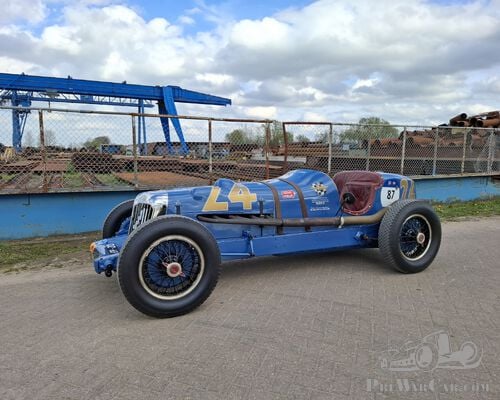
1932 - Graham " Lucenti " Indianapolis
Original participant of the 1932, 1934 and 1935 Indy 500. Best result: finishing 10th overall in the 1934 Indy 500 with driver “Herb” Ardinger...

Alfa 6C1750 Spider
Alfa 6C1750 Spider with complete history from delivery in 1930 to first owner in Firenze till today with copy Libretto/license plate all the years
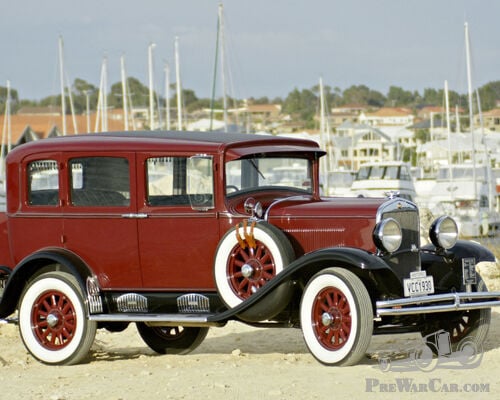
1930 Chrysler 66 Six-Wheel Equipped Royal Sedan
An exceptionally well restored and highly awarded Chrysler 66 Royal Sedan, with only two owners in nearly 97 years.The present owner ..