The global magazine and marketplace for classic car enthusiasts, by enthusiasts.


Filter
Classic Lion Peugeot, DeSoto for sale - Lion Peugeot, DeSoto cars for sale
Change your filters to get results, or show all
Sorry, there are no results with your filters Cars
.
Lion-Peugeot
France, 1906 – 1913
(1) Les Fils de Peugeot Frères, Beaulieu-Valentigney, 1906 – 1910
(2) SA des Automobiles et Cycles Peugeot, Audincourt, 1910 – 1913
The Lion-Peugeot car started as an independent venture by Robert Peugeot in the motor cycle factory at Beaulieu-Valentigney, which had been used for Lion-Peugeot car manufacture until the establishment of the SA des Automobiles Peugeot in 1897. These Michaux-designed voiturettes Lion-Peugeot cars were produced in direct competition with the cars from Audincourt, and the original chain-driven single at £125 filled a gap left by the discontinuation of the original Peugeot Baby. Already the Lion-Peugeot car company were trying their hand in the Coupe des Voiturettes, but made no impression in 1906 or 1907 against Sizaire-Naudin and Delage. The first of the classic racing V-twin Lion-Peugeot cars made its appearance in 1908, and from 1909 to 1911 the Lion-Peugeot car marque was renowned for some very odd machines, which took advantage of regulations more concerned with bores than with strokes. The 1909 Lion-Peugeot cars, victorious in both the Catalan Cup and the Coupe itself, were made with 1.9-litre engines, a single of 100x250mm and a twin of 80x192mm, the former having three valves per cylinder, but the peak of Lion-Peugeot cars was reached in 1910 with the fantastic Lion-Peugeot VX5, an 80x280mm V-twin with twin carburetors, developing 95bhp. The driver of the Lion-Peugeot car had to look round, rather than over the engine. There was a companion 65x260mm V4, really two twins in series. In spite (or perhaps because) of this, Lion-Peugeot cars had to be content with 2nd place in that year’s Coupe des Voiturettes. They tried once again in 1911 with a Lion-Peugeot V4, this time using the relatively modest stroke/bore rato of 2:1.
By 1910, the production Lion-Peugeot cars had grown up into 1.7-litre transverse V-twins with 3-speed gearboxes and shaft drive, though chain-driven versions were still available on Lion-Peugeot cars as late as 1911. The reunion of the two rival Peugeot companies, however, signaled the end of these eccentricities: though a touring V4 Lion-Peugeot car was announced in 1911 and was made with a 4-speed gearbox, pressure lubrication, and pedal-operated rear-wheel brakes, the Lion-Peugeot car designation was dropped at the end of 1913. The 1.9-litre VD Peugeot of 1914 marked the end of this line of development and none of the Lion-Peugeot car derivatives survived World War 1.
Source: Georgano, encyclopedia of motorcar; MCS
The information is written with the greatest of care. However, if you have any suggested amendments please contact us at office@prewarcar.com
DeSoto
US, 1913 – 1916
DeSoto Motro Car Co, Auburn, Ind.
The DeSoto appears to have succeeded the Zimmerman. This was a large car with a 55hp, 6-cylinder engine, which was furnished with a compressed-air starter. The DeSoto model Six-55 five-seater touring car sold for $2185.
US, 1928 – 1960
Chrysler Motors Corp, Detroit, Mich.
The DeSoto was launched in 1928 as a 3.2-litre side valve six to compete with Oldsmobile, Pontiac and the cheaper Nashes. Styling and general design of the DeSoto were in line with the 1929 Chryslers, and at $885 for a DeSoto sedan 90.000 were sold in the first twelve months. A 3.4-litre straight-8 DeSoto on a 9ft 6in wheelbase was announced for 1930 as the world’s cheapest 8-cylinder car. However, DeSoto suffered badly in the Depression, and in 1932, when flexible rubber engine mountings and free wheels were made available, sales dropped to 26.000 DeSoto cars.
The DeSoto disappeared from the British market about this time, though certain ‘Chrysler’ models listed in England (the Mortlake, Croydon, and some of the Richmonds) were in fact DeSoto cars in all but name. A 6-cylinder version of Chrysler’s advanced unitary-construction Airflow, the SE-type with a 4-litre engine, was brought out in 1934, but was an unsuccessful as its bigger sister. Later DeSotos followed regular Chrysler lines closely though in later years there was a tendency for DeSoto to move into a higher price class than Dodge; by 1952 DeSotos started $300 higher than the companion make.
By 1939 the DeSoto cars for sale were being made with independent front suspension, hypoid back axles and column change. There was a choice at DeSoto of two 6-cylinder engines and three wheelbase lengths, the longest of these being reserved for seven-seater bodywork – DeSoto continued to offer a really roomy family car right up to 1954. A 4-speed semi-automatic Vacumatic transmission became an option in 1941, but DeSoto’s big post-war change of models did not take place until 1952, when the division followed Chrysler’s lead in adopting the oversquare ohv V8; the DeSoto version was of 4½-litre capcity and developed 16-bhp. With the advent of Chrysler’s ‘flight sweep’ styling in 1955, the side-valve sixes were dropped and the standard engine in a DeSoto was now a 4.8-litre eight, giving 185bhp in Firedome guise, and 200bhp in Fireflite form. Though this redesigning saved Chrysler sales generally, the slump in the medium-price class had an adverse effect on DeSoto and in 1959 the DeSoto division was merged with Plymouth. Last of the DeSotos were the 1961 models, unitary-construction cars with a choice of three engines: Plymouth’s 145bhp ohv ‘slant six’ as used in the Valiant, and V8s of 230 and 265bhp, the two former only in Canadian DeSotos. Production of DeSoto cars ceased in November 1960 after only a few had been delivered.
Source: Georgano, encyclopedia of motorcar; MCS
The information is written with the greatest of care. However, if you have any suggested amendments please contact us at office@prewarcar.com


Featured
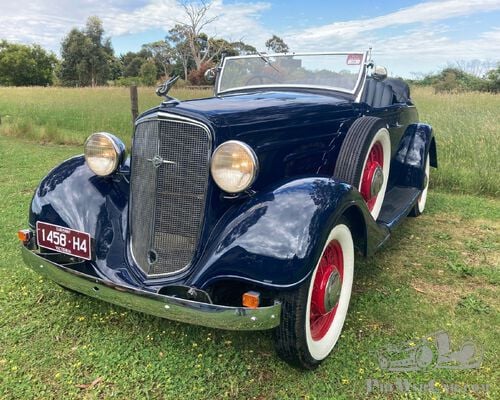
1934 Chevrolet Standard Roadster
1934 Chevrolet Standard Roadster This vehicle was delivered to Australia from Chevrolet and the body was manufactured by Holden Body Works w..
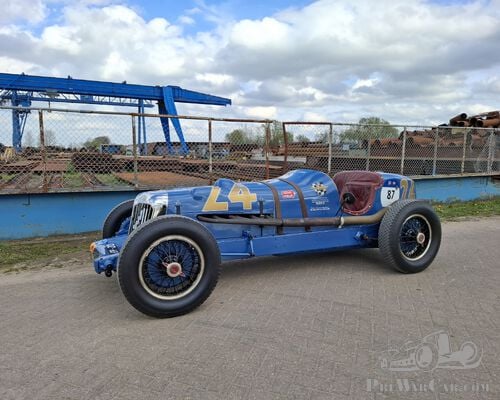
1932 - Graham " Lucenti " Indianapolis
Original participant of the 1932, 1934 and 1935 Indy 500. Best result: finishing 10th overall in the 1934 Indy 500 with driver “Herb” Ardinger...
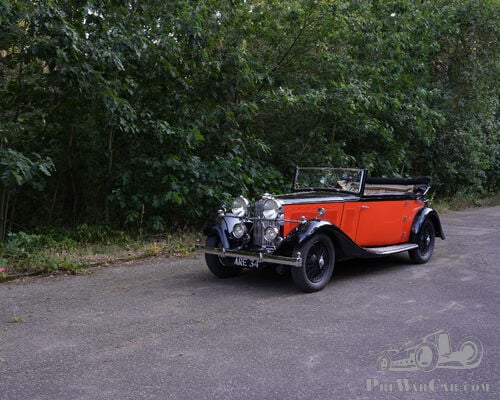
1934 Talbot AV105 Three Position Drophead Coupé
Registration no. ARE 34Chassis no. 35488 Much supporting paperworkRestored exampleVery usa..